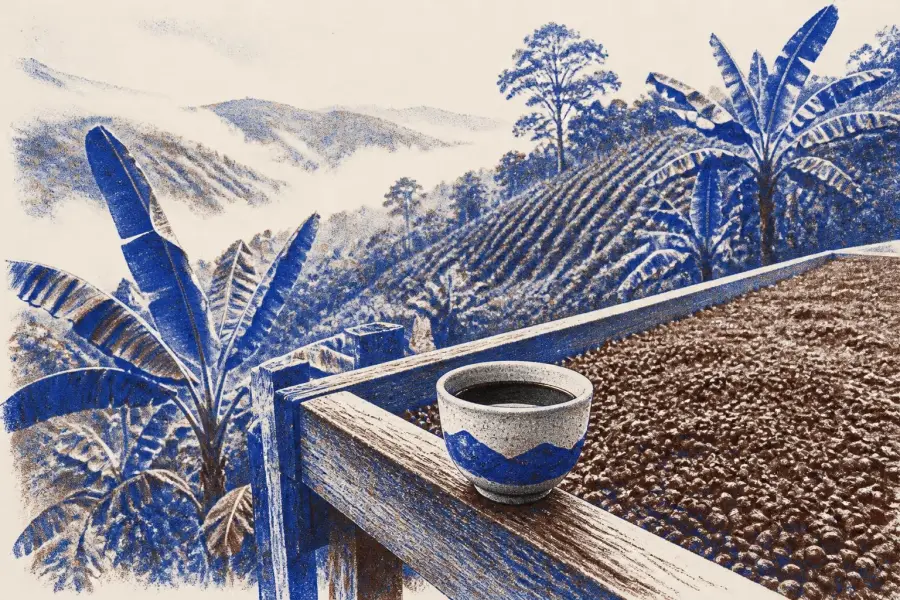
A Costa Rican coffee farmer’s year runs on one big push: the harvest, roughly November to March in most regions. The rest of the year goes to pruning, fertilizing and waiting for rain. Every cup you drink from Costa Rica passes through a picker’s basket, a mill and a drying patio first.
Where Costa Rican coffee grows
Costa Rica’s coffee board, ICAFE, recognizes eight growing regions. Each one has its own altitude, rainfall and harvest window.
| Region | Typical altitude | Character in the cup |
|---|---|---|
| Tarrazú | 1,200 to 1,900 m (3,900 to 6,200 ft) | Bright acidity, clean, chocolate |
| Central Valley | 900 to 1,600 m (3,000 to 5,200 ft) | Balanced, sweet, honeyed |
| West Valley | 700 to 1,600 m (2,300 to 5,200 ft) | Fruity, fuller body |
| Tres Ríos | 1,200 to 1,650 m (3,900 to 5,400 ft) | Elegant, floral, mild |
| Brunca, Orosi, Turrialba, Guanacaste | Lower to mid altitudes | Softer, rounder cups |
Tarrazú is the most famous name. Its steep slopes south of San José carry small farms stacked one above another. The Central Valley, around the volcanoes Poás and Barva, holds many of the older family estates.
Costa Rica grows almost entirely arabica. Varieties like Caturra and Catuaí dominate, with newer rust-resistant hybrids spreading on many farms.
The farmer’s calendar
The coffee year starts with the first rains in April or May. Within days, the coffee trees burst into white blossoms that smell like jasmine. Farmers call this the flowering, and it sets the size of next season’s crop.
From June to October, the green cherries swell slowly. The farmer prunes, controls weeds and applies fertilizer. Leaf rust, a fungus, is the constant worry in wet months.
The cherries turn red from November onward. Harvest peaks in December and January in the Central Valley. In high Tarrazú, picking can run into March.
Picking by hand
Costa Rican coffee is picked by hand, cherry by cherry. Only ripe red fruit should go in the basket. Pickers pass the same tree several times over a season.
Pickers are paid by the cajuela, a box measure of about 20 liters (5.3 US gallons). A strong picker fills many cajuelas a day on a good slope. A large share of the seasonal workforce comes from Nicaragua and from Panama’s Ngäbe-Buglé communities.
At the end of each day, the cherries go to a collection point. From there they travel to the mill that same night. Coffee cherries start to ferment within hours, so speed protects quality.
The mill: washed, honey and natural
Costa Rica built its reputation on washed coffee. At a wet mill, machines strip the skin and pulp from each cherry. The sticky seeds then ferment briefly, and water washes away the remaining fruit layer. Washed coffee tastes clean and bright.
The honey process skips the washing. The mill removes the skin but leaves some sticky mucilage on the bean. Producers label it yellow, red or black honey, depending on how much fruit stays on. Honey coffees taste sweeter and heavier.
Natural coffee dries with the whole cherry intact. It produces fruity, wine-like cups and demands careful drying.
The micro-mill boom of the 2000s changed the economics. Small farmers began processing their own coffee instead of selling cherries to large cooperatives. That shift brought honey and natural lots onto specialty menus worldwide.
Drying and resting
After milling, the beans dry on patios, raised beds or in mechanical dryers. Raised beds, called African beds, let air move under the coffee. Workers rake the beans often to dry them evenly.
The target is about 10 to 12 percent moisture. Sun drying on beds takes one to three weeks. The dry coffee, still in its papery parchment, then rests for weeks before hulling and export.
The economics of a small farm
Most Costa Rican coffee comes from small farms of a few hectares. A hectare is about 2.5 acres. Many families also hold other jobs, since coffee income swings with world prices.
Specialty and micro-lot prices pay far more than commodity rates. Even so, rising labor and fertilizer costs squeeze margins. In the Central Valley, housing development keeps pushing into old coffee land. Many farmers sell land when a harvest fails or prices collapse.
ICAFE sets a minimum share of the final price that mills must pay farmers. That rule gives Costa Rican growers more protection than many producers elsewhere.
How to visit a coffee farm
The easiest farm tours run in the Central Valley, near San José airport. Doka Estate in Alajuela runs a standard tour of about 90 minutes through the plantation, mill and roastery. Café Britt near Heredia offers a theatrical, beginner-friendly version.
For Tarrazú, contact the cooperative Coopedota in Santa María de Dota. Visit between December and February to see picking and milling in action. Wear closed shoes, since farm slopes are steep and muddy.
If you go
- Best season: December to February, when harvest and milling are in full swing.
- Easy tour: Doka Estate, Alajuela. The basic tour cost about $22 per adult on recent listings.
- High-altitude region: Tarrazú, about two hours south of San José by road.
- Order at the farm: Ask to taste a washed and a honey coffee side by side.
- Back home: Compare the cup with a European espresso, like our visit to Caffè Gambrinus in Naples.