
Hey, I'm Mark, and this is my take on the AeroPress Manual Coffee Grinder. I was pulling shots in 2017, the year the Niche Zero launched.
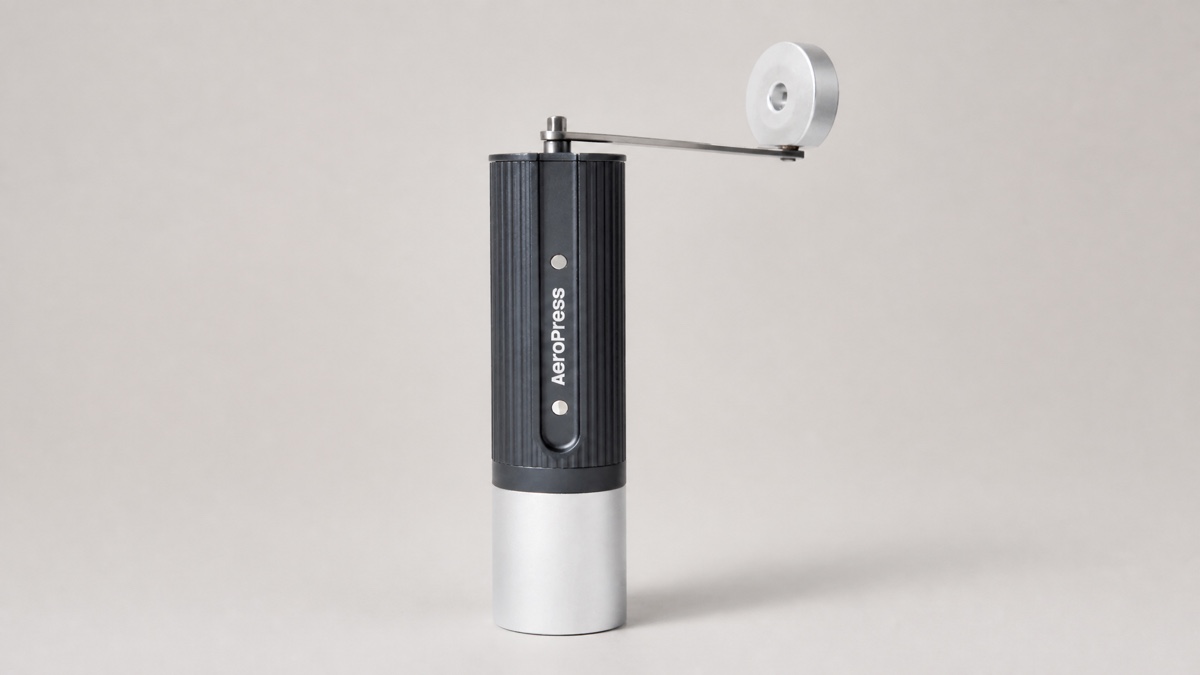
The AeroPress Manual Coffee Grinder is a compact all-metal hand burr grinder from AeroPress, the brewer brand. It launched in November 2025 and sells for $199.95. Its 38 mm (1.5 in) conical burrs are made in Italy, and the whole grinder fits inside an AeroPress plunger.
The grinder offers 60+ settings and ships preset to medium-fine for AeroPress. It ground 20 g (0.7 oz) in 49 seconds in a nine-grinder test. Fine settings tested best, while coarse settings left more chaff. Price, a loose handle and a 25 g (0.9 oz) catch draw the main complaints.
So is the fit worth the price? For AeroPress owners who travel or camp, the answer leans yes. Home-only buyers find larger burrs for less in the 1Zpresso JX and Kingrinder K6. I cover everything from grind quality to cleaning routine here, and AeroPress had no say in it.
What Is the AeroPress Manual Coffee Grinder?
The AeroPress Manual Coffee Grinder is a compact all-metal hand burr grinder with 60+ grind settings. The burrs are the two cutting parts that break the beans apart. This grinder's burrs measure 38 mm (1.5 in), use a cone shape, and are made in Italy. The grinder sells for $199.95.
Size drives the whole design. The body is ultra-slim. The crank holds on by magnet and slides into a groove on the side. With the crank stowed, the complete grinder nests inside an AeroPress plunger, handle and all.
The grinder weighs 20.5 oz (581 g). Its body measures 7.25 by 1.75 in (18.4 by 4.4 cm).
The hopper is the top chamber that holds whole beans before grinding. It takes about 30 g (1.1 oz) of beans. The separate catch below collects 20 to 25 g (0.7 to 0.9 oz) of grounds. A 25 g (0.9 oz) catch suits one or two AeroPress servings at a time.
Two metals make up the build. The body and catch use anodized aluminum. The handle, adjustment dial and internal shaft parts use stainless steel.
Gray is the finish of the standard model. A Walnut edition adds a wood finish at a higher price.
Key Specs:
| Spec | Detail |
|---|---|
| Burrs | 38 mm (1.5 in) titanium-coated stainless steel conical |
| Grind settings | 60+ |
| Bean hopper | About 30 g (1.1 oz) |
| Ground catch | 25 g (0.9 oz) |
| Weight | 20.5 oz (581 g) |
| Size | 7.25 by 1.75 in (18.4 by 4.4 cm) |
| Price | $199.95 |
The dial reaches espresso, moka pot, AeroPress, pour-over, drip, French press and cold brew. That span covers most home methods. The grinder ships preset to medium-fine for AeroPress brewing.
Who Makes the AeroPress Manual Coffee Grinder?
The AeroPress Manual Coffee Grinder is made by AeroPress, which Alan Adler founded in Palo Alto, California, in 2004. The original AeroPress brewer launched one year later, in 2005.
For most of those years the company sold brewers, not grinders. The Manual Coffee Grinder is its first one. AeroPress designed it entirely in-house and launched it in November 2025. The launch was the company's first globally timed release, through Amazon and distributors worldwide.
That grinder joins a product line that has been growing fast. Tiny Capital, a Canadian holding company, bought a controlling stake in AeroPress in 2021. New sizes, materials and accessories have appeared almost every year since then.
No single factory builds the grinder. Production is split across three countries:
- USA: The design comes from the USA, where the company is based.
- Italy: The burrs are manufactured in Italy. Burrs are the two grinding surfaces that crush the beans.
- China: The grinder itself is manufactured in China.
AeroPress CMO David Cole said baristas, competitors and coffee professionals validated each design choice.
What Comes in the AeroPress Grinder Box?
The AeroPress grinder box comes with the grinder, a tote bag, two cleaning brushes and a power drill adapter. The brushes are a two-sided brush for deep cleaning and a smaller travel brush.
The two brushes differ in stiffness. One has firm bristles and the other has soft bristles. Both clear loose grounds from the adjustment dial, the catch and the burrs.
The power drill adapter replaces the hand crank. A cordless drill then turns the burrs for very fast grinding. The tote bag keeps the grinder and its parts together on the road.
In the Box:
- The grinder
- A tote bag
- A two-sided brush for deep cleaning
- A travel brush
- A power drill adapter
Lost parts have a direct fix. The AeroPress Manual Grinder Accessories Kit costs $29.95. The kit replaces the tote bag, both brushes and the drill adapter.
How Does the AeroPress Manual Coffee Grinder Work?
The AeroPress Manual Coffee Grinder works through a hand crank that spins conical burrs over a screw-on catch. The user takes off the handle and the hopper lid and adds the coffee beans. The lid and handle then go back on.
With the grinder closed up, grinding can start. The user turns the crank and keeps the handle level during grinding. The grounds collect in the catch at the bottom of the body. Grinding is done once all the beans have passed through.
Getting those grounds out takes one more step. The catch unscrews, so the user lifts it off and pours the grounds into the brewer. The catch and the handle then go back on, which keeps both parts with the grinder for storage.
Steps:
- Remove the handle and hopper lid.
- Add the coffee beans.
- Refit the hopper lid and attach the handle.
- Grind while keeping the handle level.
- Unscrew the catch and pour the grounds into the brewer.
- Replace the catch and handle for storage.
The Easy-Grind handle drives the burrs. It is patent-pending and magnetic. Its long, single-piece arm gives more leverage than most compact grinders. A full-size grip replaces the small knob found on many travel models.
Two ball bearings sit around the shaft, one above the burrs and one below. These bearings cut friction and keep the shaft aligned. The result is smooth rotation without binding.
Grinding speed is a personal choice. AeroPress states that fast cranking is not needed. Frozen beans are not recommended, because frozen beans are harder to grind.
Which Burrs Does the AeroPress Grinder Use?
The AeroPress grinder uses 38 mm (1.5 in) stainless steel conical burrs made in Italy with a titanium coating. Conical burrs pair a cone-shaped inner burr with a ring-shaped outer burr.
The titanium coating does one job on that steel. It hardens the surface, and harder edges stay sharp for longer. So the coating targets durability rather than flavor.
Burr size marks the main trade-off. At 38 mm (1.5 in), it sits at the compact end of hand grinders. Three other hand grinders show how that size compares:
- 1Zpresso JX: uses 48 mm (1.9 in) burrs.
- Kingrinder K6: also uses 48 mm (1.9 in) burrs.
- Timemore C2 Max: matches the 38 mm (1.5 in) size exactly.
Every burr set chases the same result. That result is even particle size. Even grounds extract evenly in the brewer. Uneven grounds taste bitter, sour and astringent all at once.
How Do You Adjust the AeroPress Grinder Grind Size?
The AeroPress grinder grind size adjusts with a click dial preset at Rotation 3, Click 6, the medium-fine setting. One full rotation of the dial contains 12 clicks.
Turning the dial clockwise all the way reaches Rotation 1, Click 1. This end point is the finest setting. Turning counterclockwise adds clicks and rotations, and each step makes the grind coarser.
A stepped adjustment is a dial with fixed clicks, unlike a stepless dial that turns smoothly. The AeroPress dial is stepped. Five full rotations of 12 clicks give 60 settings, and the coarsest position is Rotation 5, Click 12.
The numbering confuses many users. Numbers on the dial run 1 to 12 clockwise as the grind gets finer. The instruction manual counts the other way, so a higher click number means a coarser grind.
Technique matters during adjustment. The handle attaches to the hopper lid and stays held in place while the dial turns. Each step gives a click the user feels and hears. A freely spinning dial means the setting has not changed.
Two rules protect the setting. Adjustments happen only while the grinder is empty. The hopper lid stays on during adjustment to stop grounds from escaping.
Taste guides fine-tuning. Sour, thin coffee signals a grind that is too coarse. Bitter, harsh coffee signals a grind that is too fine. A few clicks at a time is the best pace.
Does the AeroPress Grinder Fit Inside an AeroPress?
Yes. The AeroPress grinder fits inside the AeroPress plunger with the handle attached to its side. The magnetic crank snaps into a groove on the body, so nothing travels loose.
Because the grinder rides inside the plunger, the width of that plunger decides the fit. Most models leave enough room. The grinder fits the AeroPress Steel, Original, Clear, XL, Go Plus and Go. The AeroPress Premium is the one exception. Its glass version uses a narrower metal plunger, so the grinder does not fit.
Fitting inside the plunger is not the same as fitting inside the travel case. The Go and Go Plus come as self-contained kits, and those kits do not hold the grinder. The AeroPress XL travel bag does hold it, though the grinder sits loosely inside.
Other hand grinders sometimes fit by body alone. Their arms usually travel separately and need reassembly. The Porlex, another hand grinder, was small enough in theory, but the fit did not always work in practice.
How Well Does the AeroPress Grinder Perform?
The AeroPress grinder performs well, and it performs best at fine and medium settings. That verdict comes from a test of nine grinders, which named it the Best Coffee Grinder for AeroPress Fans. Speed and versatility stood out.
The test used a Kruve sifter. Each grinder processed 20 g (0.7 oz) of coffee on fine, medium and coarse settings. Screens of 500 microns (0.5 mm) and 1,400 microns (1.4 mm) sorted the particles.
Pour-over coffee needs particles between 500 and 1,000 microns (0.5 and 1 mm). Grinders with fewer particles outside that window scored as more consistent. Consistency matters because evenly sized grounds brew more evenly.
By that measure, fine settings delivered the best result. Two clicks into the first rotation produced grounds that were 92% acceptable on the sifter.
A second test used a Kruve Brewler, which is a particle size tester, across the dial. The finest setting gave 300 to 500 microns (0.3 to 0.5 mm). Rotation 3, Click 6 gave 600 to 700 microns (0.6 to 0.7 mm). The coarsest setting went past 1,600 microns (1.6 mm).
Measured Particle Sizes:
| Setting | Particle Size |
|---|---|
| Rotation 1, Click 1 (finest) | 300 to 500 microns |
| Rotation 3, Click 6 (preset) | 600 to 700 microns |
| Rotation 5, Click 12 (coarsest) | Over 1,600 microns |
The taste results matched the measurements. AeroPress brews tasted very good. A V60, a cone-shaped pour-over dripper, brewed on time with an even, flat coffee bed. French press coffee came out evenly extracted.
Coarse settings showed a weakness. More chaff gathered in the catch, and fewer grounds passed the sifter. Finding the best coarse setting took trial and error across the 60+ clicks.
How Fast Does the AeroPress Grinder Grind?
The AeroPress grinder grinds fast, finishing 20 g (0.7 oz) of coffee in 49 seconds. The result placed the grinder among the fastest hand grinders in a nine-model test.
That ranking only means something next to the other grinders in the same test. The 1Zpresso JX took 48 seconds. The slowest, the Eureka Baby, needed over four minutes for the same dose. The full spread sits below.
Time to Grind 20 g:
| Grinder | Time |
|---|---|
| 1Zpresso JX | 48 seconds |
| AeroPress Manual Coffee Grinder | 49 seconds |
| Comandante C40 | 50 seconds |
| Timemore C2 Max | 67 seconds |
| Eureka Baby | Over four minutes |
These time gaps point back to the burrs, the metal parts that cut the beans. Sharp burrs crack beans with less effort. The slow times show the same thing from the other side. Grinders that took longer than two minutes produced far more particles above 1,400 microns (1.4 mm).
A drill adapter cuts the time further still. A drill grinds a dose in seconds. AeroPress gives three directions for grinding with a drill:
- Lowest torque setting: AeroPress advises running the drill at its lowest torque setting.
- Slow pace: AeroPress advises a slow pace.
- No drill use below 5 clicks: AeroPress advises against any drill use below 5 clicks.
Can the AeroPress Grinder Grind for Espresso?
Yes. The AeroPress grinder can grind for espresso, reaching espresso-fine at the low end of its 60+ settings. AeroPress lists espresso and moka pot among the supported brewing methods.
Testing backs up that fine range. Two clicks into the first rotation produced grounds that were 92% acceptable. Fine settings were where the grinder excelled most.
Grinding fine enough is only half the job. Pulling real shots was less smooth. The recommended espresso settings choked a test espresso machine, meaning the grounds packed so tightly that water barely passed through.
The effort at the crank is the other catch. Hand grinding for espresso takes work at any burr size. Many people who grind espresso every day end up with an electric grinder.
The drill adapter has a limit at the fine end. AeroPress says not to use the adapter below 5 clicks. The finest espresso settings therefore stay hand-cranked.
What Do AeroPress Grinder Reviews Say?
AeroPress grinder reviews say the grinder earns 4.2 out of 5 stars from 61 ratings on Amazon. The score on the AeroPress store runs higher, at 4.7 stars. Amazon also gives the listing its Amazon's Choice badge.
More than 50 units sold on Amazon in the past month. Demand stays steady at that pace. Price does not split the two stores either. Both list the grinder at $199.95.
The written reviews explain what sits behind those scores. Reviews point to four things owners and testers like most:
- Design: Owners praise this part first. The sleek, modern build fits inside the brewer. The 60+ settings and the medium-fine preset earn steady approval.
- Grind accuracy: Grind accuracy wins praise in hands-on testing. One test found accurate grinds across the whole range, from espresso to French press.
- Daily use: One editor switched from a large countertop grinder to the AeroPress model. For that one person, the hand grinder was faster and took up less space.
- Cleaning: The firm and soft brushes in the box made the grinder and burrs easy to clean.
What Are the Common AeroPress Grinder Complaints?
Price is the most common AeroPress grinder complaint, since it costs $200 while some rivals cost half as much. The 1Zpresso Q and KingGrinder, two competing hand grinders, offer similar portability at half the cost or less.
Cost is not the only complaint. Four more come up often.
Common Complaints:
- A lid that sticks the first time: The lid frustrates first-time users. Removing it the first time takes effort. Pulling upwards releases the suction that holds it.
- A loose magnetic handle: The handle sits loose on the shaft. In testing, it risked coming off during grinding.
- A 25 g (0.9 oz) catch: The small catch limits batch size. That amount covers one or two cups. Brewing for a group means several batches in a row.
- More chaff at coarse settings: Chaff is the papery skin of the coffee bean. Coarse settings left more of it in the catch.
Marketing drew skepticism too. Some fans questioned why the Italian origin of the burrs, the discs that crush the beans, received so much attention. Others noted that existing grinders also fit inside an AeroPress, a hand-powered coffee maker.
How Does the AeroPress Grinder Compare to Other Hand Grinders?
The AeroPress grinder compares to other hand grinders as an upper-middle option on price, below elite models. Several capable hand grinders cost under $100, and some premium models cost more.
Burrs are the discs that crush the beans, and burr size, capacity and price are what set these grinders apart. Three competitors mark out the range:
- Timemore C2 Max: This is the budget rival. It uses 38 mm (1.5 in) burrs, holds 30 g (1.1 oz) and costs about $75. It took 67 seconds for 20 g (0.7 oz), and it lacks numbered grind markings. The C2 Max weighs 1 pound (454 g) and measures 7.2 by 2 in (18.3 by 5.1 cm). So the AeroPress grinder is slightly heavier and slimmer.
- Comandante C40 Nitro Blade: This is the premium rival. Comandante is a grinder maker that builds the C40 in Germany. The C40 uses 39 mm (1.5 in) burrs and holds 30 to 35 g (1.1 to 1.2 oz). It costs about $350 and took 50 seconds for 20 g (0.7 oz). It weighs 1.25 pounds (567 g) and stands 8.4 in (21.3 cm) tall.
- Kingrinder K6: This is the value rival. It uses 48 mm (1.9 in) heptagonal, or seven-sided, burrs with about 60 clicks per turn. Each click moves the burrs 16 microns (0.016 mm). It costs $126 and holds 30 to 35 g (1.1 to 1.2 oz) of beans. Its aluminium alloy body measures 180 by 55 mm (7.1 by 2.2 in) and weighs 630 g (22.2 oz). That makes it bigger and heavier in a travel bag.
Price, size and grind time separate the three.
Hand Grinder Comparison:
| Grinder | Burrs | Capacity | Price |
|---|---|---|---|
| AeroPress Manual Coffee Grinder | 38 mm | 25 g | $199.95 |
| Timemore C2 Max | 38 mm | 30 g | $75 |
| Comandante C40 Nitro Blade | 39 mm | 30 to 35 g | $350 |
| Kingrinder K6 | 48 mm | 30 to 35 g | $126 |
| 1Zpresso JX | 48 mm | 30 to 35 g | $139 |
AeroPress Grinder vs 1Zpresso JX: Which Is Better?
The 1Zpresso JX is better for home grinding, while the AeroPress grinder is better for travel with an AeroPress. The JX costs $139 and uses larger 48 mm (1.9 in) burrs, the two discs that cut the beans.
The JX is made by 1Zpresso, a Taiwan-based grinder maker founded by a group of engineers.
The JX holds 30 to 35 g (1.1 to 1.2 oz) of beans and weighs 1.9 pounds (862 g). The body measures 7.2 by 2.2 in (18.3 by 5.6 cm).
The AeroPress grinder holds 25 g (0.9 oz) and weighs 1.2 pounds (544 g). Its body measures 7.25 by 1.75 in (18.4 by 4.4 cm).
In the same test, the JX ground 20 g (0.7 oz) in 48 seconds. The AeroPress model ground 20 g (0.7 oz) in 49 seconds.
Design separates the two. The JX has a rubber-tipped handle that folds against the body and clearly marked numbers. The JX left a few boulders, or oversized particles, in its grounds.
How Do You Clean the AeroPress Manual Coffee Grinder?
The AeroPress Manual Coffee Grinder is cleaned with an included brush that sweeps grounds from the dial and catch. Daily brushing is all routine care requires.
That brushing stays dry. Water and soap strip the coffee oils inside the grinder, and those oils keep the parts lubricated. A dry brush is the only daily tool.
The box holds two brushes for two cleaning jobs. The two-sided brush is the deep-cleaning tool. The smaller travel brush handles quick cleaning on the go.
Deep cleaning happens every three to six months, depending on use. The dial turns counterclockwise until it comes off. The internal parts then lift out for brushing, and each part gets brushed dry. The parts go back in reverse order.
Deep Cleaning Steps:
- Turn the dial counterclockwise until it comes off.
- Lift out the internal parts.
- Brush every part dry.
- Reassemble the parts in reverse order.
Even a full deep clean leaves some grounds inside. A grinder that is never perfectly empty is normal for this design.
Another normal sight is a grey mark on the catch. The mark is aluminum oxide from the anodizing process, the surface finish applied to the metal. The catch threads rub the oxide off. The oxide is nontoxic and food-safe, and the grinder passed US and EU safety testing.
The wear settles down over time. The marks are a normal break-in for metal-on-metal threads, also seen on 1Zpresso grinders, another maker of hand grinders. The rubbing stabilizes once the threads settle in.
Are the AeroPress Grinder Burrs Replaceable?
No. The AeroPress grinder burrs are not replaceable as a full set, but a lifetime warranty covers them. AeroPress sends a replacement if the burrs fail under normal use.
The burr set has two pieces. One piece stays inside the grinder body. The other piece comes out when the grinder is taken apart.
The loose piece is the exception. AeroPress sells that loose piece on its replacement parts page.
How Much Does the AeroPress Manual Coffee Grinder Cost?
The AeroPress Manual Coffee Grinder costs $199.95 on the AeroPress store and on Amazon. The price is the same at both retailers.
A Walnut edition costs $249.95. AeroPress added it in late September 2026. The Walnut model combines aluminum, stainless steel and solid walnut with the same burrs, the parts that grind the beans. Only the AeroPress store sells it.
The grinder also sells in the United Kingdom. The UK price is £199.
The price marks a step up from the AeroPress brewer itself. Several hand grinders cost under $100. Some models from 1Zpresso and Timemore, two other hand grinder brands, cost the same or more.
Replacement accessories cost extra. The following are the three spare sets offered for the grinder:
- AeroPress Manual Grinder Accessories Kit: This set sells for $29.95.
- AeroPress Manual Grinder Loose Parts Kit: This spare set holds the catch, hopper lid, adjustment dial, spring and three washers. The burr is not part of it.
- AeroPress Manual Grinder Catch: The catch also sells on its own. The replacement catch is aluminum and holds 25 g (0.9 oz).
A buyer who decides against the grinder can send it back instead. Returns are possible within 30 days of delivery on the AeroPress store. The item must be unopened, or opened but unused. The buyer pays return shipping.
Prices:
| Item | Price |
|---|---|
| Manual Coffee Grinder | $199.95 |
| Manual Coffee Grinder, Walnut | $249.95 |
| Accessories Kit | $29.95 |
| Loose Parts Kit | $99.95 |
| Replacement Catch | $29.95 |
What Warranty Does the AeroPress Grinder Include?
The AeroPress grinder warranty includes lifetime burr set cover and one year on the rest of the grinder. The burr cover applies to normal use.
The warranty has one clear exclusion. Damage from the Power Drill Adapter is not covered, whether cosmetic or mechanical.
The split terms cut both ways. Lifetime burr cover stands out among hand grinders. The one-year cover on the body, handle and dial is short by comparison.
Is the AeroPress Manual Coffee Grinder Worth It?
Yes. The AeroPress Manual Coffee Grinder is worth it for AeroPress owners who travel or camp and want one kit. The grinder fits inside the brewer, grinds 20 g (0.7 oz) in 49 seconds and carries a lifetime burr warranty.
The drawbacks are real. The price is $199.95, and the burrs are a compact 38 mm (1.5 in). The catch holds only 25 g (0.9 oz). The body warranty lasts one year.
Pros:
- Fits inside most AeroPress plungers
- Grinds 20 g (0.7 oz) in 49 seconds
- 60+ settings with a medium-fine preset
- Lifetime burr warranty
Cons:
- $199.95 price
- Compact 38 mm (1.5 in) burrs
- 25 g (0.9 oz) catch
- One-year body warranty
Home-only grinding changes the math. The 1Zpresso JX and Kingrinder K6 offer 48 mm (1.9 in) burrs for less money.
The Timemore C2 Max matches the 38 mm (1.5 in) burr size for about $75. Travelers with the Go Plus or Go kits also lose some of the appeal, because those self-contained kits do not hold the grinder.
The Walnut edition costs $50 more for a walnut finish. The burrs and settings stay the same.
Alex Kaplan is a Certified Q Grader and head of coffee at Cometeer. He notes that fresh coffee can go stale minutes after grinding. Grinding right before brewing keeps the aroma that pre-ground coffee loses.
Who Should Buy the AeroPress Grinder?
AeroPress travelers should buy the AeroPress grinder, along with anyone who grinds one or two cups at a time. A lifetime burr warranty adds appeal for long-term owners.
Some buyers do better elsewhere. Three groups face clear limits, and a fourth has better options:
- Daily espresso drinkers: Pulling espresso every day runs into clear limits with this grinder.
- People who brew large pots: Brewing large pots runs into clear limits with this grinder.
- AeroPress Premium owners: Owners of the Premium model also face clear limits here.
- Value hunters: Buyers who want the most burr for the money find larger burrs at lower prices.
The Coffee Experiment is a reader-supported platform. Purchases made through our links may earn us an affiliate commission at no extra cost to you.