
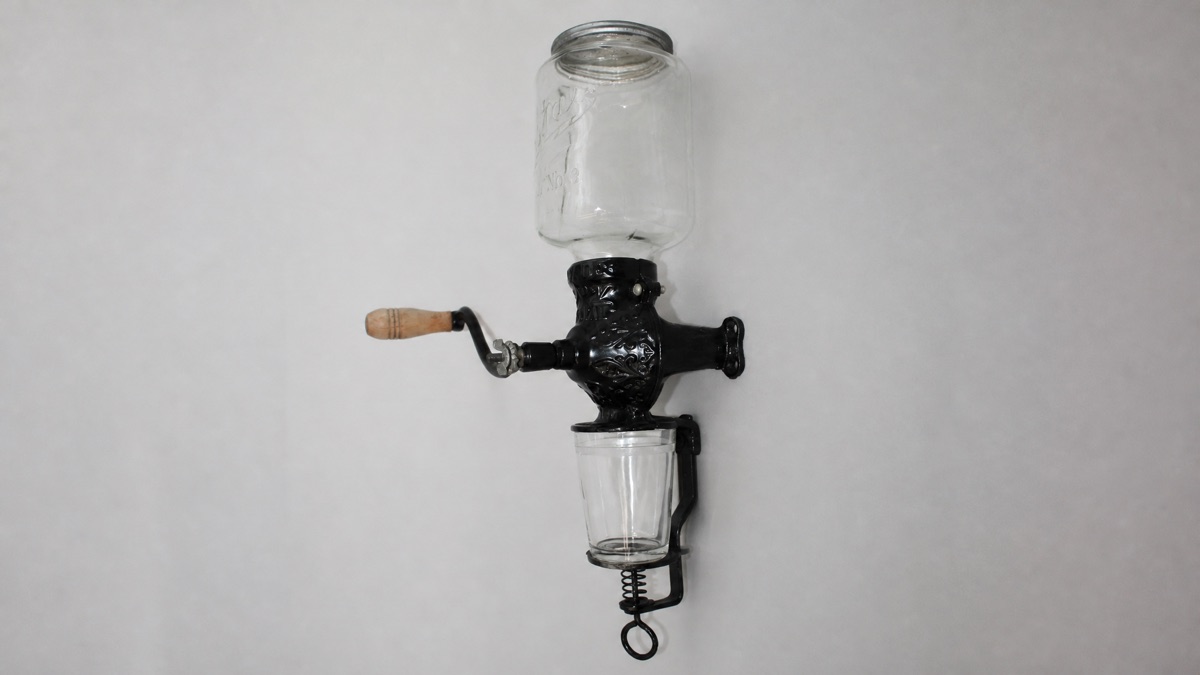
Hello, I'm Mark, the experiment barista here. 12 years of pulling shots taught me to judge antique hand grinders by the cup, not the spec sheet. The Arcade Crystal is an antique cast iron coffee grinder that mounts on a wall and turns by hand. The Arcade Manufacturing Co. of Freeport, Illinois, made it in the early 1900s. Its glass hopper and glass catch cup give the Crystal its name.
The No. 3 is the most common model and stands 18.5 inches (47 cm) tall. Owners call it adjustable, quick and easy to use. It costs about $175 to $320 in current US listings, plus shipping. Missing glass and hardened gaskets are the usual problems, and reproductions are common.
No published test measures the grind, so owner praise carries the verdict. Inside: models, sizes, common problems and a clear verdict from my own hands-on time. Nobody sponsored it.
What Is the Arcade Crystal Grinder?
The Arcade Crystal grinder is a cast iron, wall-mounted hand-crank coffee mill with a glass bean hopper and a glass catch cup. The Arcade Manufacturing Co. of Freeport, Illinois, built it in the early 1900s.
The name Crystal comes from the clear glass hopper on top and the glass cup below. Both pieces carry embossed lettering that spells out the model.
Sellers date the popular No. 3 to roughly 1910 through 1930. A September 1917 Hardware Age magazine advertisement shows the Crystal coffee mill was on sale by then.
The Crystal is an antique, not a current product. Because buyers find it secondhand through dealers and auction listings, each example differs in condition and in which parts survive.
Who Made the Arcade Crystal Grinder?
The Arcade Manufacturing Company made the Arcade Crystal grinder in Freeport, Illinois. The company began in 1868 as Novelty Iron Works, founded by brothers Edward and Charles Morgan.
A fire and money trouble forced the firm to restart. It was reorganized in 1885 as Arcade, with a third owner joining the Morgans.
Under that new name, Arcade built small cast iron machines for home use. Coffee grinders were its main product, and it made them from its start into the 1930s. The company ranked among the leading U.S. coffee mill makers of its day.
Arcade later used its cast iron skills to make toys. The cast iron Yellow Cab appeared in 1921, and a toy Fordson tractor followed in 1922.
War ended the toy line. Arcade shifted to war production in World War II and made its last toys in 1943. Rockwell Manufacturing Company acquired Arcade in 1945, and Arcade closed in 1953. For that reason, no maker sells the Crystal new today.
Which Arcade Crystal Models Exist?
The Arcade Crystal models exist as the No. 1, No. 3 and No. 4. The No. 3 is the most common, and dealers describe it as the most popular model and the most improved since the No. 1.
The No. 1 was the first glass hopper mill Arcade made. One dealer dates it to the 1880s and 1890s and lists it at 12 inches (30 cm) tall and 5.75 inches (14.6 cm) wide. Another dealer says production of the No. 1 began in 1900.
The No. 4 is a close variant of the No. 3 from the same era. Forum owners name the No. 3 and No. 4 as their favorite coffee mills.
The No. 25 is a related Arcade wall mill with a glass hopper, made around the 1920s. A restored example stands about 15.5 inches (39 cm) tall.
Arcade Crystal Models:
| Model | Height | Note |
|---|---|---|
| Crystal No. 1 | 12 in (30 cm) | First glass hopper mill |
| Crystal No. 3 | 18.5 in (47 cm) | Most popular model |
| Crystal No. 4 | Not listed | Close variant of the No. 3 |
| No. 25 | 15.5 in (39 cm) | Related wall mill |
How Does the Arcade Crystal Grinder Work?
The Arcade Crystal grinder works by hand crank, turning a moving grind wheel against a fixed grind surface in the iron housing. A wooden grip on the handle makes the crank easy to hold.
Beans start in the glass hopper on top. They drop into the iron body, where the turning wheel crushes them against the fixed surface. The ground coffee then falls into the glass catch cup below the spout.
The iron back plate mounts to a wall, which keeps the mill steady while the crank turns. Some owners display the mill on a custom tabletop stand instead.
The grinder has no motor and no cord. The only power source is the arm of the person turning the handle.
Can the Arcade Crystal Adjust the Grind?
Yes. The Arcade Crystal adjusts to any grind, says a long-time forum owner of the No. 3 and No. 4. The same owner calls both models quick and convenient to use.
That claim comes with a gap. No source documents the exact adjustment steps for the Crystal, so the owner's word is the only evidence.
A different Arcade box mill offers a clue about how such mills adjust. That mill changes its grind by loosening or tightening the nut that holds the handle.
The grind also depends on a spring, which supplies pressure on the grind surface. One restorer of a different Arcade mill found the original spring badly rusted. Replacing it brought the grind adjustment back.
What Is the Arcade Crystal Made Of?
The Arcade Crystal is made of black cast iron with glass parts and a wooden handle grip. The iron body carries cast lettering that names the maker and the model.
The glass hopper and catch cup are embossed. On a typical No. 3 the glass reads Crystal No. 3, and the iron is marked Crystal, Made in USA, 3.
Arcade also finished the cast iron in other colors. Dealers report black, blue, red, yellow, green and white, and a white example with gold lettering is documented.
Colors Arcade Used:
- Black
- Blue
- Red
- Yellow
- Green
- White
Some handles carry worn brass hardware. The wooden grip and handle are the parts most often replaced during restoration.
How Big Is the Arcade Crystal?
The Arcade Crystal is big for a coffee mill, standing 18.5 inches (47 cm) tall in the No. 3. The No. 3 is 5.5 inches (14 cm) wide and 9 inches (23 cm) deep with the handle. One dealer lists the weight at 5 lb 1 oz (2.3 kg).
Dealers do not agree on the exact size of the No. 3. Listings run from 17 inches (43 cm) to about 20 inches (51 cm) in length.
Does the Arcade Crystal Grind Well?
Yes. The Arcade Crystal grinds well enough that owners who use it call it a quality unit. A long-time forum owner says grinding with an Arcade becomes a pleasant ritual.
That praise comes from owners, not from lab numbers. No published sieve test or particle-size measurement of an Arcade Crystal exists.
Hand grinding also does not heat beans the way some electric grinders do. An owner of a different antique hand mill says the slow pace protects the flavor.
Results still depend on the condition of the grind surfaces and the spring. Listings range from fully working mills to ones sold as untested.
Is the Arcade Crystal Quick to Use?
Yes. The Arcade Crystal is quick and convenient to use, says a long-time forum owner. No timed test of the Crystal has been published, so that owner's word is the only evidence on speed.
Other hand mills grind slowly. One owner of a different hand grinder needed about ten minutes for a pot. A Peugeot mill takes about 26 full turns per measure.
The Crystal has a glass hopper, which lets beans wait ready between uses. Wall mills of this type hold a pound or more of beans.
What Problems Does the Arcade Crystal Have?
Arcade Crystal mills have four common problems: missing glass, hardened gaskets, rust and incomplete parts. Each one shows up in dealer listings and owner threads.
The glass hopper survived worse than the cast iron, so many mills lack the top jar. A catch cup is often missing too.
The original gasket between the glass hopper and the body hardens with age. A restorer found it no longer held the hopper in place and had to replace it.
Used examples show minor rust corrosion and pitted metal lids. Assembling a mill from loose parts often costs more than buying a complete one.
Common Problems:
- Missing glass hopper or catch cup
- Hardened hopper gasket
- Minor rust and pitted lids
- Incomplete parts
Are Arcade Crystal Jars Hard to Find?
Yes. Arcade Crystal jars are hard to find, and the upper glass hopper is the scarcest piece. A forum collector says the top jar did not survive as well as the iron.
Catch cups turn up for sale more often. One owner says original cups read ARCADE MFG CO FREEPORT ILL.
A missing or damaged cup does not have to stop a restoration. A new replica catch cup is a workable fix, and some restored mills already use one.
How Do You Clean an Arcade Crystal?
Cleaning an Arcade Crystal starts with the two grinding parts, the moving grind wheel and the fixed housing surface. A restorer of a related No. 25 mill cleaned those two parts, plus the glass and the exterior.
Replace the gasket if it has hardened. A hardened gasket stops the hopper from seating.
Dark spots on the mill need a closer look before anyone treats them as damage. Not every dark spot is rust. Some mills carry a blackened finish from the factory in a few places.
Are Arcade Crystal Reproductions Common?
Yes. Arcade Crystal reproductions are common, and collector guides warn that many copies are on the market. Careful buyers check every marking before they pay.
Wall-mounted mills are the more popular collector version. That popularity attracts copies.
Some listings include an Original or Licensed Reproduction field. The seller fills in that field, so it holds only a claim. It proves nothing alone, which is why the markings on the piece itself matter.
How Can You Spot a Fake Arcade Crystal?
A buyer can spot a fake Arcade Crystal by checking its markings. Originals carry raised lettering reading Crystal and No. 3 on the glass, and Crystal and Made in USA on the iron.
A mismatched catch cup does not prove a fake. Cups were sourced separately, so a cup from another maker can sit on a real mill.
Ask the seller for close photos of every marking before buying.
Markings to Check:
- Crystal and No. 3 raised on the glass
- Crystal, Made in USA and 3 on the iron
- ARCADE MFG CO FREEPORT ILL on original catch cups
How Much Does the Arcade Crystal Cost?
Buyers face a cost for the Arcade Crystal of about $175 to $320 in current US listings. One dealer lists a working No. 3 at $175, another lists a No. 3 at $300.
Condition does not set the price in a simple way. A listing for an all-original mill without its catch jar asks about $318. That is more than the working No. 3 at $175, so missing parts do not always lower the price.
The price on the listing is also not the full cost. Shipping adds to the total. One heavy listing charges $105.23 for delivery, while a smaller one ships for $25.
Prices from outside the US need separate treatment. A dealer abroad lists a No. 3 in euros. That price is left out of the dollar range.
Current Listing Prices:
| Item | Price | Note |
|---|---|---|
| Working No. 3 | $175 | Dealer listing |
| No. 3 | $300 | Dealer listing |
| All-original mill | $318 | No catch jar |
| Shipping, smaller listing | $25 | US delivery |
| Shipping, heavy listing | $105.23 | US delivery |
Is the Arcade Crystal Worth the Price?
Yes. A complete working Arcade Crystal is worth the price at $175 to $300 for a buyer who wants a durable hand mill. That price is below many new hand grinders.
The price holds only if the mill is complete. A missing jar or cup adds cost, since parts are scarce. A buyer has to replace the missing piece from a small supply.
A dealer may list the mill low and the missing glass high.
Shipping adds a last cost. It can add a third or more to the price of the heaviest listings.
How Does the Arcade Crystal Compare to Other Mills?
Arcade Crystal mills compare well with other antique mills and sit alongside Enterprise mills. Forum owners call Arcade and Enterprise units no trouble to use.
The 1939 Hobart KitchenAid A-9 is an electric rival to these hand mills. Owners call it a good grinder, though not as simple to use as an Arcade.
The Orphan Espresso Lido 3 is a modern hand grinder. An owner describes it as efficient and extremely consistent.
Mill Comparison:
| Mill | Hopper | Price |
|---|---|---|
| Arcade Crystal No. 3 | A pound or more | $175 to $320 |
| Hario Skerton Pro | 100 g (3.5 oz) | $50 to $60 |
| Orphan Espresso Lido 3 | 70 g (2.5 oz) | Not listed |
Is the Arcade Crystal Better Than a Modern Hand Grinder?
No. The Arcade Crystal is not better than a modern hand grinder for consistency. The Lido 3 is described as extremely consistent, and no such claim exists for the Crystal.
The Orphan Espresso Lido 3 uses large conical steel burrs made by Etzinger, a maker based in Liechtenstein. Burrs are the toothed parts that crush the beans. The hopper holds 70 g (2.5 oz), and the grinder weighs about 1 kg (2.2 lb).
The Hario Skerton Pro is a budget modern hand mill with ceramic conical burrs. It holds 100 g (3.5 oz) of beans. A reviewer timed it at about 1 minute 10 seconds for 20 g (0.7 oz) at a medium-fine setting.
The Skerton Pro costs roughly $50 to $60, which is below the Crystal. Its fine settings are less consistent, so the reviewer does not recommend it for espresso.
The Crystal wins as wall decor. A glass hopper full of beans on a cast iron frame doubles as a display piece.
One owner uses an older Zassenhaus for drip and French press batches, and a Lido 3 for espresso. The Crystal fits the first group of uses better than the second.
Is the Arcade Crystal Worth It?
Yes. The Arcade Crystal is worth it for a collector or a slow-morning user, and not worth it for espresso or speed. The mill rewards patience.
The strengths are a durable build, an adjustable grind, a glass hopper that shows the beans and a good look on the wall.
The weaknesses are scarce parts, common reproductions, no published test data and a hand crank only.
Pros:
- Durable cast iron build
- Adjustable grind
- Glass hopper that shows the beans
- Good looks on the wall
Cons:
- Scarce parts
- Common reproductions
- No published test data
- Hand crank only
Who Should Buy the Arcade Crystal?
Collectors of kitchen antiques should buy the Arcade Crystal, along with users who enjoy grinding by hand. Both groups get a working piece of Arcade history.
Buyers who need espresso precision or fast batches should pick a modern grinder. The Crystal does not suit those jobs.
The Coffee Experiment is a reader-supported platform. Purchases made through our links may earn us an affiliate commission at no extra cost to you.