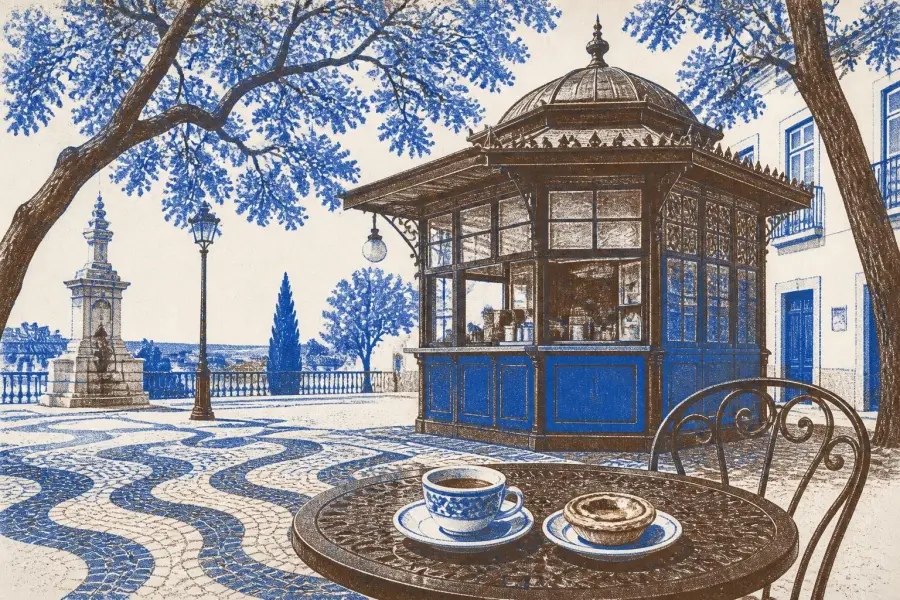
A Lisbon quiosque is a small ornate kiosk in a public square. It sells coffee, drinks and snacks to people sitting outside. The tradition dates to the 19th century, faded during the 20th, and returned after a restoration project began in 2009. Order a bica, pull up a metal chair, and you have joined one of Lisbon’s oldest street habits.
What a quiosque is
The quiosque is a tiny freestanding building, often octagonal, with a decorated roof. Many were built in a mix of Art Nouveau and Moorish styles. The kiosk holds a counter and a coffee machine, and the tables sit outside on the square.
Lisbon once had more than 100 of these kiosks across its plazas and gardens. They served cheap drinks and gave neighbors a place to talk. For many residents, the kiosk was the living room of the square.
Decline and revival
Lisbon’s kiosks declined through the 20th century. The Estado Novo dictatorship of António de Oliveira Salazar discouraged public gatherings, and many kiosks fell into disrepair or closed.
In 2009, entrepreneur Catarina Portas and architect João Regal began restoring them. Their project, Quiosque de Refresco, opened its first kiosk on Praça Luís de Camões. Others followed at Príncipe Real, Praça das Flores and Praça de São Paulo.
The pair also revived old Portuguese refreshments. Look for mazagran (iced coffee with lemon), capilé (a syrup drink with orange blossom water), and almond orchata. Lisbon’s city council later adopted the kiosk model to bring life back to its squares.
How to order coffee in Portugal
Portuguese coffee is espresso-based and served fast. Learn four words and you can order anywhere in Lisbon.
| Order | What arrives | Typical size |
|---|---|---|
| Uma bica | A short, strong espresso | About 30 ml (1 fl oz) |
| Um pingado | Espresso with a drop of milk | About 30 to 40 ml (1 to 1.3 fl oz) |
| Uma meia de leite | Half coffee, half hot milk, in a cup | About 150 ml (5 fl oz) |
| Um galão | Espresso with lots of foamed milk, in a tall glass | About 250 ml (8.5 fl oz) |
“Bica” is the Lisbon word. In Porto and the north, people ask for “um cimbalino” or simply “um café.” A popular story claims “bica” stands for “beba isto com açúcar” (drink this with sugar). Historians treat that as folklore.
Portuguese locals drink galão and meia de leite mostly in the morning. A bica works at any hour, including straight after lunch.
A few more orders are useful. “Um abatanado” is a longer espresso diluted with hot water, close to an Americano. “Um café cheio” is a bica filled to the brim. “Um descafeinado” is decaf. Say “curto” for a shorter, stronger shot.
The pastel de nata pairing
The classic partner for a bica is a pastel de nata. This custard tart has a flaky shell and a blistered, caramelized top. It measures about 7 cm (2.75 inches) across.
A good pastel de nata has a shell that shatters and a custard that is just set in the middle. Ask for it warm if the kiosk has an oven. Dust it with cinnamon and powdered sugar from the shakers on the counter. Take one bite of tart, then a sip of bica. The bitter coffee cuts through the sweet egg custard.
The best-known version comes from Pastéis de Belém, which has baked tarts in Belém since 1837. Most kiosks buy theirs from local bakeries, and quality varies.
When to go and what it costs
Kiosks are busiest at mid-morning and early evening. At sunset, Lisbon’s kiosks switch from coffee to ginjinha (sour cherry liqueur) and beer.
A bica at a kiosk usually costs between €0.80 and €1.20 (about $0.90 to $1.40). A galão or meia de leite runs roughly €1.50 to €2. Pay at the counter when you order. Tipping is not expected.
For another take on outdoor café culture, see our guide to the Paris sidewalk café.
If you go
- Start here: Praça Luís de Camões, at the top of Chiado, near the Baixa-Chiado metro station.
- Quieter option: Praça das Flores, a leafy residential square near Príncipe Real.
- Order: “Uma bica e um pastel de nata, por favor.”
- Budget: €2 to €3 (about $2.30 to $3.50) for a bica and a tart.
- Weather: Kiosk seating is outdoors. Bring a layer on windy days in winter.
- Hours: Most kiosks open mid-morning and close late evening. Times change by season.