
Hi, I'm Mark, and the Franke question lands on my bench today. 12 years behind the bar showed me what a commercial bean-to-cup machine must survive. Everything from model range to running costs is here, and the review is fully independent.
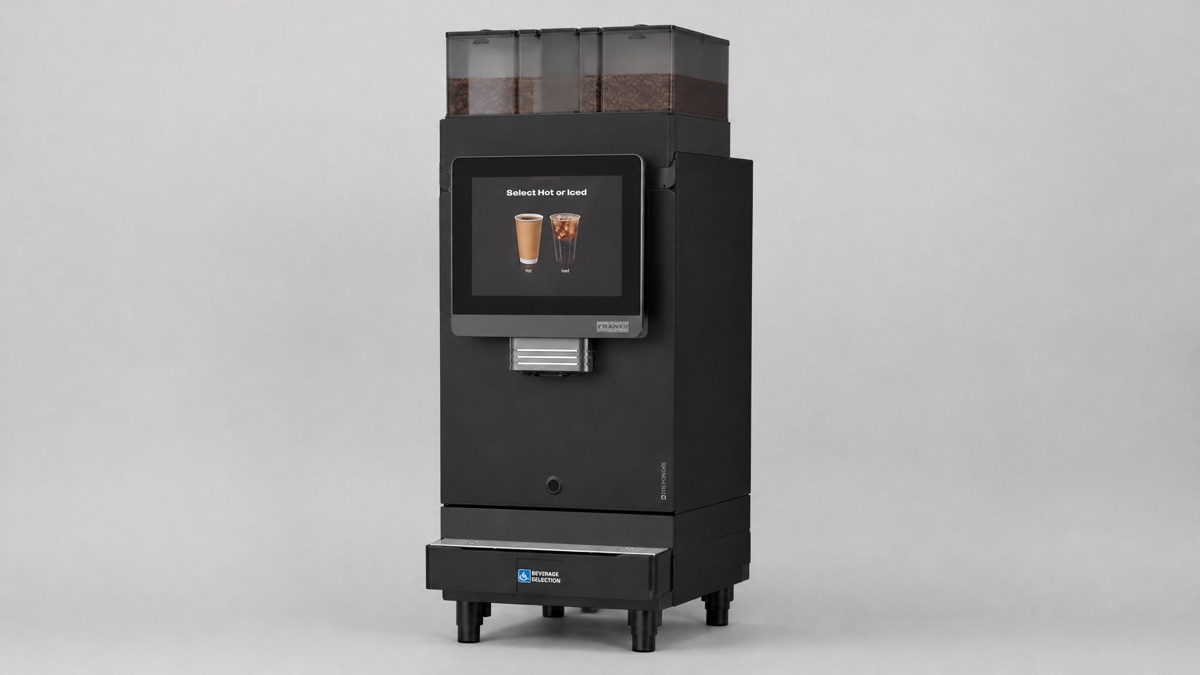
A Franke coffee machine is a professional bean-to-cup system from the Swiss maker Franke Coffee Systems. It grinds beans, brews espresso, froths milk and serves each drink from a touchscreen. The range runs from the 80 cup A300 to the 300 cup A1000.
The A400 and A600 differ in capacity, powder containers and flavor options. FoamMaster handles milk foam, and iQFlow keeps water pressure even. CleanMaster and EasyClean clean the machine. US dealer prices start near $8,800. The coffee is consistent, though no independent lab data confirms the cup.
Franke suits busy sites and untrained users, not households. Eversys offers finer espresso control, while the Franke A800 suits self-service better. The sections below cover models, cleaning, milk drinks, service, cost and who should buy one.
What Is a Franke Coffee Machine?
A Franke coffee machine is a professional bean-to-cup system that grinds, brews, froths milk and serves drinks at a touch. Franke Coffee Systems builds fully automatic and semi-automatic models for restaurants, hotels, cafes, offices and self-service areas.
Bean-to-cup means the machine grinds whole beans and brews the drink itself. No separate grinder is needed. Fully automatic models also froth milk alone, so staff only choose a drink on the screen.
The S700 works differently because it is semi-automatic. A barista steams the milk and finishes the drink by hand.
Drinks include espresso, cappuccino, flat white and hot chocolate. Some models add iced coffee and tea water.
The main advantage of the Franke range is consistency. Staff and guests get the same drink every time. Each site can also set its own menu, milk options, grinders, powders and flavors.
The current portfolio covers the A300, A400, A600, A800, A1000, SB1200 and S700. Franke also sells the Mytico line, which pairs Italian design with Swiss engineering.
Capacity, milk systems and power needs differ a lot between these machines. A buyer should check the exact model before comparing specs.
Who Makes the Franke Coffee Machine?
Franke Coffee Systems makes the Franke coffee machine at its Swiss base in Aarburg. The company builds modular A Line machines, the Mytico line and the S700 semi-automatic, and sells them through dealers and service partners.
Franke Coffee Systems is the coffee division of the Franke Group, which also sells kitchen products. The Franke Group is privately held by the Artemis Group.
Franke lists more than 700 partners worldwide for maintenance, repairs and user training. Certified partners and service providers also handle replacement parts.
Help is also available by phone. US customer service answers Monday to Friday, 7 a.m. to 5 p.m., on 1-800-310-5710. Franke also offers on-site training courses for staff.
Does Franke Make a Home Coffee Machine?
No. Franke does not make a home coffee machine, because most of the range is built for professional sites. A household buyer faces large counter, power, water, drainage and milk cooling needs.
The smallest option is the A300. The A300 serves up to 80 cups per day. The US version runs on a 15 amp circuit.
A few coffees each morning do not need that capacity. A smaller consumer machine fits that job better and costs far less.
Anyone still set on a Franke should check electrical, water, drainage, service and parts support first. Making coffee at home and being designed for home use are different things.
Home Checks:
- Electrical supply
- Water and drainage
- Counter space
- Milk cooling
- Local service and parts
Which Models Make Up the Franke Coffee Machine Range?
The Franke coffee machine range runs from the 80 cup A300 up to the 300 cup A1000, with the S700 as a semi-automatic barista option. The US lineup lists the A800 Fresh Brew, A1000 Flex, A800, S700, A1000, A600, A400 and A300 Fresh Brew.
Daily capacity rises with each step. The A300 handles up to 80 cups, the A400 about 100, the A600 150 to 200, the A800 up to 250 and the A1000 up to 300.
Daily Capacity by Model:
| Model | Cups per day |
|---|---|
| A300 | Up to 80 |
| A400 | About 100 |
| A600 | 150 to 200 |
| A800 | Up to 250 |
| A1000 | Up to 300 |
Franke introduced a New A Line with a new A600 and A800 on a shared platform. The platform adds FrankeOS, FrankeConnect and better serviceability. Both machines won a 2026 iF Design Award.
Model codes show the configuration. FM stands for FoamMaster milk foam, and MS marks a simpler milk system. CM stands for CleanMaster, which uses a cleaning cartridge. EC stands for EasyClean, which needs cleaning fluid added by hand.
Fresh Brew marks variants such as the A800 Fresh Brew. The A800 Fresh Brew brews each cup on demand and offers gram-throw flexibility.
Model Codes:
- FM: FoamMaster milk foam
- MS: simpler milk system
- CM: CleanMaster cleaning cartridge
- EC: EasyClean with manual cleaning fluid
Old and new A600 machines carry different specs. Buyers should confirm which version a seller quotes.
How Do the Franke A400 and A600 Coffee Machines Differ?
The Franke A400 and A600 differ mainly in capacity, powder containers and flavor options. The A400 serves about 100 cups per day with one powder container. The older A600 serves about 150 cups with two powder containers.
Both use FoamMaster milk foam and CleanMaster cleaning. Both offer pre-infusion, which wets the coffee grounds before full brewing starts. Each has two bean hoppers and an 8 inch (20 cm) touchscreen. Each weighs about 84 pounds (38 kg).
Size is nearly the same, so the machines fit similar counter space. The A600 stands about 2.6 feet (0.8 m) tall and the A400 about 2.4 feet (0.7 m). Width and depth match, at just over 1 foot (30 cm) and just under 2 feet (60 cm).
The real gap lies in what each machine can serve. The A600 serves about 150 cups per day against about 100 for the A400. It also holds two powder containers, while the A400 holds one. Only the A600 takes a flavor station with three syrups. A shop that wants flavored drinks must therefore choose the A600.
US dealer prices run near $8,790 for the A400 and $14,030 for the A600.
A400 vs A600:
| Spec | A400 | A600 |
|---|---|---|
| Cups per day | About 100 | About 150 |
| Powder containers | 1 | 2 |
| Height | 2.4 ft (0.7 m) | 2.6 ft (0.8 m) |
| Weight | 84 lb (38 kg) | 84 lb (38 kg) |
| US dealer price | $8,789.60 | $14,032 |
How Much Can the Franke A800 and A1000 Coffee Machines Handle?
The Franke A800 and A1000 handle the heaviest loads in the range, up to about 250 and 300 cups per day. Both use a 10.4 inch (26 cm) touchscreen and FoamMaster milk technology.
The A800 is built for that volume. It has a triple boiler system, three bean hoppers and a second fresh milk option. It weighs about 128 pounds (58 kg). It also takes a 2 gallon (7.6 L) side fridge for the extra milk.
The A1000 handles the higher of the two limits and adds more equipment. It adds an optional third grinder, a Flavor Station and an iced coffee module. It also needs three-phase power and draws 4.5 to 8.1 kW.
Hopper sizes on the heavy machines reach 2 kg (4.4 lb). Large hoppers mean fewer refills during long shifts.
How Does a Franke Coffee Machine Work?
A Franke coffee machine works by grinding, brewing and frothing automatically after one touch on the screen. A user picks a drink, and the machine handles every remaining step.
Beans drop from the hopper into the grinder. The machine doses the grounds into the brew unit. There, the pump and boiler push hot water through them. The brew unit then ejects the spent coffee into the grounds container.
Inside the brew unit, pre-infusion wets the grounds with a light stream of water first. The full extraction pressure follows. Water that hits dry grounds at full force can cut narrow paths through them, which is called channeling. Even wetting reduces channeling, so water reaches all of the coffee.
Because the machine runs each step itself, training takes minutes, not days. Staff can leave the machine to brew and froth while they serve customers.
The A300 stores up to 100 drinks, each with its own brewing temperature. Three more settings can be programmed for each drink:
- Cup size
- Aroma strength
- Bean selection
What Do FoamMaster and iQFlow Do on a Franke Coffee Machine?
FoamMaster and iQFlow control milk foam and water flow on a Franke machine. FoamMaster froths milk to a chosen thickness and temperature. iQFlow keeps water pressure even through the coffee.
FoamMaster also puts foam on cold drinks. Settings range from dense cappuccino foam to silky latte microfoam.
iQFlow gives the same flavor cup after cup without grinder changes. Franke says iQFlow pulls more flavor from the beans.
Multi-boiler designs add speed. The A800 can brew espresso, foam milk and heat tea water at once. The S700 can make 160 espressos in an hour.
How Does a Franke Coffee Machine Clean Itself?
A Franke machine cleans itself with the EasyClean or CleanMaster system, depending on the model. Both programs clean and descale the machine.
The two systems differ in how the cleaning liquid gets into the machine. EasyClean needs an operator to add the cleaning liquid. CleanMaster uses a pre-filled cartridge that pops in, so no one has to handle the liquid.
The model name shows which system a machine has. FM CM versions use CleanMaster, and EC versions use EasyClean. The A300 uses EasyClean.
Food safety rules also apply to cleaning. HACCP is a food-safety system that controls hygiene risks. Both Franke programs meet its rules when run as directed.
Automation does not remove all work. Milk-contact parts, waste containers and bean areas still need regular care. The milk system needs a daily routine.
The products used for this work matter too. Operators must use the cleaning products specified for the exact model. Household products can damage the machine.
How Good Is the Coffee From a Franke Coffee Machine?
The coffee from a Franke coffee machine is good and consistent, though no lab data confirms it. Programmable recipes give the same flat white at 7 a.m. and at 4 p.m.
Dedicated grinders, pre-infusion and iQFlow support the extraction. The A400 gives each of its two hoppers a dedicated grinder, so blends do not mix.
Consistency matters most where many untrained people use one machine. The Franke removes the variation that different hands add.
Water quality matters too. Scale is the most common cause of faults in any commercial machine. A water filter protects both the boiler and the taste.
Published measurements of brew temperature, extraction yield or dose accuracy for Franke machines are scarce. Buyers should test a demo unit with their own beans.
Does the Franke Coffee Machine Make Good Milk Drinks?
Yes. The Franke machine makes good milk drinks when it carries the FoamMaster system. FoamMaster lets users pick the foam thickness, texture and milk temperature from the menu.
Some sites serve guests with dietary needs, and one milk is not enough for them. The A800 handles this by serving two fresh milks at once, such as dairy and non-dairy.
Not every version has FoamMaster. MS versions such as the A600 MS EC use a simpler milk system without it. The A300 offers FoamMaster only as an option.
The A300 also limits milk choice in another way. It takes a 3 L or 5 L milk fridge, and dual milk is not available on it. Buyers should match the milk setup to the menu.
Where Does the Franke Coffee Machine Fall Short?
The Franke coffee machine falls short on size, upkeep and hard reliability data. A team of 15 to 25 people gets more capacity from an A600 than it will use.
The machines are not maintenance free. Daily milk care, scheduled servicing and descaling keep the brew group and boiler in shape. Scale is a common cause of faults.
Franke publishes no failure rates, so a buyer cannot judge how often these faults happen. A repair shop lists brew unit seal wear as a common fault. Independent owner data is hard to find.
The Franke leans toward set and forget use. Espresso fans who want fine control over dose and extraction get less room to tune than on an Eversys. The S700 semi-automatic gives a barista more control.
How Much Does a Franke Coffee Machine Cost?
A Franke coffee machine costs roughly $8,800 to $14,700 at US dealers for the A400, A600 and A800. Final prices depend on model, configuration, accessories, installation and dealer.
The A400 is the lowest-priced of the three. The A400 FM CM lists at $8,789.60. The A400 Fresh Brew lists at $9,548, down from $11,935.
The A600 and A800 cost more. The A600 FM CM lists at $14,032. The A800 FM EC lists at $13,888.80, and the A800 Fresh Brew lists at $14,657.60. The A1000 and A1000 Flex are quoted by request in most US listings.
Listed US Prices:
| Model | Price |
|---|---|
| A400 FM CM | $8,789.60 |
| A400 Fresh Brew | $9,548 |
| A600 FM CM | $14,032 |
| A800 FM EC | $13,888.80 |
| A800 Fresh Brew | $14,657.60 |
The price on the machine is not the full cost of owning it. A new owner also pays for installation, cleaning products, service contracts, water treatment and parts. These costs change with the setup. A dealer quote for the exact configuration is a better guide than any generic price.
What Does Franke Coffee Machine Service Involve?
Franke coffee machine service runs through certified partners who handle maintenance, repairs, parts and training. Operators should give the model, serial number, error message and recent cleaning history when they call.
Those details matter because technicians use them to find faults faster. For that reason, operators should keep records of cleaning, maintenance and error messages. A clear log shortens the repair visit. Downtime costs sales, so a service plan matters on busy sites.
Reaching the service team is the next practical step. Franke North America answers calls Monday to Friday, 7 a.m. to 5 p.m. Its service page does not list warranty terms. One US dealer lists a 1 year warranty on the A800 Fresh Brew.
Used machines need extra checks. Look at the serial number, service history, grinder condition, milk system and parts supply.
Is the Franke Coffee Machine Worth the Price?
Yes. The Franke machine is worth the price for sites that serve high volumes or untrained users. Automation and programmable recipes replace barista labor and cut drink variation.
Peak demand decides how much machine a site needs. Queues form during the busiest 20 minutes, not across the daily total. Capacity beyond that peak is money unused, so the machine should be sized against those 20 minutes.
The A300 is the entry point for sites with modest peaks. It suits teams of 30 to 60 staff and needs only a standard outlet. Smaller Franke models also need less service than the larger ones.
Heavy models only pay off with heavy use. An A1000 in a small office wastes capacity and power.
How Does the Franke Coffee Machine Compare With Rivals?
The Franke coffee machine compares with rivals as a premium option, strong on interface and drink variety. Eversys is a rival built for high-volume specialty coffee.
Franke wins on guest-facing touchscreens, chocolate and flavored drinks, and rotating staff. Eversys wins on espresso adjustment and data control.
Three other groups of machines compete with these two:
- Other premium bean-to-cup makers: WMF, Schaerer, Thermoplan and Melitta Cafina
- Jura Professional: a maker for smaller offices
- Cheaper office machines: lower prices, with plastic internals and uneven temperatures
Is the Franke Coffee Machine Better Than Eversys?
No. The Franke coffee machine is not better than Eversys for espresso nuance, but it suits self-service better. Eversys offers finer control of dose, grind, ratio, temperature and pre-infusion.
The Franke A800 is tuned for set and forget use. Quality stays steady across many users with little tinkering, which is what a self-service setup needs.
Milk drinks show the same split. Both machines make strong milk drinks. Eversys treats milk texture as a craft setting that can be adjusted. The A800 delivers steady foam for many different users.
Eversys leads on telemetry for multi-site programs. The A800 also offers usage statistics, maintenance alerts and remote menu updates.
Is the Franke Coffee Machine Better Than a Smaller Office Machine?
Yes. For heavy daily use, the Franke coffee machine beats a smaller office machine because it is built for heavy use and cleans itself. Franke builds with premium Swiss parts, while budget models often use plastic internals.
The A300 is a simple, compact model with lower service needs than larger Franke machines.
A Franke A300 fits tight spaces and runs on a standard outlet. Plumbed, tanked and hybrid setups need no renovation.
A small team of 15 to 25 people does not need an A600. A smaller, cheaper machine serves that group well.
Is the Franke Coffee Machine Worth It?
Yes. The Franke coffee machine is worth it for busy workplaces and hotels, and not for a household. Consistent drinks, automatic cleaning and a wide service network earn the price.
Machines run $8,800 and up. Heavy models also need three-phase power, which is a stronger electrical supply than a normal outlet. Daily care never disappears, so staff must set aside time for it.
Dealers offer buying, renting and leasing, so the upfront cost is not the only route.
Whichever route is chosen, the buyer still has to judge how well the machine performs. Independent lab data on brew temperature, extraction and reliability is thin, so a demo unit is worth requesting.
The last choice is size. Buyers should size by peak demand and pick the smallest model that covers it. Right-sizing is the best way to protect value.
Who Should Buy a Franke Coffee Machine?
Buyers of a Franke coffee machine should be businesses that need steady drinks from many different users. Boutique offices, dealerships and teams of 30 to 60 staff fit the A300.
Hotels, restaurants and self-service stations fit the A600 and A800. Both handle breakfast rushes and rotating staff.
Depots, mining sites and large corporate campuses fit the A1000. The A1000 runs up to 300 cups per day across multiple shifts.
Households that make a few coffees each morning should look elsewhere. A consumer machine costs less and needs no special install.
Best Fit by Model:
- A300: boutique offices, dealerships and teams of 30 to 60 staff
- A600 and A800: hotels, restaurants and self-service stations
- A1000: depots, mining sites and large corporate campuses
The Coffee Experiment is a reader-supported platform. Purchases made through our links may earn us an affiliate commission at no extra cost to you.