
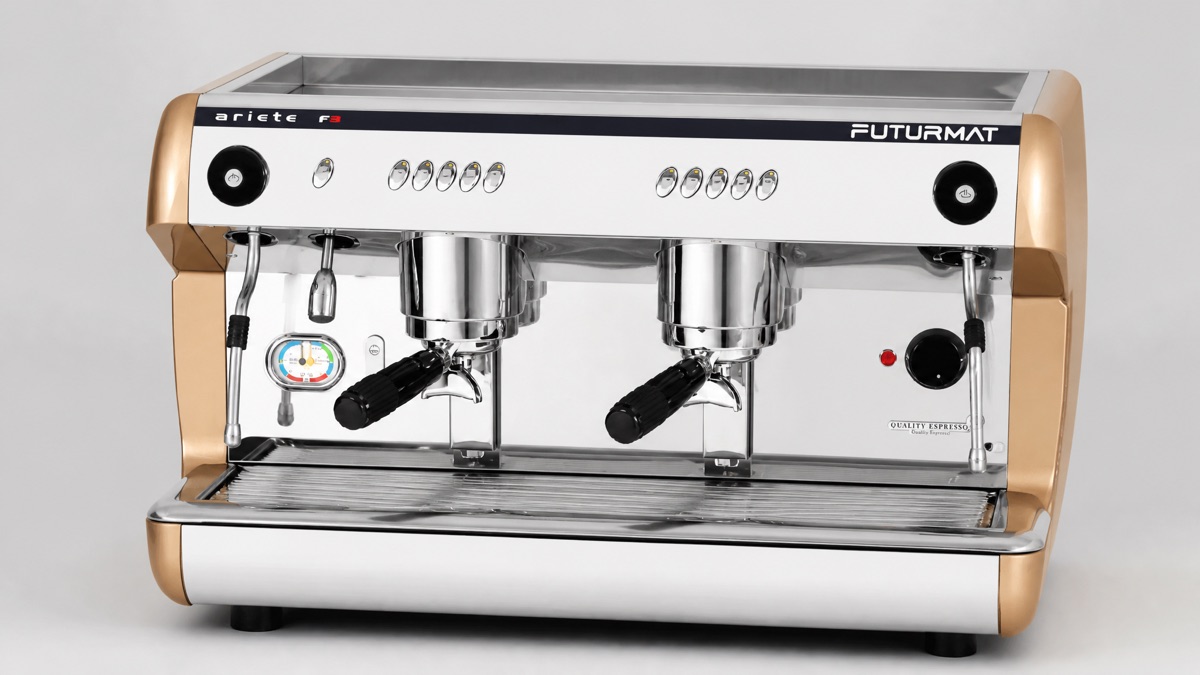
Welcome, I'm Mark, and today it's all about the Futurmat espresso machine. The Futurmat is a commercial machine from Quality Espresso in Barcelona, built since 1978 for cafes, restaurants and hotels.
Pulling shots near the Galleria Umberto I in Naples shaped how I judge commercial espresso machines. Futurmat machines cost far less than the Nuova Simonelli Appia Life. They use brass groups and a copper boiler. Dealer prices vary widely, and no independent tests exist.
I look at model lineup, dealer pricing and install needs. I tested it without any brand input. The review also covers features, warranty and service, then gives a clear verdict on who should buy a Futurmat.
What Is a Futurmat Espresso Machine?
A Futurmat espresso machine is a commercial espresso machine from a Spanish brand created in 1978. Cafes, restaurants and hotels use these machines. The range has one-, two- and three-group models with brass groups and copper boilers.
The range has no home models. Every Futurmat is a commercial machine with commercial power and plumbing needs. Dealers sell them to venues that serve coffee all day.
Those venues choose a model by its number of groups. A group is the brew head that holds one portafilter. A two-group machine pulls two shots at once. So group count sets how many drinks a busy bar serves in a rush.
The brand began in Spain. Futurmat is reported to have become the best-selling machine brand in Spain. It then grew from that home market into dozens of countries through its parent company.
The maker says the brand mixes Italian espresso tradition with newer technology. In practice that means brass group heads, a copper boiler and electronic dosing on every model.
Who Makes the Futurmat Espresso Machine?
Quality Espresso makes the Futurmat espresso machine in Barcelona, Spain. The company has more than 65 years of history. Its machines are sold in more than 90 countries.
The company lists its address as Motores 1-9, 08040 Barcelona. Its brochure says its systems follow ISO 9001, a quality management standard. Quality Espresso also sells machines under the Visacrem, Italcrem and Mairali brands. It owns the Gaggia brand for Iberia and most of Spanish-speaking Latin America.
Evoca Group bought the entire share capital of Quality Espresso on 16 May 2018. Evoca is headquartered in Valbrembo, near Bergamo, Italy. Quality Espresso is part of Evoca Group. Evoca also owns other commercial coffee brands. Brochures name Evoca S.p.A. in Valbrembo, Italy as the distributor.
Sources disagree on where the machine is made. One US dealer listing says Futurmat is made in France. The maker and a UK dealer both say Barcelona, Spain. The French claim is a listing error.
The maker website shows a notice for some visitors. The notice says Evoca export control policy bars transactions with their country. Buyers in those countries cannot order through the maker.
Which Futurmat Espresso Machine Models Exist?
Futurmat espresso machine models exist in four main lines: Ottima Evo, Rimini, Rimini Soul and F3. Each line comes in two-group form. Ottima Evo adds a one-group size and F3 adds a three-group size.
The Ottima Evo 1-group weighs 35 kg (77 lb) and holds a 5 L (1.3 US gal) boiler. The 2-group weighs 49 kg (108 lb) with an 11 L (2.9 US gal) boiler. Variants include a semiautomatic and a tall-cup model.
The Rimini has 2 groups and an 8 L (2.1 US gal) boiler at 3 kW. The Rimini Soul has 2 groups and a 13 L (3.4 US gal) boiler at 2800 W. The Soul adds a stainless steel front.
The F3 2GR weighs 63 kg (139 lb) with a 13 L boiler at 3700 W. The F3 3GR weighs 76 kg (168 lb) with an 18 L (4.8 US gal) boiler at 4800 W. A Digital variant adds an LCD.
Some dealers list the F3 as the Ariete F3. The Ariete F3 name appears on older dealer pages and used listings for the same F3 range.
The F3 comes in electronic, display and semiautomatic versions. The F3 Digital is the version with a display. It is a variant of the F3, not a separate line.
Older machines still circulate on the used market. These include the Ottima 2.0 and a three-group Ottima. The Sensius One and the Ruby Pro2 manual machine also carry the Futurmat name.
Tall-cup versions raise the groups so travel mugs fit under the spout. Cup clearance is 123 mm (4.8 in) on the tall-cup Ottima Evo against 78 mm (3.1 in) on standard models.
Main Lines:
- Ottima Evo with 1-group and 2-group sizes
- Rimini with 2 groups and an 8 L boiler
- Rimini Soul with 2 groups and a 13 L boiler
- F3 with 2-group and 3-group sizes
How Do the Futurmat Ottima, Rimini and F3 Differ?
The Futurmat Ottima, Rimini and F3 differ mainly in size, controls and extras. Ottima Evo is the plainest line. Rimini is the most compact two-group line. F3 is the largest and carries the most features.
| Model | Width | Boiler | Power |
|---|---|---|---|
| Ottima Evo 2GR | 710 mm (28.0 in) | 11 L | 2800 W |
| Rimini | 580 mm (22.8 in) | 8 L | 3000 W |
| F3 2GR | 770 mm (30.3 in) | 13 L | 3700 W |
| F3 3GR | 940 mm (37.0 in) | 18 L | 4800 W |
The Rimini is the narrowest, and its 8 L boiler suits moderate volume. It has no plastic in its body panels. It uses touch keypads and 2 kg brass groups with E61-style infusion.
The Ottima Evo sits between the Rimini and the F3 in size. It uses chrome pushbuttons with LEDs and 2.5 kg brass groups. One dealer sells the Evo in white or black for $3,300.
The F3 is the widest line and has the largest boilers. It adds two pressure gauges, a programmable hot water outlet and aluminium alloy side panels.
How Does a Futurmat Espresso Machine Work?
A Futurmat espresso machine works by pumping mains water through a copper boiler to brass group heads. An internal motor pump drives the water. An infusion and extraction system in each group head wets the coffee gently before full pressure.
Pre-infusion means a group wets the coffee at low pressure before full pressure builds. The maker lists an infusion and extraction system on its brass groups. It gives no pre-infusion timing.
Electronic water level control keeps the boiler full. The Rimini refills its boiler automatically.
Once water reaches the coffee, electronic dosing controls how much ends up in the cup. Each Ottima Evo group has four programmable doses and a continuous button. The F3 offers one cup, two cups or half cups at a single touch.
Rotating stainless steel steam arms heat and froth milk. The F3 also doses hot water by program, and venues use that outlet for tea and soup.
What Does the Futurmat Thermosiphon Boiler Do?
The Futurmat thermosiphon boiler heats each group head through its own heat exchanger inside a copper boiler. The maker says this design gives excellent thermal stability. No independent test measures that claim.
A thermosiphon moves hot water between the boiler and the group by natural convection. Hot water rises and cooler water sinks, so no pump is needed. Futurmat machines use one copper boiler for steam and group heating. A dual boiler design uses a separate brew boiler.
Heavy brass groups also hold heat. The Rimini and older Ottima use 2 kg (4.4 lb) groups. The Ottima Evo uses 2.5 kg (5.5 lb) groups.
Boiler size grows with group count. The Ottima Evo 1GR holds 5 L, and the 2GR holds 11 L. The F3 holds 13 L at two groups and 18 L at three.
The F3 Digital programs temperature per group and adjusts the boiler setting finely.
The F3 with a display adjusts boiler water temperature to within 0.2 °C (0.4 °F). That setting is made on the display. Machines without a display have no such control.
What Features Does a Futurmat Espresso Machine Have?
A Futurmat espresso machine features a steel chassis, brass groups, a copper boiler and electronic dosing. The steel chassis resists rust. Stainless steel covers the working surfaces.
Controls differ by line. Rimini and F3 use heavy-duty touch-sensitive keypads. Ottima Evo uses chrome pushbuttons with built-in LEDs. All of them dose coffee by program.
The F3 adds two independent gauges. One shows boiler pressure and the other shows pump pressure. The F3 also has two steam arms, a programmable hot water outlet and an illuminated work area.
F3 hot water is programmable in size and temperature. The temperature range runs from 78 to 98 °C (172 to 208 °F). Auto Steam is an optional extra on the F3. It cuts steam off at a set milk temperature.
The F3 Digital adds an LCD display and a serving counter for each group. It runs an automatic group cleaning program. It also has a service indicator, a water filter warning and a backup memory.
The F3 with a display has a clock that starts and stops the machine on each day of the week. An energy saving system switches the machine off if it is left on overnight. The display shows text in 9 languages.
Capsule use is optional. Ottima Evo accepts a filter holder kit for capsule formats. The Rimini Soul runs in traditional or capsule format.
Core Features:
- Rust-resistant galvanised steel chassis
- Brass group heads
- Copper boiler with a heat exchanger per group
- Electronic dosing with programmable doses
- Touch keypads or chrome pushbuttons
Does the Futurmat Support Smartia Connectivity?
Yes. Some Futurmat models support Smartia, the Evoca remote connectivity platform. Smartia lets operators monitor and manage electronic machines remotely.
The Ottima Evo 1GR lists Smartia as available. The Ottima Evo 2GR, semiautomatic and tall-cup models list it as unavailable. Buyers who want it must pick the right model.
The maker lists Smartia as available on the F3 2GR and 3GR. A US dealer repeats Smartia connectivity in its F3 specifications.
The brochure limits Smartia to electronic versions. Semiautomatic machines cannot connect. Checking the exact model code before ordering avoids a mismatch.
Smartia By Model:
| Model | Smartia |
|---|---|
| Ottima Evo 1GR | Available |
| Ottima Evo 2GR | Unavailable |
| Ottima Evo 2GR Tall Cups | Unavailable |
| F3 2GR and 3GR | Available |
The maker describes Smartia as a connectivity solution for remote control of efficiency and productivity on electronic machines. It does not publish what Smartia costs or how it connects.
What Do Owners Say About the Futurmat Espresso Machine?
Owners of the Futurmat espresso machine have left almost no public review record. No independent test or owner survey turned up. Nearly all written material is maker or dealer copy.
The only written feedback found covers the Ariete F3. It found no flaws and praised the responsive buttons. A single comment proves little.
Dealer copy praises easy cleaning, one-touch control and two steam arms. A three-group dealer calls the F3 ideal for busy cafes. Sellers write these lines to sell machines.
A thread on r/espresso covers an old Futurmat. Its title is 'Acquired a Futurmat and plan on doing a full refurbish'. The replies could not be read here, so buyers who want owner stories can read that thread.
Buyers can ask a dealer for the name of a local cafe that runs the same model. A cafe owner can report real noise, steam and servicing experience.
Is the Futurmat Espresso Machine Reliable?
No. The Futurmat espresso machine is not proven reliable by any test. The maker calls the Ottima Evo highly reliable with excellent thermal stability. That wording is marketing, not data.
The warranty gives a firmer signal. The UK maker page lists 12 months on parts and 5 years on parts for group heads and boiler. A long cover on core parts shows some confidence.
The used market adds another clue. Resellers sell refurbished Ottima A2 and Ariete F3 units with warranties of 3 to 6 months.
Servicing matters. The maker recommends annual servicing. The F3 Digital adds a service indicator and a water filter warning to prompt upkeep.
How Does the Futurmat Espresso Machine Compare to Rivals?
The Futurmat espresso machine sells for far less than its main two-group rivals but offers less proven support. The Nuova Simonelli Appia Life and Rancilio Classe 5 set the price bar in US commercial cafes.
The Appia Life 2-group holds an 11 L (2.9 US gal) boiler at 3.4 kW. One US dealer lists it at $8,505 with 2 years of parts cover. Volumetric dosing, which pours a set amount of water per shot, and two cool-touch steam wands come standard.
The Rancilio Classe 5 USB 2-group comes in two sizes. The compact 5 L model costs $7,980, and the tall 11 L model costs $9,072. The spec sheet lists 1 year of parts cover and a USB port for settings.
The Futurmat Ottima Evo 2GR has an 11 L boiler, the same size as the Appia Life. It sells for $3,300 with a 1 year warranty. The F3 2GR has a 13 L boiler and ranges from $4,539 to $8,750. Its warranty runs 12 to 24 months.
| Machine | Boiler | Price | Warranty |
|---|---|---|---|
| Futurmat Ottima Evo 2GR | 11 L | $3,300 | 1 year |
| Futurmat F3 2GR | 13 L | $4,539 to $8,750 | 12 to 24 months |
| Nuova Simonelli Appia Life 2GR | 11 L | $8,505 | 2 years parts |
| Rancilio Classe 5 USB 2GR | 5 to 11 L | $7,980 to $9,072 | 1 year parts |
Is the Futurmat Cheaper Than Nuova Simonelli and Rancilio?
Yes. The Futurmat costs less than the Nuova Simonelli and Rancilio at most US dealers. The Ottima Evo 2GR sells for $3,300. The rivals list at $7,980 to $9,072.
The F3 2GR shows how much the dealer matters. Di Pacci USA lists it at $4,539, which is below both rivals. Prime Brew Supply lists it at $8,750, which is above both.
That gap is large for one machine. The same F3 2GR spans $4,539 to $8,750 across US dealers, and dealer mark-ups drive most of it. A buyer who requests several quotes can save more than one who only compares brands.
Price is not the only cost to weigh. Warranty runs the other way. The Appia Life carries 2 years on parts, and the Classe 5 carries 1 year. Futurmat offers 12 months plus 5 years on groups and boiler on the UK page.
Labor coverage is harder to compare. Prima Coffee lists the Appia Life with 2 years on parts and 1 year on labor. Futurmat dealers list their own terms, and none of them states a labor period.
How Much Does a Futurmat Espresso Machine Cost?
A Futurmat espresso machine costs from about $3,300 for an Ottima Evo to $8,750 for a certified F3. Prices vary by dealer, model and group count. New and used units both circulate in the US.
The Ottima Evo in white or black costs $3,300 at Cafe Domino. Ex-demo Ottima units cost $3,499 to $3,850 at Di Pacci USA. The ex-demo price is not lower than a new Evo.
Di Pacci USA lists the F3 at $3,479 for one group, $4,539 for two and $5,419 for three. All three sizes showed as out of stock. Prime Brew Supply lists the F3 2GR Gold ETL at $8,750.
Vaneli's lists the Rimini Soul at $6,700.
Listed US Prices:
| Model | Price | Dealer |
|---|---|---|
| Ottima Evo 2GR | $3,300 | Cafe Domino |
| F3 2GR | $4,539 | Di Pacci USA |
| Rimini Soul | $6,700 | Vaneli's |
| F3 2GR Gold ETL | $8,750 | Prime Brew Supply |
Di Pacci includes tariffs and duties in its prices and ships US-wide by air freight. Returns last 14 days with a 30% restocking fee. Power use of 2700 W to 4800 W adds running cost.
The listed prices cover the machine only. A commercial grinder, plumbing and electrical work cost extra. A 30% restocking fee at Di Pacci would cost $1,362 on a $4,539 F3 2GR.
Is the Futurmat Espresso Machine Worth the Price?
Yes. The Futurmat espresso machine is worth the price when a dealer quote lands near $3,300 to $4,500. At that level it costs less than half of the main rival machines.
A lower price only helps if the machine can handle the work. A dealer rates the Ottima Evo at up to 50 cups per hour. The Appia Life carries a rating of 250 drinks a day.
The low price comes with risk. No independent test backs the build. The US service network is also thin, which can slow repairs. A written warranty and a local technician protect the purchase against both problems.
Buying used does not remove that risk, and it saves little. The ex-demo Ottima costs $3,499 to $3,850, which is more than a new Evo. Used buyers should compare cover terms before price.
What Does a Futurmat Espresso Machine Need to Install?
A Futurmat espresso machine needs a dedicated power supply, mains water and a drain to install. Power is 230 V at 2700 W to 2800 W for the Ottima Evo. The F3 needs 220 to 240 V at 3700 W or 4800 W.
At 230 V, the 2800 W Ottima Evo draws about 12 A and the 4800 W F3 3GR draws about 21 A. A standard 120 V outlet cannot run them. A licensed electrician should set the circuit.
The UK maker page asks for a hard-wired single-phase supply with a surface-mounted isolator. That is a UK spec. US buyers must confirm voltage and plug rules with a dealer. A Gold ETL certified F3 is sold in the US.
ETL is a North American mark from Intertek. The ETL Listed mark covers product safety, and a separate ETL Sanitation mark covers food service equipment. Prime Brew Supply does not say which mark its Gold ETL F3 holds.
The UK maker page also lists plumbing needs. It asks for a 15 mm mains water line with a 3/4 inch stopcock. A 38 mm drain with a trap handles waste.
Scale builds up in boilers fed by hard water. A softener or filter protects the copper boiler. The F3 with a display signals when the water softener needs regeneration, based on water use.
The maker recommends annual servicing. The F3 Digital warns when the water filter needs a change.
Space needs differ. The Ottima Evo 1GR is 450 mm (17.7 in) wide. The Rimini is 580 mm (22.8 in) wide. The F3 2GR is 770 mm (30.3 in) wide and 570 mm (22.4 in) deep.
What Is the Futurmat Warranty?
The Futurmat warranty runs 12 months on parts with 5 years on group heads and boiler on the UK maker page. A 12-month labour warranty applies only if a nominated installer fits the machine. Terms apply.
The UK page leaves one gap. It does not say whether the 5 years on groups and boiler includes labour. Only the 12-month labour cover is described, and that cover needs a nominated installer.
Outside the UK, cover changes with the seller. US dealers set their own terms. Cafe Domino lists a 1 year full warranty on the Ottima Evo. That cover is shorter than the UK five-year group and boiler cover.
Other sellers show the same spread. Di Pacci covers new machines for 12 to 24 months. Used machines carry 3 months. Because the range is wide, buyers should ask which figure applies to the exact machine.
Home use is another limit. Commercial warranties usually exclude it. Dealer terms for rival machines state this. Futurmat buyers should expect the same rule.
Warranty Terms By Seller:
| Source | Cover |
|---|---|
| UK maker page | 12 months parts, 5 years on groups and boiler |
| Cafe Domino | 1 year full warranty |
| Di Pacci, new | 12 to 24 months |
| Di Pacci, used | 3 months |
Is the Futurmat Espresso Machine Worth It?
Yes. The Futurmat espresso machine is worth it for a small commercial cafe when a local technician is available. The low price and solid core parts earn that verdict.
Strengths are clear. Brass groups, a copper boiler and a heat exchanger per group sit in every model. The UK page backs groups and boiler for 5 years. The F3 adds two pressure gauges.
Weaknesses are clear too. No independent tests exist. US service coverage is uncertain. The maker site blocks some countries. Dealer prices for one model vary by almost double.
Pros:
- Low entry price
- Brass groups and a copper boiler in every model
- Five years of parts cover on groups and boiler on the UK page
- Two pressure gauges on the F3
Cons:
- No independent tests
- Uncertain US service coverage
- Export notice on the maker site
- Dealer prices that nearly double for one model
Evidence is thin. This verdict rests on maker specifications and dealer listings. No hands-on test backs it. Buyers should confirm warranty and service before paying.
Four checks protect a buyer before paying. Get three dealer quotes. Confirm the voltage and plug type. Get the warranty terms in writing. Check the exact model code, because Smartia support varies by model.
Who Should Buy a Futurmat Espresso Machine?
Small cafes and food venues should buy a Futurmat espresso machine. The Ottima Evo 1GR is 450 mm (17.7 in) wide and weighs 35 kg (77 lb). That fits a tight bar.
Busy venues need more output. The F3 3GR carries an 18 L (4.8 US gal) boiler at 4800 W. Three groups serve a steady queue.
Home users should look elsewhere. The machines need commercial power and plumbing. Dealers also void commercial warranties for home use on comparable machines.
Buyers in restricted countries should check first. The maker site shows an export notice for some regions. Local service availability should be confirmed before ordering.
The Coffee Experiment is a reader-supported platform. Purchases made through our links may earn us an affiliate commission at no extra cost to you.