
Hey there, I'm Mark, your experiment barista. I brew a cortado before nine every day, and that routine tests semi-automatic espresso machines.
Gaggia is an Italian espresso maker that patented the modern steamless machine in 1938. Today it sells semi-automatic Classic models, a budget Espresso line and bean-to-cup super-automatics. Prices run from about $250 to about $2,000, and the Classic Pro E24 costs $549.
The Classic Pro E24 holds brew temperature within 3°F (1.7°C) and steams 5 oz (148 ml) of milk in 24 seconds. A brass boiler replaced the flaky coated aluminum one from the 2023 Evo Pro. The Classic GT adds a dual boiler at $1,699. The Brera super-automatic costs $499 but draws reliability complaints.
Gaggia machines reward buyers who value build quality and easy repairs. Rivals add more features for less money. I cover classic pro temperature, model changes and brera reliability in plain terms, based on my own testing. This review is not sponsored.
What Is a Gaggia Espresso Machine?
A Gaggia espresso machine is a home espresso maker from the Italian company behind the 1938 steamless espresso patent. Giovanni Achille Gaggia filed that patent on 5 September 1938. His design forced hot water through the grounds under pressure and produced crema.
Giovanni Achille Gaggia built the first modern steamless machine for his own coffee bar. The pressure produced crema, the foam layer that sits on a well-pulled espresso. The company formed in 1947 and incorporated in 1948.
Saeco bought Gaggia in 1999, and Philips bought Saeco in 2009. Gaggia followed Saeco into Philips ownership. In 2017 Philips sold the brand to N&W Global Vending, which renamed itself Evoca Group. Gaggia now sits in the Evoca Group. The Classic, Espresso and GT lines are built in Italy.
Gaggia sells manual, semi-automatic and super-automatic machines, plus accessories and coffee. The brand entered super-automatics in 1999 with the Synchrony Digital. The Classic, launched in 1991, has stayed in production since.
Which Gaggia Espresso Machine Types Exist?
Gaggia sells three main types of espresso machine: the semi-automatic Classic line, the budget Espresso line and bean-to-cup super-automatics. Each type serves a different buyer. Prices run from about $250 to about $2,000.
The Classic line runs from the Classic Pro E24 at $549 to the dual-boiler Classic GT at $1,699. The Classic UP adds a PID and a screen. Users grind, tamp and start and stop each shot themselves.
The Espresso line has three trims: Style, Deluxe and Evolution. Style is all plastic, and the other two add metal trim. Prices run about $250 to $300 in the US.
The super-automatic range climbs from the Brera at $499 to the Accademia at about $2,000. The Anima, Magenta and Cadorna models sit between them. Semi-automatics need a separate grinder, while super-automatics grind and brew at the press of a button.
Main Types:
- Classic line: semi-automatic, from $549 to $1,699
- Espresso line: budget, about $250 to $300
- Super-automatics: bean to cup, from $499 to about $2,000
Does a Gaggia Espresso Machine Need a Separate Grinder?
Yes. A semi-automatic Gaggia espresso machine needs a separate grinder, because the Classic and Espresso lines take ground coffee in a portafilter. The portafilter is the handled basket that holds the coffee. Super-automatic machines grind internally with a ceramic burr. Fresh beans in a standard basket need an espresso-capable grinder.
The Baratza Encore ESP costs $199.95 and has 40 settings split in two. Settings 1 to 20 are fine steps for espresso. Settings 21 to 40 cover drip and pour-over. The ESP name refers to its tighter espresso adjustment range.
The Gaggia MD15 grinder has only 15 coarse steps. Shims from the box help it reach espresso, but dialing in stays imprecise.
Supermarket beans in pressurized baskets forgive almost any grinder.
How Does the Gaggia Classic Pro E24 Perform?
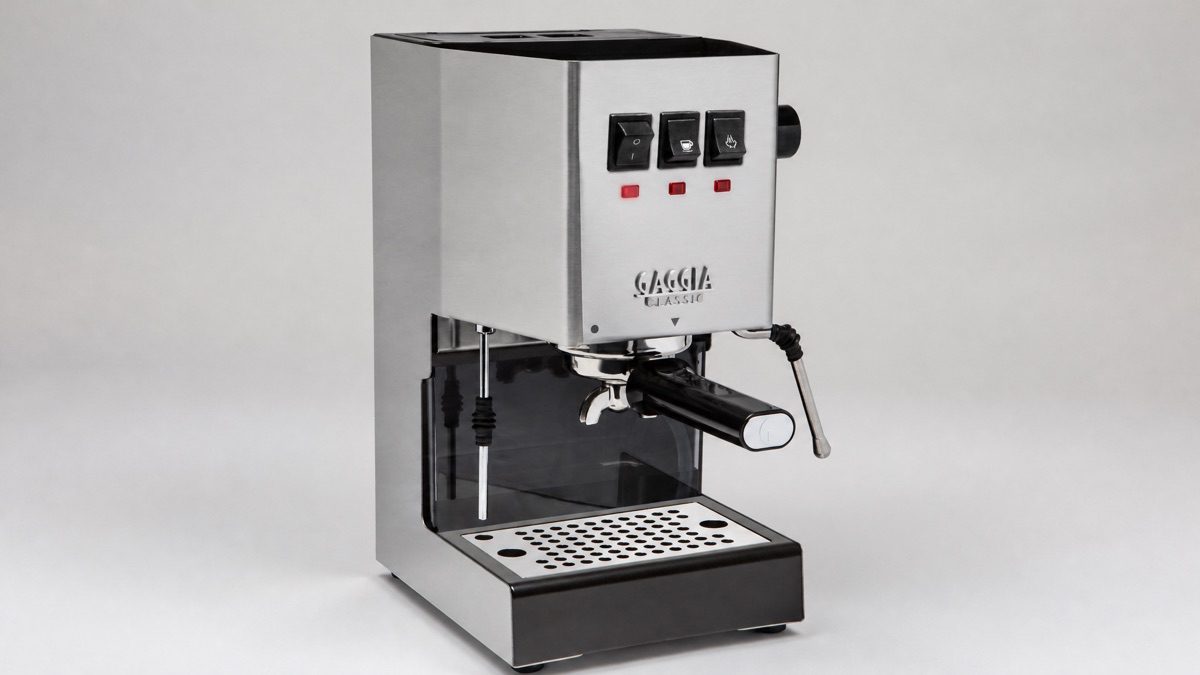
The Gaggia Classic Pro E24 performs well for a $549 single-boiler machine, with stable brew temperature and strong steam. The brass boiler holds heat better than the aluminum boiler it replaced. Testers pulled shots with thick crema and notes of honey, almond and light chocolate.
The E24 uses a lead-free brass boiler that holds 3.5 oz (104 ml), a 58 mm stainless steel portafilter and a 15 bar Ulka pump. An overpressure valve limits brew pressure to 9 bar. The machine draws 1425 W at 120 V.
Three rocker switches control power, brewing and steam. The machine measures 14.2 x 8 x 9.5 in (36 x 20 x 24 cm) and weighs 19 lb (8.6 kg). A 72 oz (2.1 L) reservoir feeds the boiler.
Shots can need work at first. A 20 g to 22 g dose and a finer grind produced full-bodied shots on the earlier Classic Pro, though they ran a little hot. The plastic tamper in the box is flimsy, so a steel tamper helps.
The E24 has no built-in pre-infusion. Opening the steam knob slightly before pressing the brew switch slows the flow at the group head. Closing the knob after a few seconds starts full extraction.
Does the Gaggia Classic Pro E24 Hold Brew Temperature?
Yes. The Gaggia Classic Pro E24 holds brew temperature within a 3°F (1.7°C) range during an extraction. In-puck readings began at 199.6°F (93.1°C), peaked just above 202°F (94.4°C) and ended at 200°F (93.3°C). The result is strong for a single boiler without a PID.
The older aluminum Evo Pro swung over a 7°F (3.9°C) range, from 202°F (94.4°C) down to 195°F (90.6°C). The Profitec MOVE, a prosumer dual boiler, holds a 2°F (1.1°C) range. The brass boiler closes much of that gap.
Brew Temperature Range:
| Machine | Range |
|---|---|
| Profitec MOVE (dual boiler) | 2°F (1.1°C) |
| Gaggia Classic Pro E24 | 3°F (1.7°C) |
| Gaggia Evo Pro (aluminum) | 7°F (3.9°C) |
The brass boiler weighs 1,349.80 g (47.6 oz), against 506.81 g (17.9 oz) for the aluminum one. The extra mass loses heat more slowly. In a 300-second test the brass boiler switched its heater on four times, and the aluminum boiler seven.
Boiler cycles still matter. The brew light goes out while the boiler reheats, and a shot pulled then can taste slightly sour and lukewarm. Waiting for the light avoids the problem.
The E24 reached the brew-ready light in 90.5 seconds, against 71.3 seconds for the Evo Pro. A warm-up of about 10 minutes heats the group head and portafilter properly.
Can the Gaggia Classic Pro E24 Steam Milk Well?
Yes. The Gaggia Classic Pro E24 steams milk well, with 5 oz (148 ml) reaching 140°F (60°C) in 24 seconds. The milk started at 42°F (5.6°C). The steam-ready light took 60 seconds to come on.
That 60-second wait does not have to be a full wait. Steaming can start before the light comes on. Starting about 25 seconds after power-up keeps the heater running while the milk froths. Gaggia claims 25% more steam power than the aluminum model.
A test timed both the E24 and the Evo Pro at 24 seconds, though the two runs used different start times. The brass boiler adds a slight steam gain on large milk volumes. The difference stays small for one or two drinks.
Speed is only part of the result, because the wand shapes the foam. The commercial-style wand has a two-hole stainless steel tip and an insulated grip. The wand rotates but sits on no ball joint. Gaggia says the microfoam is tight enough for latte art.
The machine has one boiler, so it cannot brew and steam at once. After steaming, run hot water through the group head into a cup to cool the boiler. Skipping that purge scalds the next shot.
This one-boiler workflow limits how many drinks the machine can serve. A household of two copes well with it. Four to six drinkers drain the 72 oz (2.1 L) reservoir and wait on one boiler.
What Changed Across Gaggia Classic Models?
Gaggia Classic models changed most in boiler material, controls and brew pressure since 2015. The 2019 Classic Pro marked the recovery after a weak period. The E24 and the UP are the current versions.
The 2015 Classic dropped the three-way solenoid valve, and production moved out of Italy. The 2019 Classic Pro restored the solenoid, Italian assembly and a commercial steam wand. Buttons returned to traditional rockers.
The 2023 Classic Pro Evo added a solid brass group, a stainless steel portafilter and a stainless dispersion plate. North American units shipped with a 9 bar overpressure valve. The aluminum boiler received a non-stick coating.
The Classic Pro E24 swaps in a lead-free brass boiler with about 30% more capacity. The rest of the machine matches the Evo Pro. Gaggia lists the E24 at $549.
The Classic UP keeps a 3.35 oz (99 ml) brass boiler and adds a PID, a color screen, a pressure gauge and three pre-infusion cycles. Gaggia fits a 9 bar overpressure valve at the factory. A ball joint lets the steam wand move freely.
Classic Versions:
| Version | Key Change |
|---|---|
| 2015 Classic | Dropped the three-way solenoid valve |
| 2019 Classic Pro | Solenoid, Italian assembly and commercial wand returned |
| 2023 Classic Pro Evo | Brass group, stainless portafilter, coated aluminum boiler |
| Classic Pro E24 | Lead-free brass boiler |
| Classic UP | PID, color screen, pressure gauge, pre-infusion |
Why Did Gaggia Move the Classic to a Brass Boiler?
Gaggia moved the Classic to a brass boiler after the coating on its aluminum boiler flaked in some units. Many home baristas had also disliked aluminum for years. Brass answered both problems.
Brass has better thermal properties than aluminum, so the boiler wall can be thinner. Capacity rose by about 30%. The extra volume gives a slight steam gain on large milk volumes.
Whole Latte Love measured the brass boiler at 3.68 oz (109 ml), against 2.5 oz (74 ml) for the aluminum one. A larger boiler means a refill is a smaller share of the water inside. Each ounce of reservoir water makes up 27% of the brass boiler volume, against 40% before. A refill cools the boiler less.
The change reaches beyond the boiler. A lead-free CW510L brass group replaced the chrome-plated brass group. A solid stainless steel portafilter replaced the chromed brass one.
Evo Pro owners gain little by upgrading to the E24. Buyers who are choosing a first machine get the brass boiler as a standard feature.
Is the Gaggia Classic GT Worth the Extra Money?
Yes. The Gaggia Classic GT is worth the extra money for buyers who want a dual boiler at $1,699. The GT is Gaggia's first dual-boiler machine. The price is about three times the E24.
A dual boiler has one boiler for brewing and one for steam. The brew boiler is brass and holds 3.4 oz (100 ml). The steam boiler is stainless steel and holds 30.4 oz (899 ml). A flat white takes about 20 seconds of steaming.
Each boiler needs its own temperature control. Dual PID controllers, which are digital controllers that hold a set temperature, handle this. They set brew temperature in 1° steps and offer four steam temperatures. Gaggia quotes a five-minute heat-up.
Control over the shot itself comes next. Pre-infusion, a gentle early soak of the coffee, runs automatically or by hand at 3 g per second. Volumetric shot programming stops each shot at a set amount of liquid. A brew pressure gauge shows the pressure in use. An externally adjustable overpressure valve lets the user change the pressure limit.
These features take space and weight. The GT weighs 39 lb (17.7 kg) and measures 16.7 x 10.2 x 16.5 in (42 x 26 x 42 cm). The reservoir holds 67.6 oz (2 L) and the drip tray holds 24 oz (710 ml). A 2.4 in (6 cm) color screen holds the menus.
The GT serves a different market than the Classic. The E24 buyer and the GT buyer rarely overlap.
What Problems Do Gaggia Espresso Machines Have?
Gaggia espresso machines have recurring problems in workflow, accessories and a few model-specific parts. None of the problems is a deal breaker for the right buyer. Each one has a known fix.
The Classic Pro single boiler cannot brew and steam together. Switching between the two needs a boiler purge.
The box also holds a plastic tamper and scoop. The tamper and scoop feel cheap. A stainless tamper replaces the plastic one.
The 2019 Classic Pro ships with a fixed overpressure valve set near 13 to 14 bars. A low-cost aftermarket kit fits in minutes and sets the valve to 9 or 6 bars. North American E24 units already ship at 9 bar.
Daily handling brings other complaints. The water tank is awkward to remove, so owners fill it from the top. The steam wand feels flimsy and has no ball joint. The machine is also heavy at about 20 lb (9 kg).
Service is easy. Gaggia builds the Classic like a commercial machine from mostly standard parts, and those parts are simple to source. An owner or an engineer can repair most faults. Daily use calls for descaling about every two months with Gaggia's own descaler.
What Was the Gaggia Evo Pro Boiler Coating Problem?
The Gaggia Evo Pro coating problem was a non-stick boiler coating that flaked into the coffee in some 2023 units. Owners found flakes in their cups. Social media reacted loudly.
Gaggia had added the coating to the 2023 Evo Pro to prevent galvanic corrosion. This is damage that happens when two different metals touch, here the aluminum boiler and the brass group. Some coatings failed to bond to the boiler. The flakes then came off the boiler wall and ended up in the coffee.
Faulty boilers stayed in the single digits as a share of units. The model sold in large numbers, though, so many machines were still affected.
Owners can test a machine by running water through the steam wand with the tip removed. Flakes in the water mean the boiler is faulty. Gaggia Direct, the maker's UK store, repairs affected machines.
Gaggia dropped the coating on 2024 units and went back to bare aluminum. Experts later found the corrosion worry unfounded. The E24 brass boiler ended the question for new buyers.
Is the Gaggia Brera Reliable?
No. The Gaggia Brera is not known as a reliable machine, and long-term complaints are common at its price. Opinions split sharply. Seals on the drainage valve are the usual weak point.
Some buyers saw persistent errors within the first weeks and returned the machine. Others bought one and stayed happy for months. The machine feels cheap to some owners and solid to others.
Weak, watery espresso is the top complaint. The usual cause is perished seals on the drainage valve below the brew unit. When the seals fail, water bypasses the coffee and runs into the drip tray. Replacement seals are cheap.
Gaggia, Saeco and Philips are the same company, and their machines share internals. Because of this, drainage valve seals are a normal wear item across that family. Rinsing the removable brew group under the tap regularly prevents many flavor complaints.
The Brera carries a one-year warranty. Buying from a specialist coffee retailer helps, because those shops stock the parts.
Do Gaggia Super-Automatic Machines Make Good Espresso?
Yes. Gaggia super-automatic machines make good espresso for their price, though a semi-automatic with a quality grinder makes stronger shots. Milk drinks are a stronger suit than straight espresso. Ceramic burr grinders are standard.
Ceramic burr grinders run cool, which helps keep aroma in the beans. The Cadorna Prestige offers 10 grind settings, and a tool on the scoop adjusts them. Adjusting is slightly awkward.
Home Coffee Expert rates espresso quality from 7.5 out of 10 for the Brera to 9 out of 10 for the Magenta Prestige. The Anima Prestige and the Cadorna Prestige each score 8.
The Cadorna Prestige makes 12 specialty drinks and saves four user profiles. It has a color TFT display, an integrated milk carafe and a 10.6 oz (300 g) hopper. The reservoir holds 50.7 fl oz (1.5 L), and the price runs near $1,050 to $1,100.
The Magenta Prestige offers 10 drinks and a removable milk carafe, and it runs quite loud. Testers set the dose to maximum and the grinder to the finest setting to get good shots.
Is the Gaggia Brera Worth $499?
Yes. The Gaggia Brera is worth $499 as a compact entry super-automatic for black coffee and Americanos. The Brera is not the pick for latte art. The reliability record argues for a specialist retailer.
The $499 price buys a machine that grinds, brews and froths:
- Grinder: A ceramic flat burr grinder offers 5 grind settings and 3 strength settings.
- Bean hopper: The hopper holds 8.8 oz (250 g).
- Water reservoir: The reservoir holds 1.2 L (40 oz).
- Milk wand: A pannarello wand froths milk.
- Bypass doser: This slot takes pre-ground coffee.
The machine is 10 in (25 cm) wide and weighs 18 lb (8.2 kg). The water tank and dreg drawer load from the front, so the Brera fits under cabinets. A brushed stainless steel panel covers the front.
The grinder caps the strength of each shot. Aiming for a 1:3 ratio instead of 1:2 suits the Brera better. The De'Longhi Magnifica Evo makes a stronger cup at similar money because its brew group holds a larger dose.
A Breville Bambino Plus paired with a separate grinder takes more work but makes a better cup. The Brera wins on convenience. The Bambino Plus wins on flavor.
How Do Gaggia Espresso Machines Compare With Rivals?
Gaggia espresso machines compare well on build quality and serviceability but trail rivals on convenience features. Rivals add PIDs, pre-infusion and volumetric control for less money. Gaggia adds standard parts and a long repair record.
The Classic Pro E24 offers a 58 mm portafilter, a three-way solenoid valve and a brass boiler. The Breville Bambino Plus lists near $500 and offers a 54 mm portafilter, a PID and pre-infusion. Its ThermoJet heater reaches extraction temperature in about 3 seconds.
Imported machines such as the Mii Coffee Apex V2 and Turin Legato V2 cost slightly less than the Classic. They add an adjustable PID, pre-infusion, a pressure gauge and an adjustable overpressure valve. They carry little or no real warranty and need DIY service.
The Lelit Anna PID has an adjustable PID, a pressure gauge, a brass boiler and a three-way solenoid valve. The Lelit portafilter measures 57 mm, an odd size that limits accessory choice. The Classic keeps the standard 58 mm size.
Rival Comparison:
| Machine | Portafilter | PID |
|---|---|---|
| Gaggia Classic Pro E24 | 58 mm | No |
| Breville Bambino Plus | 54 mm | Yes |
| Lelit Anna PID | 57 mm | Yes |
Among super-automatics the Brera trails the De'Longhi Magnifica Evo on cup strength at the same price. The De'Longhi wins on brew dose. The Brera wins on footprint, front-access tank and bypass doser.
Is the Gaggia Classic Pro Better Than the Breville Bambino Plus?
Yes. The Gaggia Classic Pro is better than the Breville Bambino Plus for buyers who want to learn and repair. The Bambino Plus is better for buyers who want convenience. The two machines suit different people.
The Classic suits anyone who wants to master an old-school machine and modify it. Its parts are standard, and the machine can run for decades. Used units also hold their value.
The Bambino Plus wins for convenience because it handles the hard parts of a shot automatically. A PID, which holds the water at a steady temperature, comes standard, along with pre-infusion. Volumetric shot control stops the shot at a set volume. The machine also heats up fast.
The Gaggia asks for more work from the user. It needs a boiler purge. It also needs a wait between milk and shots. The Bambino Plus skips these steps.
Both machines need an espresso-capable grinder for fresh beans. The Baratza Encore ESP and Breville's Smart Grinder Pro, sold as Sage in the UK, are the minimum picks.
How Much Does a Gaggia Espresso Machine Cost?
A Gaggia espresso machine costs from about $250 for the Espresso to about $2,000 for the Accademia. The Classic Pro E24 sits near the middle at $549. The price ladder follows automation.
The Espresso Evolution lists at $299.99 on Gaggia's own site and at $249 at Whole Latte Love. The line runs about $250 to $300. The Brera costs $499 and the Classic Pro E24 costs $549. The Anima sits near $699 and the Magenta Plus near $749.
Higher up, the Cadorna Barista Plus costs near $899 and the Cadorna Prestige near $1,050. The Classic GT costs $1,699. The Accademia costs about $2,000.
Gaggia Price Ladder:
| Model | Price |
|---|---|
| Espresso Evolution | $299.99 |
| Brera | $499 |
| Classic Pro E24 | $549 |
| Cadorna Prestige | About $1,050 |
| Classic GT | $1,699 |
| Accademia | About $2,000 |
The true cost of an E24 setup is higher than $549. A semi-automatic machine needs a separate espresso grinder, a steel tamper and a scale. The Baratza Encore ESP is the minimum grinder pick.
Parts cost little. Gaggia lists a descaler at $9.00, a group gasket at $9.95, three 2-way pins at $9.99 and a chrome double-spout portafilter at $52.92. The Brera Mavea Intenza filter costs $12.99, and its brew group service kit costs $14.99.
Is the Gaggia Espresso a Good Budget Machine?
Yes. The Gaggia Espresso is a good budget machine with a PID and a standard portafilter at about $250. The Espresso is made in Italy. Most machines at this price are not.
A 1900 W stainless steel thermoblock heats in about 25 to 30 seconds. A thermoblock is a metal block that heats water as it flows through. It heats water on demand, so steam power stays constant and does not run out the way a small boiler can. The side-access tank holds 40.5 oz (1.2 L).
Steam is used to texture milk, and the wand shapes how well that works. A panarello wand sits over a bare steam pipe with a single-hole tip. A panarello wand is a plastic sleeve that mixes air into the milk for easy foam. Pulling it off exposes the pipe and allows real microfoam, which is fine, smooth milk foam. Learning this takes practice.
The machine has no three-way solenoid and no 9 bar overpressure valve. A three-way solenoid releases pressure after a shot, and an overpressure valve caps the pump pressure at 9 bar. Without them, water sprays hard onto the puck, and pucks come out soggy. The puck is the packed coffee left in the basket. A 53 mm puck screen or a paper filter softens the spray.
The De'Longhi Dedica is the closest rival. The Espresso offers 1900 W against 1300 W, a PID, and a standard portafilter in place of a pressurized one. A PID is a controller that keeps water temperature steady.
Is a Gaggia Espresso Machine Worth It?
Yes. A Gaggia espresso machine is worth it for buyers who value build quality, repairability and a home barista workflow. Buyers who want maximum features per dollar find better value elsewhere. The answer depends on the model.
The Classic Pro E24 gives commercial-grade parts for $549. Brew temperature stability is strong for a single boiler, and parts are standard and easy to find.
The super-automatics are a mixed case. The Cadorna and Magenta lines earn good scores for milk drinks. The Brera carries reliability complaints.
The Classic GT suits buyers who want a dual boiler under $1,700 and accept a 39 lb (17.7 kg) machine.
Performance-first buyers can find imported machines with more features for less. Those machines give up warranty and parts support. Gaggia sells build quality and serviceability.
Who Should Skip a Gaggia Espresso Machine?
Households of four to six drinkers, pod fans and anyone who dislikes tinkering should skip a Gaggia Classic espresso machine. The Classic rewards patience. Other machines reward convenience.
Skip If:
- The household has four to six coffee drinkers
- Pods or one-touch drinks are the goal
- Strong straight espresso from a super-automatic is the goal
- A learning curve is unwelcome
Four to six drinkers drain the 72 oz (2.1 L) reservoir quickly. One boiler then makes everyone wait between shots and steam.
Pod fans and one-touch fans are better served by a super-automatic or a Breville with a PID and fast heat-up.
Anyone who wants strong straight espresso from a super-automatic should avoid the Brera. The Brera grinder limits how fine the grind goes.
The Classic needs a separate grinder, a real tamper and practice. Buyers who dislike a learning curve will find the machine frustrating.
The Coffee Experiment is a reader-supported platform. Purchases made through our links may earn us an affiliate commission at no extra cost to you.