
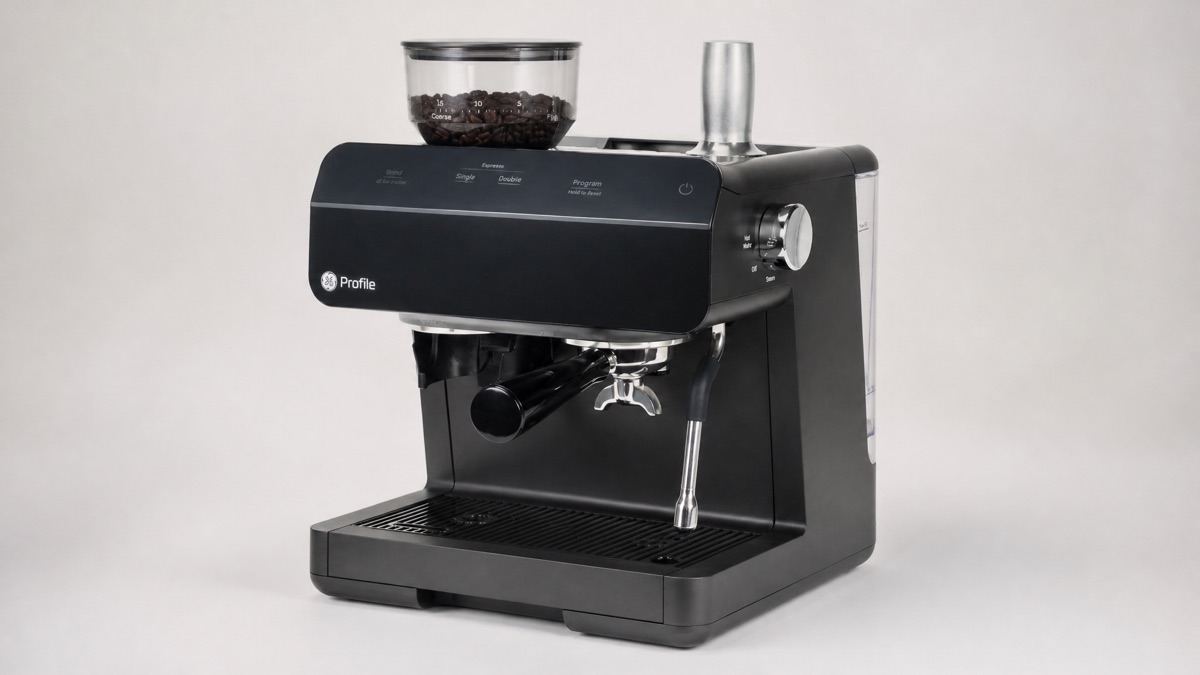
Hello, coffee friends, Mark here. I have followed GE through 12 years of café work. The GE Profile espresso machine is a home espresso maker from GE Appliances. It has a built-in conical burr grinder and SmartHQ WiFi. GE sells a semi-automatic P7CESAS6RBB with a 58 mm portafilter and an automatic P7CEBBS6RBB that brews with one button.
The automatic grinds, brews and ejects the puck after one press. The semi-automatic leaves tamping to the user. Pump ratings of 15 and 20 bar are maximums, so shots depend on grind, dose and beans. The Clearly Coffee review praises the espresso but dislikes the LED-only display.
Prices run from $464 to $649 for the automatic and $599 for the discontinued semi-automatic, with sales far lower. The verdict is yes near $300 to $470. Read on for grinders, cleaning, the GE Cafe comparison, warranty and who should skip it. Here I cover the grinder, descaling and the GE Cafe comparison from my own use. My verdict is not for sale.
What Is the GE Profile Espresso Machine?
The GE Profile espresso machine is a countertop espresso maker from GE Appliances with a built-in conical burr grinder, a frother and WiFi control through the SmartHQ app. GE sells it in semi-automatic and automatic versions.
The maker behind it is GE Appliances, a Haier company based in Louisville, Kentucky. Haier closed its purchase of the appliance business from General Electric in June 2016.
GE's manual limits both machines to household use. The target buyer wants a grinder, boiler and steam wand in one body.
The two versions differ in how much work the user does. The semi-automatic P7CESAS6RBB uses a 58 mm portafilter and manual tamping. The automatic P7CEBBS6RBB grinds, brews and ejects the puck after one button press.
Pump pressure also differs by version. The semi-automatic lists a 15 bar pump. The automatic lists 20 bar with a low-pressure pre-infusion step.
Those pump ratings are maximums, not brew pressure. Most home machines hold about 9 bar at the coffee, so 15 and 20 bar do not mean stronger shots on their own.
Both versions take whole beans only. The automatic manual forbids pre-ground coffee in the bean container, and the machine does not use capsules.
Which GE Profile Espresso Models Exist?
Three GE Profile espresso models exist: the semi-automatic P7CESAS6RBB, the automatic P7CEBBS6RBB with a steam wand, and the automatic P7CEBAS6RBB without one. All three carry SmartHQ WiFi and a one year limited warranty.
The semi-automatic P7CESAS6RBB lists 15 grind settings, a water tank of about 95 oz (2.8 L) and 1300 W. It weighs about 15 lb (6.8 kg). Its bean hopper holds about 275 g (9.7 oz), and its heater is a 1300 W aluminum block boiler. GE's page shows $599.00 and marks the model as no longer manufactured.
The automatic P7CEBBS6RBB lists five grind levels, a 40.5 oz (1.2 L) tank and 1470 W. It heats water with a thermoblock, which is a flow-through heater. Its hopper holds about 184 g (6.5 oz). Its listed size is about 13.3 x 7.2 x 16.3 in (33.8 x 18.3 x 41.4 cm). Retailer prices for the P7CEBBS6RBB run from about $464 to $649.
The P7CEBAS6RBB drops the steam wand and the milk pitcher. Hot water comes from the spout instead. Only this model has a Lungo button.
GE Profile Espresso Models:
| Model | Type | Grind Settings | Steam Wand | Lungo Button |
|---|---|---|---|---|
| P7CESAS6RBB | Semi-automatic | 15 | Yes | No |
| P7CEBBS6RBB | Automatic | 5 | Yes | No |
| P7CEBAS6RBB | Automatic | 5 | No | Yes |
How Does the GE Profile Espresso Machine Work?
The GE Profile espresso machine works by grinding fresh beans, heating water and pushing it through the coffee at 15 or 20 bar. The automatic model does every step after one button press.
On the automatic model, pressing Espresso starts the grinder, then the brew, and the used puck drops into an internal waste box. The Americano button adds hot water through the same spout.
The semi-automatic model leaves more of the work to the user. The user presses Grind, taps and tamps the portafilter, then locks it into the group head. A press of Single or Double starts the shot.
Pressure shapes how each shot starts. Pre-infusion wets the grounds at low pressure before the full pump push. The step helps the water flow evenly through the coffee. The 20 bar automatic starts at low pressure before the ramp. The semi-automatic lists pre-infusion and a gradual pressure ramp as well.
The semi-automatic makes espresso in single and double sizes, plus hot water and steam. The P7CEBBS6RBB adds Americano, My Brew and Steam buttons, and My Brew defaults to a ristretto.
The SmartHQ app changes settings the buttons cannot reach. Examples are the My Brew volume, brew temperature and descale alert frequency.
Descaling removes mineral buildup from hard water. The water hardness strip in the box sets how often the descale alert appears. First power-up runs a rinse cycle, and the machine rinses again whenever it powers on from cold.
Milk frothing stays manual on every model. The user holds the pitcher, and no model froths automatically.
How Does the GE Profile Grinder Work?
The GE Profile grinder works as a stainless steel conical burr set that sits above the brew path. The semi-automatic feeds a portafilter and the automatic feeds the brew chamber.
The two models differ in how they decide the dose. The semi-automatic dispenses by time. One press of Grind makes a single dose of about 13-15 g (0.5 oz). Two quick presses make a double of about 18-20 g (0.7 oz).
The automatic controls grind size instead. A knob on the bean container offers five grind sizes. The knob turns while the grinder runs, and the smallest circle gives the finest grind.
Finer settings exist because the burrs wear down. The manual says the grinder dulls with use, so a finer setting makes up for the loss.
How Does the GE Profile Steam Wand Work?
The GE Profile steam wand heats and froths milk with steam from the machine's own water heater. The semi-automatic selects it with a control knob. The automatic selects it with a Steam button.
The semi-automatic knob has Steam, Hot Water and neutral positions, each with an indicator light. The wand swivels, and hot water also exits through it.
Among the automatics, only the P7CEBBS6RBB has a wand. The wand purges a little water while the steam preheats, so the milk waits until the purge ends.
Once steam is ready, the manual sets the wand tip just under the milk surface. The angle should be about 45 degrees. The pitcher stays at most half full, because milk grows in volume as it froths and could overflow.
Order matters between steaming and brewing. Espresso brews before steaming. Steam needs a higher temperature than brewing, and a shot pulled right after steaming changes in taste. The wand gets purged after every use.
Does the GE Profile Espresso Machine Make Good Espresso?
Yes. The GE Profile espresso machine makes good espresso on the evidence of one long-term review, though no independent shot data exists. That Clearly Coffee reviewer used the automatic daily for months as a decaf machine.
The Clearly Coffee reviewer called the results great espresso and Americanos. Shots from the semi-automatic can read as solid, not great.
The manual targets a 20-40 second shot and a ratio of 1:2. An example is 18 g (0.6 oz) of coffee for 36 g (1.3 oz) of espresso.
Double-layer filters give more consistent results and generally more crema. Single-layer filters react more to grind size and bean type but allow more adjustment.
The manual advises preheating the cup with the Hot Water button. Espresso has a small volume and cools quickly in a cold cup.
Dose and ratio set the taste. On the semi-automatic, the grinder times each dose, so weighing the grounds on a scale keeps shots repeatable.
Sour shots call for a finer grind or more water volume. Bitter shots call for a coarser grind or less water volume. The manual says to change one variable at a time.
Does the GE Profile Grind Fine Enough for Espresso?
Yes. The GE Profile grinder grinds fine enough for espresso, but the automatic offers only five size levels. The semi-automatic offers 15 settings.
The semi-automatic warns that a grind set too fine causes overpressure. All function buttons flash white, and the fix is a coarser grind, a smaller dose or a lighter tamp.
The automatic jumps in larger steps. The manual says to start at a medium setting and change the size a little at a time.
The manual links symptoms to fixes. Slow flow means grounds that are too fine. A shot with no crema means grounds that are too coarse or beans that are not fresh.
The Coffeeness review lists the small number of grind settings among the cons of the semi-automatic.
What Do GE Profile Espresso Machine Owners Complain About?
GE Profile espresso machine owners complain mostly about the LED-only display, hidden parts and thin reliability evidence. The coffee itself draws praise.
The display uses colored lights instead of a screen. The Clearly Coffee review calls the learning curve steep, and the manual has a full table of light colors.
Hidden parts add to this problem. The bean hopper sits under a panel. The black water tank sits at the back. Neither level is visible without lifting a part.
Upkeep also takes steady effort. The automatic needs its waste box and pucks emptied about every 8 cups. The drip tray and disposal box need regular washing.
Reliability is harder to judge. The evidence base is small. It rests on the Clearly Coffee review, scattered retailer comments and the manuals, so no complaint has a failure rate.
The few failure reports show why. A semi-automatic can need a warranty replacement within a year. A grinder can clog slightly after about 1.5 years. Both are single reports.
Is the GE Profile Display Hard to Read?
Yes. The GE Profile display is hard to read because the machine has no screen and shows status only through colored LED lights.
The colors carry the meaning, so a new owner has to learn which color stands for which state. Blue is add water, yellow is add or stir beans, orange is empty waste and red is check brew unit.
LED Colors:
| Light | Meaning |
|---|---|
| Blue | Add water |
| Yellow | Add or stir beans |
| Orange | Empty waste |
| Red | Check brew unit |
| Rotating red | Heating |
| Magenta | Brew in progress |
Rotating red means heating and magenta means a brew is in progress. The Clearly Coffee reviewer compared these lights with a Krups screen that spells out each state in words.
Some alerts do appear as words on top of the machine. Empty Waste, Add Water and Descale all show that way.
Does the GE Profile Descale Light Stay On?
No. The GE Profile descale light turns off after a completed descale cycle, though the Clearly Coffee reviewer's light never cleared. That machine was over a year old.
The manual states that a descale that is not finished properly can time out. The unit then returns to idle, and the user runs the descale again.
The semi-automatic can snooze the alert. Holding Program and Double together for 3 seconds does that.
The stuck light is a single report on one automatic machine. The research turned up no wider pattern.
How Do You Clean and Descale the GE Profile Espresso Machine?
The GE Profile espresso machine needs a monthly descale, a hand wash of the tank and trays, and a weekly grinder clean. The automatic manual sets descaling to once a month or more, depending on water hardness.
Skipped descaling causes trouble. The manual lists skipped descaling as a cause of cooler coffee and slow flow. Heavy scale can also fill the internal drip tray with water.
Descaling runs in two stages. The semi-automatic cycle takes about 30 minutes. The supplied cleaning solution or a 1:1 mix of white vinegar and water both work. Only cleaning agents from GE or the manual belong in the machine, and white vinegar is the one named alternative.
Before descaling, fill the tank, empty the drip tray and set a large container under the spout. Cold water only goes into the tank.
Daily care is simple. Wash the water tank and drip tray by hand and wipe the body with a microfiber cloth. No part goes in the dishwasher.
Care Schedule:
| Part | Frequency | Method |
|---|---|---|
| Water tank and drip tray | Daily | Hand wash |
| Waste box (automatic) | About every 8 cups | Empty and wash |
| Grinder | Weekly | Brushes |
| Descale | Monthly or by water hardness | Cleaning solution or white vinegar mix |
The machine must cool and be unplugged before parts come off.
On the semi-automatic, rinse the portafilter and filters after every shot and let them air dry. The steam wand tip unscrews, and a cleaning pin clears blocked holes.
The automatic has a removable brew unit behind a side door. Pinch both orange tabs, lift it out, wash it in warm water and air dry it fully.
Before a long break, run System Empty, dry the tank and leave the lid open.
How Often Should You Clean the GE Profile Grinder?
The GE Profile grinder needs cleaning at least once a week. The manual sets that schedule. Brushes and a cup under the chute are the only tools needed.
On the semi-automatic, the user removes the bean hopper and rotates the outer burr to unlock it. The brushes then clear grounds from the top to the bottom of the chute.
Steps:
- Remove the bean hopper from the machine.
- Rotate the outer burr to unlock it and pull it out.
- Brush the grounds out from the top to the bottom of the chute.
The manual forbids fingers inside the grinder. Only the supplied brushes touch the grounds.
Bean choice affects cleaning too. The automatic manual advises against oily beans, because oil coats internal parts and may shorten the machine's life.
GE Profile Espresso Machine vs GE Cafe: Which Is Better?
The GE Profile espresso machine compares closely with the GE Cafe models, so the better pick depends on semi-automatic or automatic control. GE sells both lines.
A semi-automatic machine leaves the steps of the shot to the user. An automatic machine handles them with one button.
The Profile semi-automatic lists 15 bar, a 58 mm portafilter and 15 grind settings at $599. The portafilter is the handle that holds the ground coffee. The Cafe Bellissimo is also semi-automatic. It lists a 58 mm portafilter, 15 grind settings and no pre-infusion function at $579.
The Cafe Affetto is a compact automatic with a thermoblock heater and five grind levels. A listing shows $629.
Profile vs Cafe:
| Machine | Type | Grind Settings | List Price |
|---|---|---|---|
| GE Profile P7CESAS6RBB | Semi-automatic | 15 | $599 |
| GE Cafe Bellissimo | Semi-automatic | 15 | $579 |
| GE Cafe Affetto | Automatic | 5 | $629 |
Model numbers help a buyer find the right color and version. The Cafe Affetto in matte white carries model number C7CEBBS4RW3. The Cafe Bellissimo in matte white carries C7CESAS4RW3. The GE Cafe review covers both in detail.
The Breville Barista Express is the common rival for the semi-automatic. Its list price is $699.95, with a 54 mm portafilter and 16 grind settings.
Manual control points to the semi-automatic models. One-button convenience points to the automatic models.
Is the GE Profile the Same as the GE Cafe Affetto?
No. The GE Profile is not confirmed to be the same machine as the GE Cafe Affetto. Shoppers claim the two share hardware, but no source verifies it.
The claim comes from what the listings share. Both automatics list five grind levels and pre-infusion, which wets the grounds before the full shot. Shoppers read that overlap as proof of one machine.
The Profile automatic lists a 20 bar pump and, on one model, a steam wand. The Affetto lists a thermoblock and five automatic functions.
Heaters differ in listings. The Affetto uses a single 1,470 W thermoblock. The Bellissimo uses an aluminum block boiler with a copper coil, like the Profile semi-automatic.
Because the overlap is real but the differences are too, the safe reading is that the two are close relatives. Compare the exact model numbers and prices before buying either one.
How Much Does the GE Profile Espresso Machine Cost?
The GE Profile espresso machine costs $599.00 for the semi-automatic on GE's own page and about $464 to $649 for the automatic. Sale prices run far lower.
GE marks the semi-automatic as clearance and no longer manufactured. A deal thread lists the same model at $299.
The automatic also sells below its usual range at times. It appeared at $269.95 in one deal. Stock levels vary, and at least one listing showed it as backordered.
GE Profile Prices Seen:
| Model | Price | Where Seen |
|---|---|---|
| P7CESAS6RBB | $599.00 | GE's product page |
| P7CESAS6RBB | $299 | Deal thread |
| Automatic models | $464 to $649 | Retailer listings |
| Automatic | $269.95 | One deal |
Size and weight differ between the two models, and so does the space each needs. The semi-automatic measures 16.1 x 13.7 x 12.70 in (40.9 x 34.8 x 32.3 cm). The automatic measures about 13.3 x 7.2 x 16.3 in (33.8 x 18.3 x 41.4 cm).
The semi-automatic weighs about 15 lb (6.8 kg). Its tank holds about 95 oz (2.8 L), against 40.5 oz (1.2 L) on the automatic.
The box includes a milk pitcher, a cleaning kit and a water hardness strip. The semi-automatic adds a tamper.
What Does the GE Profile Warranty Cover?
The GE Profile warranty covers one year from the purchase date against defects in materials or workmanship. GE repairs or replaces the machine during that term.
The coverage is a limited warranty, so it does not protect against every problem. The manual also limits implied warranties to one year or the shortest period the law allows.
A buyer who wants protection past that first year has one more choice. One retailer deal offers an added one or two year plan at purchase. That plan is a separate product from the GE warranty.
Repairs also depend on parts, and one model has a problem there. GE marks the semi-automatic as no longer manufactured. Buyers of that model should confirm parts availability before relying on repairs.
Is the GE Profile Espresso Machine Worth It?
Yes. The GE Profile espresso machine is worth it at a sale price near $300 to $470, and hard to justify at $599 or $649.
The strengths are real. Grinder, frother and app share one body, daily use is simple and the Clearly Coffee reviewer rates the espresso highly.
The weaknesses are just as real. The display relies on LEDs, the tank and hopper hide, and the grinder offers few steps.
Pros:
- Grinder, frother and app in one body
- Simple daily use on the automatic
- Good espresso in the Clearly Coffee review
Cons:
- LED-only display
- Hidden tank and hopper
- Few grind steps on the automatic
- One year warranty
Rivals set the price bar. The Breville Barista Express lists at $699.95. The Breville Bambino Plus lists at $499.95 and the De'Longhi Dedica Style at $279.95, but both need a separate grinder.
At $599, the semi-automatic undercuts the Barista Express list price by $100.95. At $299, it is the stronger buy.
No independent timed shots or brew temperature data were found. The verdict rests on manuals, listings and a few owner reports.
Who Should Skip the GE Profile?
Buyers who want exact control should skip the GE Profile and look at machines with finer grind steps and a pressure gauge. The automatic has only five grind levels.
Anyone who wants on-screen messages will dislike the LED display. The Krups comparison in the Clearly Coffee review shows the gap.
Fans of dark, oily beans face a limit. The automatic manual advises against them.
Buyers who want long coverage get only one year. A discontinued semi-automatic adds parts risk.
The Coffee Experiment is a reader-supported platform. Purchases made through our links may earn us an affiliate commission at no extra cost to you.