
Welcome to another semi-automatic espresso machines review, I'm Mark. I worked a café counter near the Louvre for five years, serving the noisette.
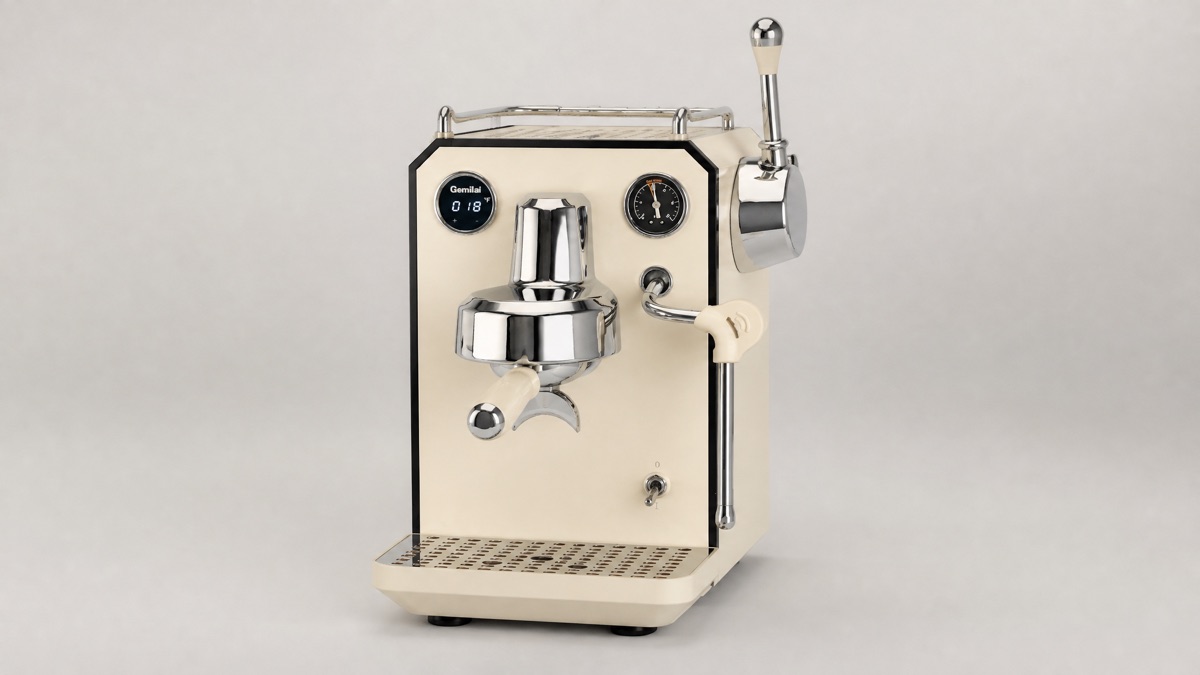
The Gemilai espresso machine is a semi-automatic home espresso maker built in China. The Owl G3006 leads the range at $359.99 with a 58 mm portafilter, PID control and a heated group head. Four home models run from $299.99 to $759.99: the G3005E, the Owl G3006, the G3007L and the Ele G3028A.
The Owl has a real PID but no real pre-infusion. It heats in about a minute and needs five more for the group head. Its espresso comes out full-bodied, and the steam wand is strong. Drawbacks include no water sensor, no volumetric shots and no brewing while steaming. The Breville Bambino Plus and the Gaggia Classic Pro are the main rivals.
A grinder and a scale add about $184-$200 to the price. The Owl suits beginners and hobbyists on a budget. Households that make milk drinks back to back should look at a boiler model. Anyone who wants volumetric shots or a built-in grinder should look elsewhere. The sections below cover specs, heat-up times and a clear verdict.
I unpack heated group head, steam wand and heat-up time. Gemilai had no input on this review.
What Is the Gemilai Espresso Machine?
The Gemilai espresso machine is a semi-automatic home espresso maker with a 58 mm (2.3 in) portafilter and a steam wand. Gemilai also builds commercial machines. The home range has no built-in grinder.
The Gemilai Owl G3006 is the best-known model. Gemilai fits it with a 1500 W thermoblock, a 15 bar pump, PID temperature control and a 57 oz (1.7 L) tank. Amazon lists it at $359.99.
The home range starts with the G3005E at $299.99 and reaches the Ele G3028A at $759.99. Every model asks the owner to dose, tamp and time the shot by hand.
Semi-automatic means the owner doses, tamps and starts the shot. A pump handles the pressure. No pods or capsules fit, and the machine takes ground coffee only.
Buyers who want a 58 mm basket size and manual control on a small budget are the target. The Owl suits a beginner who is ready to learn dial-in.
Where Is the Gemilai Espresso Machine Made?
The Gemilai espresso machine is made in China. Gemilai calls its main operating company a maker founded in 2011. The brand is reported to be well known in Southeast Asia and now sells a small range in North America.
Gemilai built its skills in steps. It launched its first home machine with a commercial 58 mm system in 2012. The first commercial machine followed in 2015, and the first grinders arrived in 2020.
In 2024, Gemilai moved to a 50,000 square meter (538,000 sq ft) factory. The company states a capacity of 400,000 units a year and 176 patents. It also raised its global warranty to two years in 2024.
The same Owl hardware sells in Europe as the Cecotec. The two versions differ in voltage. The European version runs on 220V, while the North American version runs on 120V.
Which Gemilai Espresso Machine Models Can You Buy?
The Gemilai espresso machine range covers four main home models: the G3005E, the Owl G3006, the G3007L and the Ele G3028A. Prices run from $299.99 to $759.99.
The G3005E is the entry model at $299.99. It has a 1500 W heater and a 15 bar pump. Its tank holds 1.7 L (57.5 oz). The body weighs 6.7 kg (14.8 lb) and measures 11.4 x 10 x 12.8 inches (29 x 25.5 x 32.5 cm).
The Owl G3006 is the next model up at $359.99. PID control keeps water temperature steady from 176-215°F (80-102°C). It also has a heated group head, a pressure gauge and a shot timer.
The Owl G3006A adds a cold extraction mode. Gemilai lists it as Hot & Cold Dual Brew, with a two-minute cold brew. The base G3006 has no cold mode.
The G3007L moves up to a 550 ml brew boiler and adjustable pre-infusion. Reviews list it near $499. The Ele G3028A, at $759.99, adds an automatic milk frother and an adjustable over-pressure valve.
Gemilai Home Models:
| Model | Key Feature | Price |
|---|---|---|
| G3005E | 1500 W, 15 bar, 1.7 L (57.5 oz) tank | $299.99 |
| Owl G3006 | PID, heated group head, gauge, timer | $359.99 |
| G3007L | 550 ml brew boiler, adjustable pre-infusion | About $499 |
| Ele G3028A | Brew boiler, automatic milk frother, adjustable OPV | $759.99 |
How Does the Gemilai Espresso Machine Work?
The Gemilai espresso machine works by heating water on demand in a 1500 W thermoblock and pushing it through a heated group head at up to 15 bar. The thermoblock has a stainless steel lining. The Owl is ready to start after about a minute.
A thermoblock is a metal channel that heats water as it flows through. No hot water is stored, so heat-up is fast. The trade-off is that temperature holds less steady than in a boiler.
Silicone tubing carries cold water from the tank to the pump. PTFE tubing then carries hot water from the thermoblock to the solenoids. The polished stainless steel exterior is grounded.
Two heaters sit inside the Owl brew group. They warm the group, the portafilter and the basket. The water then keeps one temperature along its whole path.
The group head looks like an E61 but is not one. Faema introduced the real E61 design in 1961. It circulates hot water through the group by thermosiphon, a passive loop. The Owl group head only copies the look and relies on its two heaters.
The pump is rated at 15 bar, but the shot does not run at that pressure. The over-pressure valve, or OPV, diverts the excess to the drip tray. Extraction pressure lands near 9 bar.
A three-way solenoid releases pressure from the puck after each shot. Gemilai confirms that its machines have a three-way valve. The puck comes out drier and easier to knock out.
Does the Gemilai Espresso Machine Have a Real PID?
Yes. The Gemilai espresso machine has a real PID, with a thermoprobe at the thermoblock exit that feeds the controller. A PID is a controller that reads the water temperature and adjusts the heater to hold the set value. A round display shows the set temperature in real time.
The range runs from 176-215°F (80-102°C). A higher setting suits light roasts. A lower setting suits dark roasts. Because the controller holds whatever value is set, the brew temperature stays easy to adjust.
The probe reads water at the thermoblock exit, not at the puck. Water loses some heat on the way to the cup, so the reading and the coffee's actual temperature differ. Gemilai says the stated temperature is the temperature inside the boiler.
A single thermoblock limits the result. A thermoblock is a metal block that heats water as it flows through. The group head and the steam side need at least 5 minutes of warm-up before temperatures settle. A cold group head cools the first shot.
The Ele G3028A takes a different route with a 550 ml brew boiler instead. Brew Coffee Home measured 194°F (90°C) in the basket through extraction at a 197°F (91°C) setting.
Does the Gemilai Espresso Machine Have Real Pre-Infusion?
No. The Gemilai espresso machine has no real pre-infusion, only a short wet-and-pause step. The step wets the puck for about 2 seconds. The owner then sets a pause.
Two seconds of water does not saturate a puck. One tester turns the feature off for that reason. Shots run fine without it.
Gemilai states that the pre-infusion setting applies only to the single cup and double cup modes. Manual mode skips it. The setting does not carry across modes.
The Owl has no water wheel, so no volumetric shots exist. A volumetric shot stops after a set amount of water. Without that measure, the one cup and two cup buttons run on a timer instead. A shot can run from 10 to 120 seconds.
How Good Is the Gemilai Espresso Machine?
The Gemilai espresso machine makes good espresso for its price, with full-bodied, well-textured shots from the heated group head. A tester who lived with the Owl for 2 months rated its shots above the Bambino Plus.
The manometer marks a red zone at 8-9 bar. The over-pressure valve opens near 11 bar. A well-prepared puck sends the needle to about 9 bar.
A starting recipe uses 15-17 g (0.5-0.6 oz) of coffee in the double basket. The target is 30-34 g (1.1-1.2 oz) of espresso in 25-30 seconds. That makes a 2:1 ratio.
A sour shot means the grind is too coarse or the water too cool. A bitter shot means the grind is too fine or the shot ran long. Change one variable at a time, starting with grind size.
The Owl ships with single-wall baskets, not pressurized ones. A grinder that can dial in a fine grind matters more than the machine. A G3005E tester pulled over 125 shots with no loss in performance.
The Baratza Encore ESP is one grinder that reaches espresso grind sizes. It has 40 mm conical steel burrs and espresso steps from 1 to 20. It costs about $199.95.
How Good Is the Gemilai Espresso Machine Steam Wand?
The Gemilai espresso machine steam wand is good: long, articulating and powerful for its price. The wand gives about 45 seconds to texture milk. That time suits beginners.
A strong wand matters only if it turns milk into something usable. Brew Coffee Home steamed milk in 34 seconds on the G3006. The texture came out smooth and glossy enough for latte art.
The wand shares its heating system with the brew side, and that sets the workflow. Switching from brew to steam takes about 45 seconds to a minute. A 10-second cooling flush then returns the thermoblock to brew temperature. Brewing and steaming cannot run together.
The G3005E has a weaker wand. A tester needed at least 90 seconds to froth 4 oz (120 ml) of cold milk. That is far longer than the G3006 needed. A frothing pitcher helps on both models.
How Does the Gemilai Espresso Machine Compare With Rivals?
The Gemilai espresso machine compares well with rivals on features at $359.99. It offers a 58 mm portafilter, a heated group head, PID control, a gauge and a timer.
The Breville Duo Temp Pro costs $399-$499. It adds PID control, low-pressure pre-infusion and a manual steam wand. The Owl adds the larger basket and the gauge.
The Breville Barista Express adds a built-in conical burr grinder. Amazon listed it near $680, with deals near $500. The Owl needs a separate grinder, so the total costs draw closer.
Dual-boiler machines cost $700-$1,200. The Gemilai G3007L, the Breville Dual Boiler and the Rancilio Silvia Pro X sit in that band. Owl owners often move up when they want milk drinks back to back.
The Ele G3028A uses a brew boiler instead of a thermoblock. Owners pick it for steadier temperature on back-to-back shots. The price rises to $759.99.
The De'Longhi Dedica takes the opposite approach. The slim Dedica series is only 15-16.5 cm (5.9-6.5 in) wide. The Owl is wider but gives far more control over the shot.
Gemilai Espresso Machine vs Breville Bambino Plus?
The Gemilai espresso machine costs less than the Breville Bambino Plus and adds a heated group head, a gauge and a shot timer. The Owl lists at $359.99. The Bambino Plus costs $499.95.
The Bambino Plus heats in about 3 seconds with its ThermoJet. The Owl needs about 1 minute to heat.
The Bambino Plus has a 54 mm portafilter and volumetric dosing. The Owl has the 58 mm basket size.
The Bambino Plus also has an automatic steam wand and better materials. Its tank holds 64.2 oz (1.9 L). The Owl tank holds 57.5 oz (1.7 L). Both machines steam milk well.
Coffeeness judges the Owl the better pick for a serious hobbyist. The Bambino Plus wins on speed and ease.
Gemilai Espresso Machine vs Gaggia Classic Pro?
The Gemilai espresso machine is an easier route to good espresso than the Gaggia Classic Pro, and it costs less. The Classic Pro costs $450.83. It has a 58 mm portafilter and a commercial steam wand.
The Classic Pro is a single boiler machine. Coffeeness reports about half an hour of heat-up. The Owl is ready in minutes. It also has PID control, which holds the water temperature steady, and a gauge.
The Classic Pro has a larger 71 oz (2.1 L) tank. It weighs 18.7 lb (8.5 kg), against 17.1 lb (7.8 kg) for the Owl. Modders prize the Gaggia for its tuning potential.
Both machines carry a two-year warranty and a 15 bar pump rating. Those traits do not separate them. The Gaggia suits the tinkerer. The Owl suits the owner who wants quick results.
Owl vs Rivals:
| Feature | Gemilai Owl | Bambino Plus | Classic Pro |
|---|---|---|---|
| Price | $359.99 | $499.95 | $450.83 |
| Portafilter | 58 mm | 54 mm | 58 mm |
| Tank | 57.5 oz (1.7 L) | 64.2 oz (1.9 L) | 71 oz (2.1 L) |
| Heat-up | About 1 minute | About 3 seconds | About 30 minutes |
What Are the Gemilai Espresso Machine Drawbacks?
The Gemilai espresso machine has several drawbacks: no water level sensor, no volumetric shots, no real pre-infusion and no brewing while steaming. These drawbacks apply to the Owl G3006 and the G3005E.
The Owl tank sits at the back with no sensor. Owners must check the level before each shot. The machine has no water filter option, so filtered water matters.
Model scope matters. The G3007L has a 550 ml brew boiler, while the other models use a thermoblock. Brew Coffee Home reports that the G3006A adds adjustable pre-infusion. The Ele G3028A adds an adjustable OPV.
The tamper handle is plastic. The tank and drip tray are plastic as well. The portafilter has dual spouts, and a bottomless portafilter costs extra.
The over-pressure valve is not made for adjustment. Gemilai is also new to Western markets. The parts and service ecosystem has little history.
The brew-to-steam switch costs about 45 seconds to a minute. A 10-second cooling flush follows. Shots run on a timer, so a scale helps with dosing.
Main Drawbacks:
- No water level sensor
- No volumetric shots
- No real pre-infusion
- No brewing while steaming
- Plastic tamper handle and tank
Is the Gemilai Espresso Machine Durable?
Yes. The Gemilai espresso machine is durable enough for a light-duty home machine, but it feels lighter than mid-range rivals. The exterior is polished stainless steel.
RoastAroma scores the Owl 2 out of 5 for build longevity. The site calls it a 3-5 year machine. Because of that short lifespan, owners should treat it as a starter machine.
The warranty runs two years. Opening the machine to reach the OPV screw voids it, so reviewers advise against that step.
The G3005E shows the brand can hold up in use. A tester pulled over 125 shots from one unit with no noticeable loss in performance.
How Do You Use and Clean the Gemilai Espresso Machine?
The Gemilai espresso machine is simple to use and clean. The routine runs: fill the tank, heat the machine, dose, tamp, lock the portafilter and pull the shot. A new machine needs 2-3 discarded shots first.
The routine starts with water. Fill the tank with filtered water and wait for the machine to heat.
Next comes the coffee. Dose the double basket. Tamp the grounds evenly, then lock the portafilter into the machine. Place a cup on a scale under the spouts and press the manual button.
A few tools make this routine work. The kit needs a burr grinder, a scale and a milk pitcher. The grinder sets the grind, and the scale shows how much espresso is in the cup. A 58 mm tamper replaces the stock plastic one. A bottomless portafilter and a precision basket are optional upgrades.
The scale also tells the barista when to stop. The shot should end at 30-34 g (1.1-1.2 oz) of espresso.
Daily Steps:
- Fill the tank with filtered water and let the machine heat.
- Dose the double basket and tamp evenly.
- Lock the portafilter and press the manual button.
- Stop the shot at 30-34 g (1.1-1.2 oz) of espresso.
- Rinse the portafilter and brush the dispersion screen.
Daily cleaning takes a minute. Empty and rinse the portafilter. Scrub the dispersion screen with the included brush. Run hot water through the group for a couple of seconds.
Milk drinks add a second task. Press the steam button and wait about a minute. Purge condensation from the wand, then texture the milk for roughly 45 seconds. Milk stays on the wand afterward, so wipe it and purge it again.
Change the tank water daily and wash the tank with warm soapy water every couple of weeks. Gemilai recommends descaling every three months. A tripped safety protection needs a 30-minute rest.
How Long Does the Gemilai Espresso Machine Take to Heat Up?
The Gemilai espresso machine takes about 6 minutes to heat up fully. The thermoblock needs about 1 minute and the group head about 5 more. Coffeeness advises waiting around 10 minutes in total.
The wait matters because cold metal takes heat from the first extraction. Running an empty shot warms the lines and the portafilter, which cuts that loss. The portafilter can stay locked in during warm-up.
A warm machine still needs to deliver a hot cup of coffee at the end. Gemilai lists three ways to raise the cup temperature:
- Warm the group head: Press a brew button before extraction.
- Preheat the cup: Use the warm cup zone.
- Raise the set temperature: This applies to the G3006 or G3007L.
Steam needs about another minute after a shot. The Ele G3028A reaches brew readiness in about 3 minutes because it has a brew boiler.
How Much Does the Gemilai Espresso Machine Cost?
The Gemilai espresso machine costs $299.99 to $759.99 depending on the model. The Owl G3006 lists at $359.99, down from $399.99 on Amazon.
Other models sit at different points in that range. The G3005E costs $299.99. The G3007L costs about $499. The Ele G3028A costs $759.99 on Gemilai's own site. Prices change by seller and by date.
The machine price is not the full cost, because no Gemilai home machine includes a grinder. A fine-adjusting grinder matters more than the machine itself. A burr grinder and a scale add to the budget.
Gemilai sells its own grinders, which it has made since 2020. The Molight G9010B has 38 mm stainless steel burrs. It lists at $229.99 and sold for $183.99 on Gemilai's site.
Rival machines cost more than the Owl. The Owl undercuts the Bambino Plus by $139.96. It undercuts the Gaggia Classic Pro by $90.84. Those gaps shift as deals come and go.
Adding a grinder shows what a full starter setup costs. The Owl at $359.99 plus the Molight G9010B at $183.99 costs $543.98. The Owl plus a Baratza Encore ESP costs $559.94. A Bambino Plus with that grinder costs $699.90.
Starter Setup Cost:
| Setup | Total |
|---|---|
| Owl alone | $359.99 |
| Owl plus Molight G9010B | $543.98 |
| Owl plus Baratza Encore ESP | $559.94 |
| Bambino Plus plus Baratza Encore ESP | $699.90 |
Where Can You Buy the Gemilai Espresso Machine?
Buyers can buy the Gemilai espresso machine on Amazon, on Gemilai's own site and at Walmart. Dealers such as DF64 list the G3007L under its CRM3007L name.
Fake websites also copy the brand, and Gemilai warns buyers about them. The brand tells buyers to check official channels before ordering. The official site carries the warranty terms.
Gemilai lists a two-year warranty with local repair and replacement support. One retailer lists one year for the CRM3007L. Terms differ by seller, so the warranty should be checked at the point of purchase.
Help after the sale sits on Gemilai's support pages. They hold manuals, videos and an FAQ. The FAQ covers flow rate, crema, pressure readings and descaling.
Is the Gemilai Espresso Machine Worth It?
Yes. The Gemilai espresso machine is worth it for a beginner or hobbyist on a budget. Tom's Coffee Corner grades the Owl B for features and A- for value.
RoastAroma reports that 90 percent of equally capable machines cost more. The Owl gives a 58 mm basket, PID, a gauge and strong steam at $359.99.
The grinder changes the total price. The Owl with a grinder costs about $544-$560. That sits near the street price of the Breville Barista Express, which has a grinder built in.
The single thermoblock and the short service history cap the ceiling. Owners often outgrow the machine within a few years. Spend the savings on a good grinder.
Skills built on a 58 mm machine transfer to dual-boiler models later. The Owl works as a first step into home espresso.
Who Should Skip the Gemilai Espresso Machine?
Back-to-back milk drinkers should skip the Gemilai espresso machine and pick a boiler model. The Ele G3028A is one. The thermoblock needs about a minute to switch between brew and steam.
Buyers who want volumetric shots, a built-in grinder or a filter-ready tank should look elsewhere. The Owl offers none of them.
Buyers who want a ten-year machine with proven parts support should pick a longer-established brand. Gemilai has a short record in Western markets.
Buyers unwilling to buy a grinder and a scale should also pass. The Owl rewards a careful dial-in.
Skip It When:
- Milk drinks back to back are a priority
- Volumetric shots are a must
- A built-in grinder is a must
- A ten-year machine with proven parts support is the goal
- A grinder and a scale are off the table
The Coffee Experiment is a reader-supported platform. Purchases made through our links may earn us an affiliate commission at no extra cost to you.