
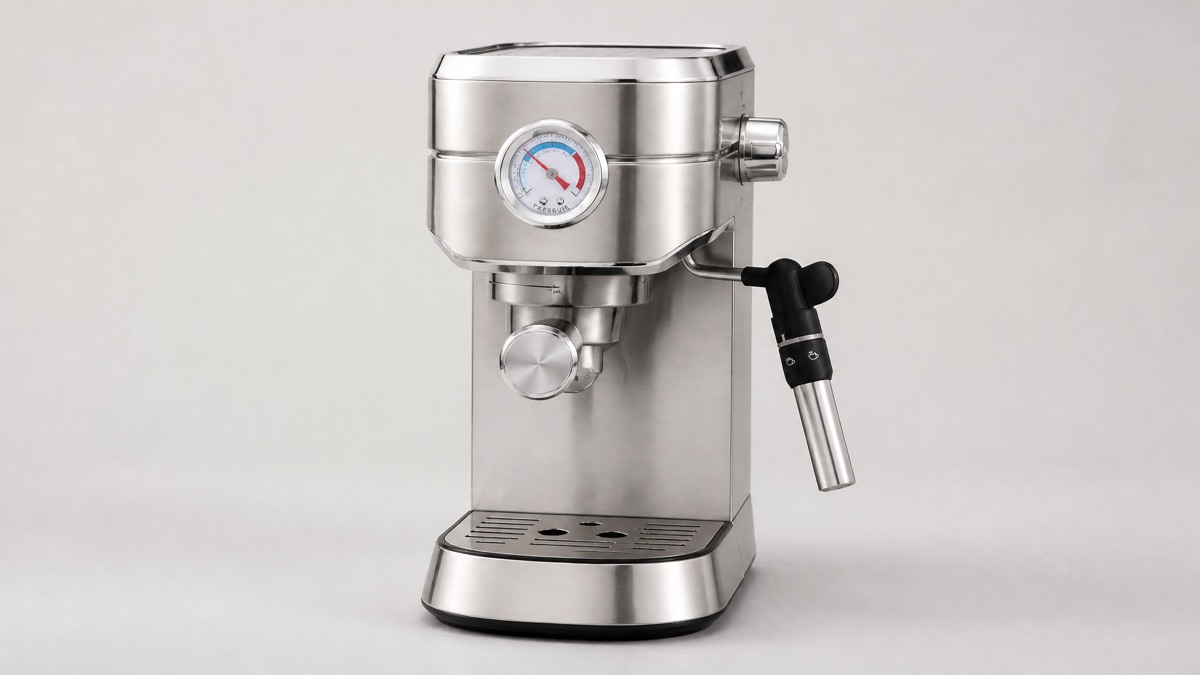
Hey coffee lovers, Mark here. I have handled compact semi-automatic espresso machines from many makers, and Gevi has a reputation to test. The Gevi espresso machine is a compact home semi-automatic espresso maker. It has a 20 bar pump, a steam wand and a mostly plastic body. Gevi sells eight models, coded ECMA0 to ECMN0, for $108.00 to $359.99. Most models need a separate grinder.
The 20 bar rating is a pump figure, and real extraction sits near 9 bar. A thermoblock heats the water in about 45 seconds. TechGearLab rated espresso quality 6.3 out of 10 and milk quality 8.0. Shots are significantly better than average but below café quality.
The build is mostly plastic, and some units have failed within a year. A full ECMA0 setup with a grinder and a pitcher costs $224.97. Beginners get a fair deal for that money. Buyers who want café depth do not. I cover thermoblock heating, steam wand milk and descaling, then give a straight verdict from my own testing. Nobody sponsored it.
What Is a Gevi Espresso Machine?
The Gevi espresso machine is a compact semi-automatic espresso maker with a 20 bar pump and a mostly plastic body. It also has a steam wand. Gevi sells it in several models, priced from $108.00 to $359.99.
Semi-automatic means the user grinds, doses and tamps the coffee. The machine then drives the pump and heats the water.
Coffeeness lists the 20 bar compact model, GECME400BA-U, at $139.99 with a one year warranty. The unit weighs 9.2 lb (4.2 kg). The Kitchn measures its unit at 12 inches (30 cm) tall and 5.4 inches (13.7 cm) wide.
Wired places the Gevi at the high end of the second-lowest gift tier and calls it a no-frills machine priced as such. The mostly plastic chassis will not impress most buyers.
Which Gevi Espresso Machine Models Are Available?
Gevi sells eight espresso machine models, coded ECMA0, ECMC0, ECMD0, ECME0, ECMF0, ECMG0, ECMI0 and ECMN0. Prices on Gevi's own store run from $108.00 to $359.99.
The models fall into four groups by price and features:
- ECMD0 and ECME0: The ECMD0 and ECME0 cost $108.00 each (list $119.99). The ECMD0 adds a visual thermometer display and NTC water temperature control.
- ECMA0 and ECMG0: The ECMA0 costs $139.99 (list $219.99). The ECMG0 costs $129.99 (list $199.99). Both are compact models with pre-infusion and a 9 bar extraction setting.
- ECMN0: The ECMN0 costs $285.99 (list $499.99). The ECMN0 has a single boiler, an Italian ULKA pump, an OPV, PID and NTC control, a 58 mm group head and a touchscreen. The ECMN0 has no grinder.
- Built-in grinder: The ECMI0 costs $289.99 and adds a 30-step built-in grinder. The ECMF0 costs $359.99. It is the dual boiler and also includes a grinder.
Gevi Model Lineup:
| Model | Price | Key Feature |
|---|---|---|
| ECMG0 | $129.99 | Compact, 51 mm |
| ECMD0 | $108.00 | Thermometer display, NTC |
| ECMA0 | $139.99 | Compact, pre-infusion |
| ECMN0 | $285.99 | Touchscreen, OPV, 58 mm |
| ECMI0 | $289.99 | 30-step grinder |
| ECMF0 | $359.99 | Dual boiler, grinder |
Who Is the Gevi Espresso Machine Made For?
The Gevi espresso machine is made for beginners who want espresso and milk drinks on a small counter. Gevi describes the line as beginner-friendly and semi-automatic.
Semi-automatic means the user does some of the work. The controls ask for a grind, a dose and a tamp. TechGearLab found the learning curve no steeper than on most semi-automatic machines. A first-time buyer is not at a special disadvantage.
The small footprint suits tight kitchens. Coffeeness says the 20 bar model could live in a camper van, and Gevi's own guide names RVs.
Serious enthusiasts outgrow the machine fast. The tested portafilter maxed out at a 17 g (0.6 oz) dose. That limits how much coffee goes into each shot. The shots also stay a little weaker than café shots.
Pod and capsule users need an add-on. The Capsule Extraction System for ESE pods and Nespresso capsules is not in the box.
How Does a Gevi Espresso Machine Work?
A Gevi espresso machine works by pushing heated water through ground coffee in a portafilter with a pump. The compact models use a 51 mm portafilter, and the ECMN0, ECMI0 and ECMF0 use a 58 mm one.
Water travels from the tank through the pump and heater to the group head. It then crosses the coffee puck and drops into the cup.
The user grinds and doses the coffee, tamps it and locks the portafilter in. A turn of the side knob to the coffee cup icon starts the pour. The preset volume is about 2 ounces (59 ml).
Steps:
- Fill the water tank and switch the machine on.
- Grind and dose the coffee into the portafilter.
- Tamp the coffee and lock the portafilter in.
- Turn the side knob to the coffee cup icon.
- Return the knob to the center when the pour ends.
Shot volume is programmable. Press the shot button for two seconds, press it again to start the pour and press it to stop. Press once more within 15 seconds to save.
The 20 bar model switches itself off after 15 minutes of inactivity.
Pre-infusion wets the coffee at low pressure before full pressure starts. The ECMA0 and ECMG0 list it as a feature.
Does the Gevi Espresso Machine Really Reach 20 Bar?
No. The Gevi espresso machine reaches 20 bar only as a pump rating, and real extraction sits near 9 bar.
True espresso extraction needs only 9 bar. A 15 bar machine is just as likely to make good espresso as a 20 bar machine. The pump rating on the box says little about the cup.
A pressurized basket has one small exit hole that builds pressure on its own. It forgives a poor grind and makes thick crema, but it hides flavor detail.
The ECMN0 adds an OPV, an over-pressure valve, that holds extraction between 9 and 12 bar. The valve pairs with an Italian ULKA pump.
A gauge shows whether the pressure is right. The ECMN0 has one and the ECMI0 has none. The 20 bar GECME400BA-U also lacks one, which Coffeeness missed for diagnosing a grind that is too fine or too coarse.
Testing shows the limits of this setup. The tested 2021 unit could not match the high pressures of costlier machines. TechGearLab found its shots a bit weaker than café shots.
How Does the Gevi Espresso Machine Heat Water?
The Gevi espresso machine uses a thermoblock to heat water in about 45 seconds. A thermoblock heats water as it flows instead of storing a hot tank.
The 20 bar model has two separate thermostats, one for espresso and one for steam. Separate thermostats keep a shot brewed right after steaming from running at steam temperature.
After a shot, the single boiler on the tested 2021 unit needed a full minute to reach steam temperature. Cooling back to brewing temperature took 12 minutes unless the user purged steam.
Steam readiness also varies from one machine to the next. On a grinder model, Wired's steam started after 10, 20, 30 or as long as 35 seconds. A blinking light signals when steam is ready.
Temperature control explains how the machine holds these settings. The ECMA0 page lists NTC and PID control that holds water between 195 and 205 degrees Fahrenheit (90.6 and 96.1 C). An NTC is a temperature sensor. A PID is a controller that uses the sensor reading to hold that temperature steady.
Does the Gevi Espresso Machine Make Good Espresso?
Yes. The Gevi espresso machine makes good espresso for its price, though it falls short of café quality.
TechGearLab rated espresso quality 6.3 out of 10. Its shots tasted significantly better than average, with good flavor and a decent layer of crema.
Tested Shots:
| Tester | Dose | Result |
|---|---|---|
| Wired | 19 g (0.7 oz) | 31 seconds, 2 oz (59 ml), rich crema |
| Coffeeness | 14 g (0.5 oz) | About 2 oz (59 ml), golden crema, little depth |
| TechGearLab | 17 g (0.6 oz) maximum | Espresso quality 6.3 out of 10 |
On a grinder model, Wired's tester used a 19 g (0.7 oz) dose and a 31 second shot. The 2 ounce (59 ml) double came out with rich crema and mild bitterness.
A common starting recipe is a 1:2 ratio, such as 18 g (0.6 oz) of coffee for 36 g (1.3 oz) of espresso in 25 to 30 seconds. Sour, thin shots call for a finer grind. Harsh, bitter shots call for a coarser grind.
With pressurized dual-wall baskets and a 14 g (0.5 oz) dose, Coffeeness got golden crema. The taste stayed bold and full-bodied but lacked depth and complexity.
A middle fine grind came out slightly too coarse and under-extracted, though still smooth. First Coffee Then advises a grind slightly finer than fine.
Is the Milk Steam Wand on the Gevi Espresso Machine Any Good?
Yes. The milk steam wand on the Gevi espresso machine makes creamy microfoam once the user has practiced.
TechGearLab scored milk quality 8.0 out of 10. The wand needs more finesse than some rivals, so beginners may be disappointed at first.
The wand is a panarello type with a limited range of motion. Coffeeness found it flimsy but powerful, and thick foam came easier than latte art microfoam. Wired found the steam start erratic.
Wired's tester frothed 5 ounces (148 ml) of 45 F (7 C) whole milk to 140 F (60 C) in 56 seconds. The Gevi Commercial model takes 60 to 75 seconds for a double latte.
Steam is either on or off, with no temperature control, so milk can overheat.
No milk pitcher ships in the 20 bar box, so the user must buy one. Pitchers cost $7 to $30.
Does the Gevi Espresso Machine Need a Separate Grinder?
Yes. The Gevi espresso machine does need a separate grinder on most models, since only the ECMI0 and ECMF0 include one.
The built-in grinder on the ECMI0 has 30 steps. Wired's grinder model suggests settings 5 to 10 for espresso, and its tester settled on 3.
Out of the box, one press on that model gave 12 g (0.4 oz) and a double press gave 16 g (0.6 oz). Wired's tester failed about 10 times to reprogram the dose and weighed by hand instead.
Gevi sells the CGA0 burr grinder for $69.99 (list $79.99). Buyers without a grinder can instead buy the Capsule Extraction System for pods and capsules.
Espresso needs a burr grinder, which cuts uniform fine particles. A blade grinder gives uneven particles and poor shots. Pre-ground coffee works with pressurized baskets but goes stale within days.
Is the Gevi Espresso Machine Easy to Use and Clean?
Yes. The Gevi espresso machine is easy to use and clean once the user learns a few dial and button quirks.
TechGearLab scored ease of use and ease of cleaning 5.7 out of 10 each. The manual is confusing, so owners often search online for answers.
The dial must sit at the coffee cup icon before a shot brews. First Coffee Then first thought the unit was defective because the manual left this out.
Cleaning has its own catch. The portafilter holds a tiny plastic piece that traps grounds and adds a cleaning step.
The rest of the cleaning is simple. The drip tray and water tank lift out for hand washing. Rinse the portafilter and flush the steam wand after each use. Keep the machine out of the dishwasher.
How Do You Descale a Gevi Espresso Machine?
A Gevi espresso machine tells the user when to descale by flashing all three front buttons white for about ten seconds. The reminder comes after 100 brew cycles.
Gevi's manual covers the full descale process.
The cleaning solution can take a few forms. First Coffee Then lists cleaning tablets, liquid descaler or white vinegar with warm water. Coffeeness says the maker recommends citric acid.
The timing depends on the owner. Most owners descale every couple of months, depending on use and water hardness.
Gevi sells descaler in an 8 pack for $14.99 and a 12 pack for $20.00.
Is the Gevi Espresso Machine Built to Last?
No. The Gevi espresso machine is not built to last, with a plastic body and early failures in some units.
The chassis is plastic with stainless steel accents. Wired found sturdy metal where it counts and a stainless steel basket that feels solid.
First Coffee Then found the buttons move together and some parts sit unevenly. Several buyers report a breakdown inside the first year.
The 20 bar model is light. Coffeeness found it slides when the user locks in the portafilter and feared snapping the handle.
Longer use is possible. The Kitchn's reviewed unit has run a little over two years, and the Gevi Commercial pulled 30 shots back to back without overheating.
The included plastic tamper weighs about 80 g (2.8 oz), one fifth of the tamper that ships with the Casabrews 5700PRO.
What Does the Gevi Espresso Machine Warranty Cover?
The Gevi espresso machine warranty covers defects in materials and workmanship for one year. Gevi also offers 30 day returns.
Registering the machine within 30 days of receipt adds a three month extension. The warranty applies within the U.S.
Buyers who want more time can pay for it. Gevi sells optional coverage for up to three years beyond the standard term.
If a unit fails within the term, Gevi replaces or repairs it. Coffeeness describes the cover as a replacement or repair promise.
Claims go through support at service@gevi.com. Gevi's own guide admits some owners wait for replies.
How Does the Gevi Espresso Machine Compare With Rivals?
The Gevi espresso machine compares well with rivals on price and size but trails on accessories and build.
TechGearLab says the Gevi gives about 75 percent of the quality of the best machines at a far lower price.
The Casabrews 5700PRO ships with a tamper five times heavier than the Gevi tamper.
First Coffee Then found the Gevi beat the Tru 15-Bar, which suffers pressure problems.
The Breville Bambino Plus costs $499.95 and heats in 3 seconds with a ThermoJet system. The Gevi thermoblock takes about 45 seconds.
An LED screen and thermoblock heating are rare on espresso makers under $240, Coffeeness notes.
Is the Gevi Espresso Machine Better Than a Breville Barista Express?
No. The Gevi espresso machine is cheaper than a Breville Barista Express but not proven better, since no head-to-head test exists.
Price is the clearest gap between the two. The Breville Barista Express costs $699.95, while the closest Gevi, the ECMI0, costs $289.99. But a lower price says nothing about how well each machine makes espresso.
Both machines include a built-in grinder, so each one grinds beans and brews in a single unit. The Breville has 16 grind settings and a 54 mm portafilter. The ECMI0 has 30 steps and a 58 mm group head. Neither detail shows which machine tastes better.
The Breville uses a 15 bar pump. It starts with pre-infusion, a gentle first soak of the coffee, and then extracts at 9 bar. Its thermocoil heater uses PID control to hold water at 200 F (93 C). PID is a controller that keeps the temperature steady.
Breville Versus Gevi ECMI0:
| Spec | Breville Barista Express | Gevi ECMI0 |
|---|---|---|
| Price | $699.95 | $289.99 |
| Grinder | 16 settings | 30 steps |
| Portafilter | 54 mm | 58 mm |
| Heating | Thermocoil with PID | PID and NTC control |
How Much Does a Gevi Espresso Machine Cost?
A Gevi espresso machine costs between $108.00 and $359.99 depending on the model.
The 20 bar compact model sells for $139.99, against a list price of $219.99.
The grinder model Wired tested sells for $279, down from $350.
Extras add up. A milk pitcher costs $7 to $30, the CGA0 grinder costs $69.99 and an 8 pack of descaler costs $14.99.
A full ECMA0 setup costs $224.97. That sum is the machine at $139.99, the CGA0 grinder at $69.99 and the Gevi milk pitcher at $14.99.
Setup Costs:
- ECMA0 machine at $139.99
- CGA0 burr grinder at $69.99
- Gevi milk pitcher at $14.99
- Total of $224.97
Is the Gevi Espresso Machine Worth the Price?
Yes. The Gevi espresso machine is worth the price for a first machine, with one of the best price-to-performance ratios TechGearLab tested.
First Coffee Then says the machine pays for itself quickly if it replaces coffee shop visits. Each home-made drink takes the place of one bought drink, so the savings build with every cup.
Savings do not make a machine good, though. Wired rates it 6 out of 10 and compares it to the nicer bottle on the bottom wine shelf.
Is the Gevi Espresso Machine Worth It?
Yes. The Gevi espresso machine is worth it for beginners who want drinkable espresso and milk drinks for about $108 to $140, but not for those who want café depth.
A full setup with a grinder and pitcher costs $224.97 on the ECMA0. Its strengths are small size, fast thermoblock heat, easy milk foam with practice, low price and programmable shots.
Its weaknesses are a plastic build, no grinder on most models, erratic steam timing, pressurized baskets and thin accessories.
Pros:
- Small footprint
- Fast thermoblock heat
- Easy milk foam with practice
- Programmable shots
Cons:
- Mostly plastic build
- No grinder on most models
- Erratic steam timing
- Thin accessories
Ratings back this split. Wired gives 6 out of 10, TechGearLab gives 63 out of 100 and First Coffee Then calls it a decent entry-level machine.
Who Should Skip the Gevi Espresso Machine?
Latte art fans, hosts, flavor chasers and long-term owners should skip the Gevi espresso machine. Each group has a different reason.
The panarello wand makes latte art microfoam hard. The wand is the steam arm that froths the milk. Microfoam is the smooth, fine-bubbled milk that latte art needs.
Several milk drinks in a row feel slow. The user must wait between steaming and brewing.
Coffeeness found the shots lacking in depth and complexity, and no amount of tweaking changed that. Reports of failure within a year make the machine a gamble for long-term owners.
The Coffee Experiment is a reader-supported platform. Purchases made through our links may earn us an affiliate commission at no extra cost to you.