
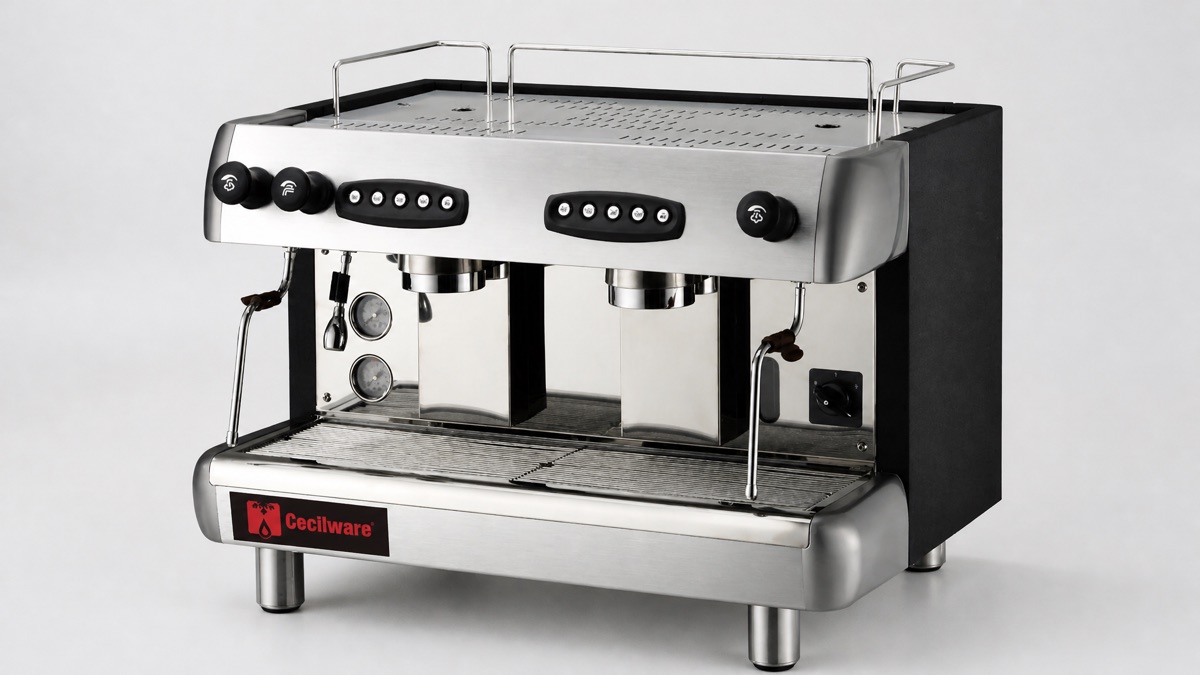
Pull up a chair, I'm Mark, and the Grindmaster espresso machine is on the bench today. The Grindmaster espresso machine is a commercial espresso and cappuccino maker from Grindmaster-Cecilware. It comes in one, two and three groups for cafes, restaurants and hospitality venues. Most models need a 230V circuit, a water line and a drain.
The Classic series brews through direct-to-boiler groups with programmable volume keys. A two-group Classic 2 HP makes 150 to 200 drinks a day. A three-group Classic 3 makes up to 300. Installation takes a dedicated circuit, a backflow device and clean water. Cleaning means a daily rinse and a regular back flush.
I learned to taste Kenyan AA closely during my café years. Chef scores run 4 and 5 for reliability and cleaning. Prices run from $3,584 to $8,707, and a grinder costs extra. This review handles model lineup, installation needs and cleaning routine, without any brand deal.
What Is the Grindmaster Espresso Machine?
The Grindmaster espresso machine is a commercial espresso and cappuccino maker built for cafes, restaurants and hospitality venues. Grindmaster-Cecilware sells it with stainless steel bodies, steam arms and a hot water dispenser.
Most models run on 230V single-phase power at 30 amps. A water line and a drain line connect directly to the machine. One 110/120V, one-group CS1-110 draws 18 amps, but no model plugs into a standard kitchen circuit without planning.
The names follow a code. CS stands for Classic series, so the CS1, CS2 and CS3 are the Classic 1, 2 and 3. HP means high profile, and the Classic Plus models use it, as in the Classic 2 HP.
Listings carry safety marks. ETL stands for Edison Testing Laboratories. The Classic 2 HP holds NSF, cETLus and ETL-Sanitation listings. The Classic 3 listing shows cETLus and ETL-Sanitation.
Who Makes the Grindmaster Espresso Machine?
Grindmaster-Cecilware makes the Grindmaster espresso machine from its base at 4003 Collins Lane in Louisville, Kentucky. Parts Town notes that the company is now known simply as Grindmaster.
The Classic series has a different listed maker. Its manufacturer is Crathco-UNIC. Sellers label these machines Grindmaster-UNIC-Crathco, with part numbers such as LV602978 and LV602647.
The technical service line is open Monday through Friday, 8 AM to 6 PM Eastern time. Callers need the model and serial number ready.
Warranty claims follow their own rule. They need prior authorization before any work starts. Registration is online at gmcw.com.
Which Models Does the Grindmaster Espresso Machine Line Include?
The Grindmaster espresso machine line spans the Classic series, the Venezia series and older traditional models. Classic models come in one, two and three groups, from the Classic 1 to the Classic 3.
The Venezia line covers the ESP1, ESP2 and ESP3. The Venezia II ESP1-220V is listed as an automatic machine rated at 240 cups per hour. Arco Coffee lists the Venezia VAE-J1 at $3,584.00.
The older Grindmaster 2450 Traditional has two steam wands and touch pad controls with preset portions. The 2400Q is a two-group semi-automatic model. It offers high steam capacity, quick recovery and separate steam and water systems.
Model Families:
- Classic series: one, two and three groups
- Venezia series: ESP1, ESP2 and ESP3
- Traditional models: 2450 and 2400Q
- UNIC Tri-Mira: three groups
The CS1-110 has a 1.5 gallon (5.7 L) boiler. The CS3-220 has a 4.75 gallon (18 L) boiler. Kitchenall lists both as Classic series machines.
The UNIC Tri-Mira is a three-group machine with a 16 liter (4.2 gallon) boiler. It measures 34 x 23 x 23 inches (86 x 58 x 58 cm) and has four programmable volume keys per group.
How Does the Grindmaster Espresso Machine Work?
The Grindmaster espresso machine does its work through direct-to-boiler group heads that hold shot temperature steady. The group head is the part that locks in the portafilter and sends hot water through the coffee. Because it connects straight to the boiler, the water stays at a steady heat from one shot to the next.
A full-sized rotary vane pump builds the pressure. Gauges show both pump and steam pressure.
The CS manual sets pump pressure at 9 bar (130 psi) from the factory. A bar is a unit of pressure. The green zone on the gauge runs from 8 to 10 bar (116 to 145 psi). Steam boiler pressure is set at 1.2 bar (17 psi), with a green zone of 1 to 1.4 bar (14.5 to 20 psi).
A barista fills the portafilter with ground coffee, tamps firmly and locks it into the group. Tamping means pressing the grounds flat so the water passes through them evenly. A portion button starts the shot. Holding the continuous flow button also works, and pressing it once stops the flow.
The steam wand opens with a counterclockwise turn of the knob for a variable flow. Pulling the handle out gives maximum steam. The hot water knob works the same way.
How Do You Program the Grindmaster Espresso Machine?
Installers program the Grindmaster espresso machine by hand, because the CS panel ships with no default coffee output. Turning on the programming switch lights buttons one to four and makes the fifth LED flicker.
A measuring cup goes under the group. The installer holds a button until the cup holds the wanted amount. The button light then goes off to confirm the save. Each new switch-on of the programming mode resets the buttons.
Multi-group machines copy the far right panel to the others. Programming therefore starts at the right and moves left. Starting on the left would overwrite the earlier settings.
Venezia models use five steps. Flip the right toggle up, press PROG, press the target button and press PROG again at the right time. Flipping the toggle down locks the program in.
Venezia Programming Steps:
- Flip the right toggle switch up to On.
- Press the PROG button.
- Press the button you want to program.
- Press PROG again when the wanted time is reached.
- Flip the toggle switch down to Off to lock the program in.
How Many Drinks Can the Grindmaster Espresso Machine Make?
The Grindmaster espresso machine makes 150 to 300 drinks a day, depending on the model. Grindmaster sells models at several sizes. The size is set by the number of brew groups, which are the heads that each brew espresso.
The two-group Classic 2 HP is rated at 150 to 200 drinks a day. It brews four espressos at once.
The three-group Classic 3 is rated at 200 to 300 drinks a day. It brews six espressos at once. Its 16 liter (4.2 gallon) steam boiler is 6 liters (1.6 gallons) larger than the Classic 2 HP boiler.
Two other models are also listed. The Venezia II ESP1 is listed at 240 cups per hour. The Tri-Mira three-group machine suits shops that use 40 or more pounds (18 kg) of coffee per week.
What Does the Grindmaster Espresso Machine Need to Install?
The Grindmaster espresso machine needs a qualified installer and a dedicated circuit to install. The CS manual says only qualified service personnel should install the unit. The machine also needs four inches (10.2 cm) of clearance at the sides and rear.
The Classic 2 HP measures 25 x 23 x 26 inches (63.5 x 58.4 x 66 cm) and weighs 139 pounds (63 kg). The Classic 3 measures 34 x 23 x 23 inches (86 x 58 x 58 cm). Sellers list its weight at 218 pounds (99 kg).
Install Checklist:
- Qualified installer
- Dedicated grounded circuit, no extension cord
- 4 inches (10.2 cm) of clearance at each side and the rear
- Water filter, or a softener in very hard water areas
The outlet must be grounded and dedicated to the machine. Extension cords are not allowed. After the first start, the tank takes about three to four minutes to fill.
A filter system removes odors and slows scale. Areas with very hard water need a water softener. Unsoftened water turns into limescale after boiling, and the manual ties that to the warranty.
What Power and Plumbing Does the Grindmaster Espresso Machine Need?
The Grindmaster espresso machine needs 230V single-phase power at 30 amps on the Classic 2 HP and Classic 3. The CS manual lists 20 amps for the CS2-220 and 27 amps for the CS3-220.
Seller listings give the Classic 3 a rating of 4.6 kW at 30 amps. The CS3-220 manual lists 6,500 watts at 27 amps. The two sources differ. The identification label on the front of each machine is the final word on its exact voltage and wattage.
The one-group CS1-220 draws 10 amps at 2,000 watts. The CS1-110 draws 18 amps at 2 kW on 110/120V. The CS3-220 draws 6,500 watts. The table below lists the manual figures for each model.
Manual Electrical Figures:
| Model | Voltage | Amps | Power |
|---|---|---|---|
| CS1-110 | 110/120V | 18 A | 2 kW |
| CS1-220 | 220/240V | 10 A | 2,000 W |
| CS2-220 | 220/240V | 20 A | 4,700 W |
| CS3-220 | 220/240V | 27 A | 6,500 W |
Water enters through a 1/2 inch (12.7 mm) line to a 3/4 inch GHT connection. Water pressure must stay above 20 psi (138 kPa). A drain line of 18 mm (0.7 inches) attaches at the bottom center.
An approved backflow preventer, such as a double check valve, is required. A check valve type needs a 100 mesh screen upstream. The power cord and plug must stay unaltered, or the warranty is void.
How Do You Clean the Grindmaster Espresso Machine?
Owners clean the Grindmaster espresso machine with a rinse after each brew, a daily wipe and a regular back flush. The portafilter gets rinsed with hot water from the continuous flow button.
Milk is the next thing to leave residue, and it sits on the steam arm. The steam arm and nipple get wiped with a cloth wet with sanitizer after each use. A short steam burst then clears leftover milk.
The outside of the machine gets a soft, slightly damp cloth each day. Spraying cleaner directly on the machine risks corrosion and electrical damage. The drain tray comes out for washing. A teaspoon of detergent in the trough dissolves oils.
Some products harm the machine itself. Chlorine and bleach products pit stainless steel and void the warranty. The portafilter handle never goes underwater, and the group gasket stays out of liquid. Sanitized parts air dry without wiping.
How Does Back Flushing Work on the Grindmaster Espresso Machine?
Back flushing on the Grindmaster espresso machine runs 10 automatic cleaning cycles from one button press. The group head loses its screw, shower screen and plate first. Hot metal parts call for care.
A rubber disc goes into the portafilter with 2 to 3 grams (0.07 to 0.1 ounces) of espresso machine detergent. The portafilter locks into the group head. The operator presses the first and fifth buttons together.
Back Flush Steps:
- Remove the screw, shower screen and plate from the group head.
- Place the rubber disc and detergent in the portafilter and lock it in.
- Press the first and fifth buttons together to start 10 cleaning cycles.
- Rinse the portafilter and the disc.
- Press the same two buttons again to rinse the group.
The third button stops the cycle at any time. Afterward, the operator rinses the portafilter and the disc. Replacing the disc and pressing the same two buttons again rinses the group.
The screw, screen and plate get a brush wash with the portafilter, steam nipple and hot water sprayer. They then get a rinse, a sanitizing soak and an air dry before reassembly.
What Do Owners Say About the Grindmaster Espresso Machine?
Owners rate the Grindmaster espresso machine 4 or 5 out of 5 on reliability, operation, cleaning and maintenance. ChefWorthy shows scores from three chefs for Grindmaster hot beverage equipment, and one covers the Classic 1.
The Classic 1 review gives the most detail. That chef rated it 5 out of 5 on May 22, 2025. The scores were reliability 5, operation 4, cleaning 5, maintenance 5 and versatility 4. The chef ran several units for one to two years, so the scores come from long use.
Tolya Ashe, Head Chef at Little Gem NYC, scored it 5, 5, 5, 4 and 4 on April 2, 2026. Michael Paige scored it 5, 5, 4, 4 and 5 on March 20, 2026.
Owner scores are the only evidence found. No independent lab test of a Grindmaster espresso machine turned up in the research. A 2022 Home Barista thread shows a buyer who found little public information on the Venezia ESP1.
What Do Owners Like About the Grindmaster Espresso Machine?
Owners like the Grindmaster espresso machine for easy operation and solid build quality. The Classic 1 chef named both as what works, and the machine came recommended by a trusted partner.
Easy operation starts at the group, the part that holds the portafilter and brews each shot. Every group has four programmable volume keys. A semi-automatic key gives manual control when needed. The shot timer and cup warmer are built in, so staff skip steps during a rush.
Build quality shows up in service work. Side panels come off easily for routine service. The direct-to-boiler group head simplifies cleaning. Three chef reviews back this up. Across them, cleaning scored 5 and 4 and maintenance scored 5 and 4.
What Problems Does the Grindmaster Espresso Machine Have?
The Grindmaster espresso machine has two problems that show as fault patterns on the control panel.
All lights on means the water level has not risen after two minutes. The first fill alone takes more than two minutes. Causes of that fault are a water level probe, a water intake solenoid or interrupted supply. The fix starts with an open water valve. Then the operator restarts the machine after three seconds.
All lights flashing on one panel means no water leaves the brewing group, or a shot runs too long. Coffee ground too fine slows the water and causes it. A faulty solenoid or flow meter causes it too.
Pressing any key clears the signal. A technician handles any solenoid or flow meter repair.
Water quality affects the machine as well. Limescale from unsoftened water cuts thermal efficiency and machine life.
Pressure also needs a technician. The technician sets pump and steam pressure back into the green zone. One turn of the adjusting screw changes pressure by 0.1 bar (1.5 psi).
How Much Does the Grindmaster Espresso Machine Cost?
The Grindmaster espresso machine costs from about $3,584 for a Venezia VAE-J1 to $8,707.05 for a Classic 3. Prices vary by seller and freight.
ChefsDeal lists the two-group Classic 2 HPSA with a 10 liter (2.6 gallon) boiler at $8,653.15. Arco Coffee lists the Venezia VAE-J1 at $3,584.00.
Listed Prices:
| Model | Seller | Price |
|---|---|---|
| Venezia VAE-J1 | Arco Coffee | $3,584.00 |
| Classic 1 | Kitchenall | $4,725.60 |
| Classic 2 HPSA | ChefsDeal | $8,653.15 |
| Classic 3 | Kitchenrestock | $8,707.05 |
Kitchenall lists the one-group Classic 1 at $4,725.60. Kitchenrestock lists the three-group Classic 3 at $8,707.05.
Older Grindmaster-Cecilware terms list one year of parts and one year of labor on espresso machines. Those terms require preventive maintenance and proof of it for the second year. Claims need prior authorization, and gmcw.com holds the current terms.
Hard water and chlorine cleaners can void coverage. A water filter and the right cleaner protect the investment.
Does the Grindmaster Espresso Machine Need a Separate Grinder?
Yes. The Grindmaster espresso machine needs a separate grinder because no Classic or Venezia listing includes one. Each machine ships with portafilters for ground coffee.
A new owner therefore has to buy a grinder as its own purchase. Cuda Coffee lists the Cecilware VGT Time Switch grinder, the VGA Automatic, and the VGHDA Heavy Duty Automatic.
Cecilware Grinder Prices:
| Grinder | Price |
|---|---|
| VGT Time Switch | $1,089.39 |
| VGA Automatic | $1,351.96 |
| VGHDA Heavy Duty Automatic | $1,893.44 |
Grinders are also sold for the machines themselves. The HC-600 Venezia II grinder doses 5.5 to 9 grams (0.19 to 0.32 ounces) and has a five-minute manual timer. ChefsDeal pairs the Classic 2 HPSA with Ceado E37S and E36P on-demand grinders. Their hoppers hold 3.5 pounds (1.6 kg) and 1.3 pounds (0.6 kg).
Is the Grindmaster Espresso Machine Worth It?
Yes. The Grindmaster espresso machine is worth it for a cafe or restaurant serving 150 or more drinks a day. Chef scores of 4 and 5 on Grindmaster hot beverage equipment back its reliability, operation, cleaning and maintenance.
Programmable volume keys, direct-to-boiler groups and a stainless build give a working crew speed and steady shots. The Classic 3 stretches to 300 drinks a day.
Pros:
- Programmable volume keys on every group
- Direct-to-boiler group heads
- Stainless steel build
- Capacity of 150 to 300 drinks a day
Cons:
- 230V, 30 amp circuit needed
- Water line, drain and backflow device needed
- Separate grinder needed
- Price in the thousands
The costs are real. The install needs a 230V, 30 amp circuit, a water line, a drain and a backflow device. The grinder costs extra, and the machine price runs into the thousands.
Who Should Buy the Grindmaster Espresso Machine?
Cafes, restaurants and hospitality venues should buy the Grindmaster espresso machine when they need two or three groups. Those shops serve 150 to 300 drinks a day.
A shop with lower volume needs less machine. A low-volume counter fits a one-group Venezia or CS1 model. The CS1-110 runs on 110/120V at 18 amps. Even that machine needs a dedicated circuit.
A home kitchen is a hard fit for the same reason. The commercial plumbing and 230V needs show in a 2022 forum post, where a buyer planned to plumb a Venezia ESP1 for home use.
Anyone who wants a built-in grinder or a plug-in appliance should skip it.
The Coffee Experiment is a reader-supported platform. Purchases made through our links may earn us an affiliate commission at no extra cost to you.