
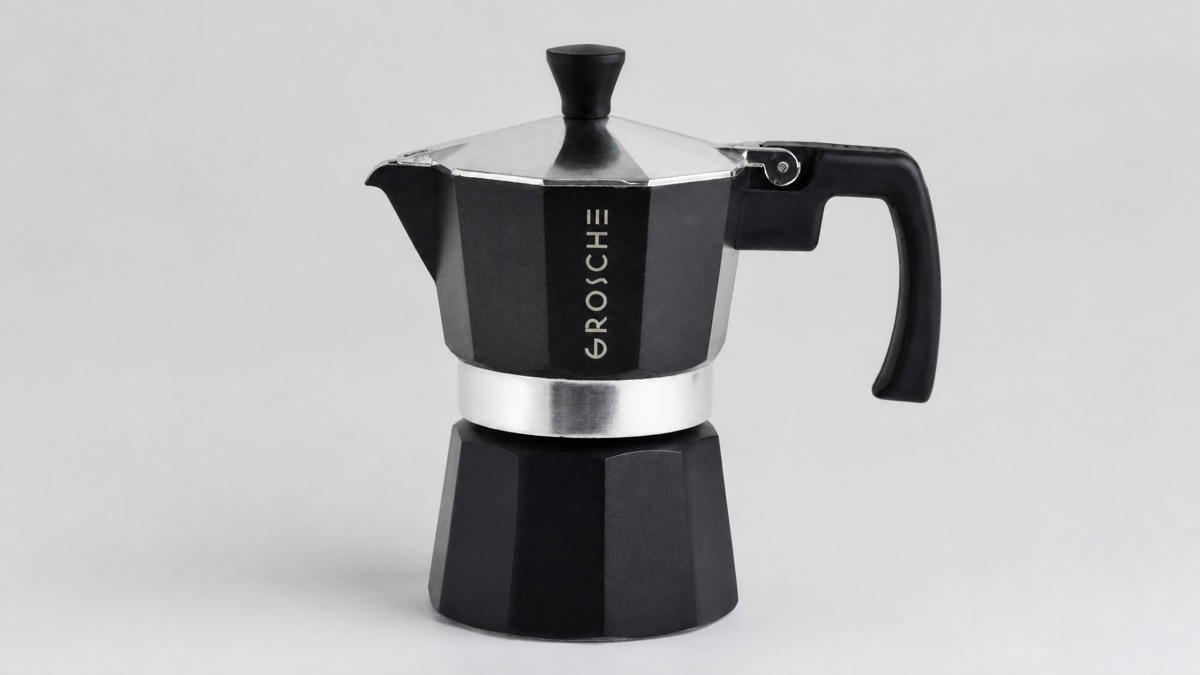
Hi, I'm Mark. My barista years include five in Paris, close to the Palais-Royal. The Grosche espresso machine is a line of stovetop moka pots called the Milano. It brews strong coffee over a flame with no electricity and no pump.
I used it myself, and Grosche did not pay for this review or send me anything for it. The Milano brews at about 1 to 1.5 bar. A pump machine runs at 8 to 9 bar, so crema stays thin here. The aluminum body is sturdy. Standard pots skip induction, while the Steel version handles it.
Prices run about $28 to $42 for the standard pot and $44.99 for the Steel. Owners praise the taste and the build and complain about hand washing. Read on for brewing steps, care, a Bialetti comparison and a clear verdict on who should buy the Milano.
What Is the Grosche Espresso Machine?
The Grosche espresso machine is a line of stovetop moka pots called the Milano, from the Canadian brand Grosche. Retailers file these pots under espresso machines. The Milano line has no pump, no boiler tank and no electric parts.
A moka pot is also called a caffettiera, an Italian coffee maker or a stovetop espresso maker. Alfonso Bialetti introduced the format in Italy in 1933. Grosche is a modern Canadian maker of that Italian design.
The design needs no electricity because it brews with steam pressure over a flame. The Milano has three parts: a bottom boiler, a funnel filter and a top chamber.
Grosche was founded in 2006 and is headquartered in Canada. The company is a certified B-Corp. Each purchase funds at least 50 days of safe drinking water through its Safe Water Project.
The Milano is Grosche's best-selling series. The 6-cup black pot holds 4.4 stars from 25,732 ratings on Amazon.
Is the Grosche Milano a Real Espresso Machine?
No. The Grosche Milano is not a real espresso machine, because it brews at about 1 to 1.5 bar. A pump machine runs at around 8 to 9 bar. The gap changes the texture of the cup.
Pressure shapes the coffee itself. The Milano makes a strong, concentrated coffee. Its intensity sits between drip and espresso.
The same low pressure explains the crema. Crema is the thick, golden foam on top of an espresso. A pump builds a thick layer of it. The Milano cannot, so a moka pot makes a little crema at best, and the layer stays thin.
Grind quality can close part of that gap. With a good burr grinder, the result comes close to espresso.
Brew the pot, then add hot or frothed milk for a latte or cappuccino. These drinks work well with the Milano.
Which Grosche Milano Models Exist?
Five Grosche Milano models exist: aluminum, Stone, Steel, Induction and Stella Aroma. Each model targets a different stove type or budget.
The standard Milano is anodized aluminum. It comes in 3, 6, 9 and 12 cup sizes. Each size holds a set amount. The 3-cup holds 150 ml (5 fl oz). The 6-cup holds 275 ml (9.3 fl oz). The 9-cup holds 450 ml (15.2 fl oz). The 12-cup holds 700 ml (23.6 fl oz). A 1-cup pot holds 45 ml (1.5 fl oz).
The Milano Stone keeps the aluminum body but adds a textured enamel finish. It comes in five sizes, from 59 ml (2 oz) to 651 ml (22 oz).
The Milano Steel is 18/8 stainless steel. It comes in 6-cup and 10-cup sizes. The 6-cup holds 266 ml (9 oz). The 10-cup holds 562 ml (19 oz).
The Milano Induction has a stainless steel base for induction cooktops.
The Stella Aroma sits at the top of the range. It is a handcrafted luxury pot cut from solid stainless steel blocks. It started at $125 at launch in 2020.
Milano Models:
| Model | Material | Sizes | Induction |
|---|---|---|---|
| Milano | Anodized aluminum | 3, 6, 9, 12 cup | No |
| Milano Stone | Aluminum with stone enamel | 59 ml to 651 ml (2 oz to 22 oz) | No |
| Milano Steel | 18/8 stainless steel | 6 and 10 cup | Yes |
| Milano Induction | Stainless steel base | 3, 6 and 9 cup | Yes |
| Stella Aroma | Solid stainless steel | 4 cup | Yes |
How Does the Grosche Milano Work?
The Grosche Milano works by turning water into steam and pushing the hot water up through the coffee grounds. Steam builds pressure in the sealed bottom chamber. That pressure forces the water through the funnel into the top chamber.
The Grosche Milano has three parts that do this job:
- Bottom boiler: This part holds the water. Steam builds here.
- Funnel filter: This part holds the grounds. The hot water passes through it.
- Top chamber: This part collects the finished coffee.
The pressure in this process stays low. A moka pot brews at about 1 to 1.5 bar (15 to 22 psi). An espresso machine runs at 8 to 9 bar (116 to 131 psi).
A safety valve sits on the boiler, where the steam pressure builds. The valve releases steam if a blockage builds too much pressure. Grosche states that its valves are made in Italy.
How Do You Brew With the Grosche Milano?
You brew with the Grosche Milano by filling the boiler, adding level grounds and heating on low. Each step protects the seal and the flavor.
Use a medium-fine grind, finer than drip and coarser than espresso. A grind of about 500 microns suits medium roast. Go coarser for dark roast and finer for light roast.
Level the grounds and do not tamp them. Tamping adds pressure and slows the flow of water.
Set the pot on the smallest burner at medium-low heat with the lid open. Turn the heat to its lowest setting once coffee starts to flow. Take the pot off the heat when the gurgling stops.
Brewing takes about 4 to 5 minutes. A meat thermometer in the spout helps. Shut off the heat once the pot reaches 158 to 167°F (70 to 75°C).
Steps:
- Fill the boiler with cool water to just below the safety valve.
- Fill the funnel with medium-fine grounds and level them without tamping.
- Screw the top chamber on tightly and set the pot on medium-low heat with the lid open.
- Lower the heat once coffee starts to flow.
- Remove the pot from the heat when the gurgling stops.
Bitter or sputtering coffee has three usual causes. The heat is too high, the grind is too fine or the pot boils at the end. Grosche advises medium-low heat, a medium-fine grind and removing the pot as soon as the coffee turns pale and sputters.
What Is the Grosche Milano Made Of?
The Grosche Milano is made of food-grade anodized aluminum with a silicone gasket and a soft-touch handle. The body is mid-grade aluminum, the same class most moka pots use.
Aluminum heats fast and sheds heat fast. That trait is why moka pots use the metal.
The gasket is the seal between the pot's parts, and the Milano makes it from silicone. Rubber gaskets on many rivals crease and lose their seal over time. Silicone avoids both problems, so the pot lasts longer.
The handle is larger than usual and sits away from the heat. A burn guard shields the fingers. Because of this design, the handle survives a brush with a flame without melting.
The country of origin is not stated the same way everywhere. Listings for the Milano Steel and the Milano Stone say Italy. Another guide says Grosche designs in Canada and manufactures in Taiwan, China or Germany. Grosche itself states only that the safety valve is Italian.
Aluminum has two drawbacks. It can add a faint metallic edge to the cup. It also tarnishes in a dishwasher. Stainless steel Milano Steel pots avoid both issues.
Does the Grosche Milano Work on Induction?
No. The standard Grosche Milano does not work well on induction, because aluminum is not magnetic. Grosche's Amazon listing says a glass-top induction hob heats the pot very slowly.
The standard pot works on gas, electric and propane camp stoves. Grosche says aluminum pots usually need an induction adapter plate to work on induction.
Grosche also sells two induction-ready alternatives, the Milano Steel and the Milano Induction. Both work on induction cooktops. They keep it simple, because no adapter plate is needed.
Is the Grosche Milano Safe to Use?
Yes. The Grosche Milano is safe to use when filled below the valve, left untamped and brewed on medium-low heat. Those three rules cover the main risks of a pressure brewer.
Every Milano carries a certified safety valve made in Italy. Grosche describes the valve as an FDA compliant, lead-free part.
The valve opens if a clogged filter or tamped grounds raise the pressure too high. Steam escaping through the valve means the filter or valve needs cleaning.
Water above the valve is the one fill-line rule Grosche stresses. Keep the water level just below it.
Safe Use Rules:
- Fill the water below the safety valve
- Level the grounds without tamping
- Brew on medium-low heat
- Clean the filter and valve if steam escapes
What Do Owners Say About the Grosche Milano?
Owners say the Grosche Milano brews strong, rich coffee at a low price. Most owners count themselves fans of moka pots.
The ratings show how widely that view is shared. The 6-cup black pot averages 4.4 stars from 25,732 ratings on Amazon. Grosche's own store shows 4.4 to 4.5 stars for the 3, 6, 9 and 12 cup sizes.
Assembled, a one-cup Milano takes up about as much room as a pint glass. The pot fits a small kitchen shelf.
What Do Owners Like About the Grosche Milano?
Owners like the Grosche Milano for its strong coffee, sturdy build, cool handle and low price. The pot earns praise for both the cup and the construction.
The coffee tastes bold, full-bodied and chocolatey. Owners also find the pot easier to use and maintain than an espresso machine. The strong cup does not demand much work.
The handle stays comfortable to hold, and Grosche calls its burn guard unique among moka pots.
The build holds up as well. Business Insider's review team tested more than a dozen moka pots. The team ranked the Milano first for build and melt resistance.
The social mission draws buyers. Several owners cite the Safe Water Project as a reason to buy.
What Do Owners Complain About With the Grosche Milano?
Owners complain about the Grosche Milano mainly for hand washing, no induction support and a hard-to-clean filter. None of the complaints is unusual for an aluminum moka pot.
Some owners find the filter difficult to remove and clean properly. A few owners report quality problems with individual pots.
The aluminum body is reactive. A trip through the dishwasher tarnishes it and can leave flecks in the coffee.
Cup sizes mislead first-time buyers. A moka 'cup' is an espresso-sized serving of about 30 to 60 ml (1 to 2 oz), not a mug. The 6-cup pot makes 9.3 fl oz (275 ml).
How Do You Clean and Maintain the Grosche Milano?
You clean and maintain the Grosche Milano by rinsing every part with warm water once the pot has cooled. The routine takes a minute.
Avoid soap and the dishwasher on aluminum pots. Soap leaves residue and can strip the seasoning from the aluminum. A dishwasher turns the aluminum black and leaves salt-like build-up. The Milano Steel is the exception and is dishwasher safe.
Take the pot apart after each brew. Rinse the basket, plate and gasket separately. Dry every part to prevent oxidation.
Remove old grounds from the filter basket after every use. The step prevents coffee oil buildup.
Cleaning Steps:
- Let the pot cool completely.
- Take the pot apart into boiler, funnel, plate and top chamber.
- Rinse every part with warm water and no soap.
- Dry every part before storing the pot.
How Often Does the Grosche Milano Need a New Gasket?
The Grosche Milano needs a new gasket every 6 to 12 months of regular use. Some guides advise a swap every 3 to 6 months.
Heavy users replace the gasket sooner. Grosche sells replacement gaskets and filter screens for each size. A 9-cup gasket and filter set lists at $14.99.
A cracked, stiff or hard gasket signals a replacement. A leaking pot or off flavors point to the same cause.
Gaskets come in 3, 6, 9 and 12 cup sizes. Some sellers say the Grosche seals also fit Bialetti pots, but fit varies. Measure the old seal against the size chart before buying a new one.
Gasket Facts:
- Replace every 6 to 12 months of regular use
- Replace sooner under heavy use
- Replace when the seal cracks, stiffens or leaks
- Match the cup size before buying
Grosche Milano vs Bialetti Moka Express: Which Is Better?
The Grosche Milano is the better build than the Bialetti Moka Express in Business Insider's tests, though both brew alike. The difference lies in materials and fittings.
Bialetti has made the moka pot since the 1930s. The design is original and timeless. The modern pot brews as well as the Milano, so taste does not separate the two.
Build does. Grosche uses a silicone gasket and a silicone-fitted handle. Business Insider's tester says Bialetti's modern plastic fittings melt when the pot sits on the heat too long.
The stove type also limits the choice. Neither standard aluminum pot suits induction. Bialetti sells the Venus for induction hobs.
Price does not settle the question, because it is close. The Strategist listed both pots at about $32. Current US listings put a 6-cup Bialetti at about $38 to $58.
How Does the Grosche Milano Steel Compare to the Bialetti Venus?
The Grosche Milano Steel compares closely to the Bialetti Venus, trading dishwasher safety for a shorter warranty. Both are steel pots.
Both pots use 18/8 stainless steel, and both work on induction, gas and electric hobs. Price does not separate them much. The Milano Steel costs $44.99, and the Venus costs $43.99.
Cleaning is where the Milano Steel gains ground. It is dishwasher safe and has a steel handle. The Venus is hand-wash only and has a thermoplastic handle, which is a type of hard plastic.
The Venus gains ground on support and choice. It carries a two-year warranty, while the Milano Steel has one year. The Venus comes in 2, 4, 6 and 10 cup sizes. The Milano Steel comes in two sizes.
The Coffee Guru, a spec-based site, scores the Milano Steel 9.0 out of 10 without hands-on testing. That score rests on the listed specifications only.
Steel Pot Comparison:
| Feature | Milano Steel | Bialetti Venus |
|---|---|---|
| Price | $44.99 | $43.99 |
| Warranty | 1 year | 2 years |
| Dishwasher safe | Yes | No |
| Handle | Stainless steel | Thermoplastic |
| Sizes | 6 and 10 cup | 2, 4, 6 and 10 cup |
How Much Does the Grosche Milano Cost?
The Grosche Milano costs about $28 to $42 at US retailers for the standard aluminum pot. Size and retailer set the price.
Business Insider lists the pot at $27.54 on Amazon, $29.24 at Wayfair and $41.68 at Walmart. The list price is $31.99. The same pot can cost about $14 more at one store than at another, as the table shows.
Milano Prices:
| Retailer | Price |
|---|---|
| Amazon | $27.54 |
| Wayfair | $29.24 |
| Walmart | $41.68 |
Size also changes the price. Larger pots cost more, and Grosche raises the price with each step from the 3 cup to the 12 cup.
Other Grosche pots cost more than the standard Milano. The Milano Steel costs $44.99. The Stella Aroma is a luxury pot that started at $125.
Is the Grosche Milano Worth the Price?
Yes. The Grosche Milano is worth the price for gas and electric stove owners, at under $35. The cost stays low next to any pump machine.
A moka pot replaces most of a coffee-shop habit. A buyer who makes strong coffee at home skips the daily café trip.
A pump espresso machine costs far more and takes more counter space. The Breville Bambino lists at $299.95 and often sells near $250, before a grinder. The Milano needs only a spot on the stove.
Running costs stay small. A replacement gasket every 6 to 12 months is the main expense. A burr grinder adds cost for buyers who lack one.
The Milano works on gas and electric stoves. Buyers who need induction pay about $15 to $17 more for a Milano Steel.
Is the Grosche Milano Worth It?
Yes. The Grosche Milano is worth it for anyone who wants strong, espresso-style coffee without a machine. The pot delivers a bold cup at a small cost.
The strengths are a sturdy build, a silicone gasket, a cool handle and a price under $35. The weaknesses are hand washing, no induction support and thin crema.
Pros:
- Sturdy aluminum build
- Silicone gasket and cool handle
- Price under $35
Cons:
- Hand washing only
- No induction support
- Thin crema
Buyers who want true espresso with thick crema need a pump machine. The Milano stays a moka pot.
Who Should Buy the Grosche Milano?
Gas and electric stove owners should buy the Grosche Milano for strong coffee at a low price. The pot suits anyone who wants strong coffee, a small footprint and a low price.
Induction owners buy the Milano Steel or the Milano Induction instead. Buyers who rely on a dishwasher pick the Steel too.
The 3-cup pot suits a solo drinker. The 10-cup Steel covers a table of four to five.
Some buyers have no hob at all, so a stovetop pot is not an option. These buyers look at electric moka pots such as the Gourmia. The Gourmia is an aluminum pot on a 550 W powered base and holds 300 ml (10 oz).
Crema is the foam on top of an espresso. Buyers who care most about crema should skip the Milano and choose a pump machine.
The Coffee Experiment is a reader-supported platform. Purchases made through our links may earn us an affiliate commission at no extra cost to you.