
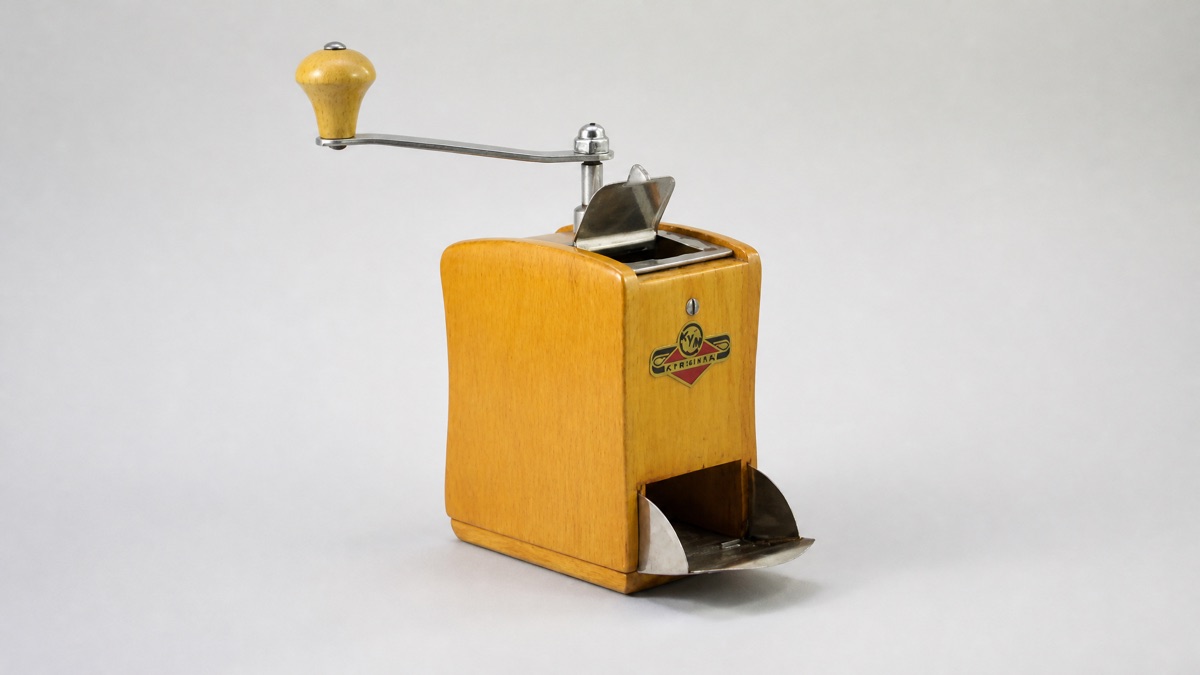
Welcome to my deep dive on the KyM coffee grinder, I'm Mark. I have spent years around gear like the Timemore C2. The KyM is a vintage German hand-crank mill, usually a small wooden box with a drawer. Kissing & Möllmann of Iserlohn made most surviving mills, and the company closed in 1980.
KyM mills come in dozens of models, from wooden Mokka boxes to plastic, bakelite and brass types. Owners report fluffy, consistent fine grounds, but no sifter test exists. Listings cost $25 to $89 before shipping. Cracked bakelite and seized brass are the usual faults, and spare parts do not exist at all.
Condition decides every purchase, so the review shows how to check a mill before buying. From vintage models to secondhand prices, I cover what matters. KyM had no part in writing it. The verdict is clear: a good working collectible, but not a daily grinder.
What Is the KyM Coffee Grinder?
The KyM coffee grinder is a vintage German hand-crank mill, usually a small wooden box with a crank on top and a drawer below. Kissing & Möllmann of Iserlohn made most of the surviving KyM mills between the 1930s and the 1960s.
The firm used the name K&M until the late 1920s or early 1930s. Mills with a K+M mark are older. Mills marked KyM, or KYM in listings, come from the later period.
Grinder production stopped in 1962. A retro wave in 1976 brought back three old-style lap mills at a few thousand units a year. The company closed on 7 November 1980.
Production fell fast before the end. Output dropped from 213,000 mills in 1956 to 76,000 in 1959 as electric grinders reached the market.
No new KyM stock exists today. Buyers find these mills secondhand through dealers and auction listings, so each example differs in condition.
German collectors call the small box type a Schoßmühle, or lap mill. Searching that word finds German listings.
A mark helps date a mill. A K+M mark means an older mill, and a four digit model number means it was made after 1945.
Who Made the KyM Grinder?
Kissing & Möllmann made the KyM grinder in Iserlohn, Germany. Ferdinand Möllmann and Johann Hermann Kissing founded the firm in 1826 and began with bronze goods and lighting.
The company built its own coffee mills from 1872. By 1877, 25 workers made 50,000 mills.
In 1894 the firm was the largest coffee mill maker in Germany. It built 200,000 mills a year with 120 workers and was the first to make printed tin mills.
Output peaked at up to 500,000 mills a year around 1910. In 1938 about 320 workers made up to 800 mills a day.
The factory at Obere Mühle 28 has been a listed monument since 1986. A city housing company bought it in 2019.
The Museum für Handwerk und Postgeschichte in Iserlohn opened a coffee mill room with KyM exhibits at the end of 2013.
Which KyM Grinder Models Exist?
Several KyM grinder models exist: KyM sold dozens of mill models, and the four digit numbers mark the post-1945 ones. The company switched from three digit to four digit model numbers in 1945.
The 9450 and 9460 are small Mokka box mills:
- 9450: This mill dates from about 1955. It has a dovetailed beech box.
- 9460: This mill dates from about 1955. It has a polished cherry box, a chromed lid and an aluminium crank.
The 9490 family dates from 1951 to about 1960. KyM built it for its 125th anniversary. The 9491 uses maple or walnut, and the 9493 uses cherry.
The 9485 is the budget box mill. It has a lacquered beech body and no funnel insert. It ran from 1950 to 1960.
KyM also made mills from other materials. These are three further types:
- Milly: This plastic mill has a chrome lid and crank. It ran from 1950 to 1960. Its rivals were the Dienes Mahlchen and the BeHa Liliput.
- Bakelite mill: This mill dates from about 1950. It has a red and brown marbled body.
- Brass Turkish-style mill: This mill dates from about 1950. It comes apart into four pieces.
KyM Models at a Glance:
| Model | Years | Body |
|---|---|---|
| 9450 | About 1955 | Dovetailed beech |
| 9460 | About 1955 | Polished cherry |
| 9490 | 1951 to about 1960 | Lacquered beech |
| 9485 | 1950 to 1960 | Lacquered beech |
| Milly | 1950 to 1960 | Polyethylene plastic |
| Bakelite mill | About 1950 | Marbled bakelite |
How Does the KyM Coffee Grinder Work?
The KyM coffee grinder works by grinding beans between two steel burrs turned by a hand crank. Beans go into the hopper on top, the crank turns the burr, and the grounds fall into the drawer or chute below.
The gap between the burrs sets the grind size. A smaller gap gives finer grounds, because the burrs crush each bean into smaller pieces.
Use is simple. Open the lid, fill the hopper, hold the box in the lap and turn the crank. Pull the drawer out and empty it into the brewer.
Collectors list most 1950s KyM mills with an underslung burr on a mandrel, a fixed spindle. The burr sits under the hopper, so the grounds drop straight down.
The older 1926 jubilee mill uses an upper burr instead. Its funnel and grinding ring screw together like a bulb and a socket. After 100 years, the two parts have fused.
A copper-bodied KyM Turkish-style mill carries a conical burr of tool steel. A steel cage holds the burr inside the housing.
Can the KyM Grinder Adjust the Grind?
Yes. The KyM grinder can adjust the grind: the copper Turkish-style mill uses a wheel that a thick spring holds in place. The spring keeps the setting from drifting while the crank turns.
No source lists numbered settings for the wooden box mills. The wheel and spring therefore give a feel setting, not a click count.
The fineness of the grind depends on the burr, the part that crushes the beans. Collectors call the burr a Mokka burr. Mokka burrs target fine grounds, so the KyM suits Turkish-style coffee best.
Old units can have worn or seized parts. A 2022 forum thread describes brass cylinders that will not pull apart.
What Is the KyM Coffee Grinder Made Of?
The KyM coffee grinder is mostly made of wood, with a metal burr, a metal crank and a metal funnel. The box mills use beech, cherry, or maple and walnut.
Metal parts sit on top of the wooden body. Lids and funnel rings come chromed or nickel plated. The crank is usually polished aluminium, and a few early 1950s mills have a curved steel crank.
The funnel is often a white painted steel insert. Some models differ. The model 369 has an orange and white sliding funnel, and the model 9311 has a nickel funnel.
Two models skip wood. The Milly uses polyethylene plastic with a chrome lid. The bakelite mill uses a red and brown marbled body.
The Turkish-style mill is brass or chromed brass. A copper-bodied version also exists.
How Big Is the KyM Grinder?
The KyM grinder is not big, standing between 17 and 27 cm (6.7 to 10.6 inches) tall, depending on the model. Most box mills are small enough to hold in a lap.
Models listed from shortest to tallest include:
- Milly: This model stands 17 cm (6.7 inches) tall.
- 9460: It measures 18 x 7 x 11 cm (7.1 x 2.8 x 4.3 inches).
- 9490: It measures 20 x 12 x 17 cm (7.9 x 4.7 x 6.7 inches). It is wider and deeper than the 9460.
- 369: It measures 21.5 x 11 x 11 cm (8.5 x 4.3 x 4.3 inches).
- Brass Turkish-style mill: It is 25 cm (9.8 inches) high and 5.5 cm (2.2 inches) across. This makes it the tallest slim model.
- 1926 jubilee: It measures 27 x 15 x 15 cm (10.6 x 5.9 x 5.9 inches). It is the largest model.
Does the KyM Coffee Grinder Grind Well?
Yes. The KyM coffee grinder grinds well, and owners report fluffy grounds with a very consistent particle size. That report comes from a CoffeeSnobs forum post about the copper Turkish-style model.
No published sifter test or particle size measurement of a KyM mill exists. The verdict rests on owner praise, not on lab numbers.
The praise makes sense for the job the mill is built to do. Mokka burrs target fine grounds, the kind Turkish-style coffee needs. That coffee is brewed in a cezve, a small pot with a long handle.
A buyer can ask the seller for a photo of a test grind.
Condition matters more than the brand. A 1950s mill with worn burrs will grind worse than a well kept one.
Is the KyM Grinder Fast?
Yes. The KyM grinder can be fast for a hand grinder, at about 80 turns for 14 g (0.5 oz) of fine grounds. An owner called the Turkish-style model very aggressive.
The box mills hold only a small dose, so each batch is quick but limited. The 9460 stands only 18 cm (7.1 inches) tall, and its box measures 7 x 11 cm (2.8 x 4.3 inches).
The 80 turn figure is the only speed number on record. No timed test against a modern hand grinder exists. The speed claim rests on that one count.
What Problems Does the KyM Coffee Grinder Have?
The KyM coffee grinder has age problems, since the mills are decades old. Cracked bakelite, seized parts and worn burrs are the common faults.
Bakelite is brittle. Bakelite KyM mills often have cracks or chips on the edges of the two body halves, so a buyer should inspect those edges first.
Brass mills can seize. A 2022 forum thread describes two brass cylinders that will not pull apart, and another member doubts the burr can come out at all.
The 1926 jubilee mill has a fused funnel. The 9485 is the budget design, and its dovetailed body and mandrel burr were already dated in the 1950s.
A short check before buying helps. Look for cracks, a smooth crank turn, a drawer that fits, rust on the burr and woodworm holes in the box.
Spares do not exist. The company closed in 1980, and no manual turned up for the box mills.
Common Problems:
- Cracked or chipped bakelite
- Seized brass cylinders
- Fused funnel on the 1926 jubilee mill
- Worn burrs
- No spare parts or manual
How Do You Clean a KyM Grinder?
A KyM grinder needs dry cleaning, with a brush to clear the grounds from the burr and drawer. Wood and water do not mix, so skip soaking.
The four-part brass mill comes apart for cleaning. Taking it apart lets the brush reach the burr and the grounds trapped inside. The chromed brass version may not release its burr, so brush it in place.
Old mills sit unused for decades. Run a few spare beans through a new purchase and throw that first batch away.
The collector site old-coffee-grinders.com keeps a section on cleaning and restoring old mills.
How Much Does the KyM Coffee Grinder Cost?
The KyM coffee grinder costs about $25 to $89 in current US listings, before shipping. Sellers price by model and condition.
The cheapest listing is a K+M dovetailed mill with a drawer at $25. The most costly is a painted wood 1940s Mokka mill at $89, or best offer. A wooden mill with a red crank costs $44.99, and a 1950s hand crank mill costs $49. An iron and wood KYM mill costs $80.
KyM Listing Prices:
| Listing | Price |
|---|---|
| K+M dovetailed mill with drawer | $25 |
| Wooden mill with red crank | $44.99 |
| 1950s hand crank mill | $49 |
| Iron and wood KYM mill | $80 |
| Painted wood 1940s Mokka mill | $89 |
Shipping can exceed the price. The $25 listing adds $41.73 for international shipping. It also adds an estimated $3.37 in import fees.
The listings come from eBay and Etsy, checked in October 2026. Prices move, so the range is only a snapshot.
Sold prices at Worthpoint sit behind a paywall. Completed sale figures are therefore not public.
Is the KyM Grinder Worth the Price?
Yes. The KyM grinder is worth the price for a working collectible at $25 to $89. A new Timemore C2 hand grinder lists at $67.99 to $83.
The listing price is not the full cost, because shipping can exceed the mill's price. A $25 mill with $41.73 in shipping and $3.37 in fees totals about $70. The exact sum is $70.10. That total sits close to the price of a new Timemore C2. A low sticker price does not guarantee a savings.
Condition is the remaining risk once the total cost is clear. Listings say the grinder works, but the seller cannot show how worn the burrs are. Burr wear stays unknown until the first batch.
How Does the KyM Coffee Grinder Compare to Other Mills?
The KyM coffee grinder sits among a crowd of German mills from the same period. Dienes, BeHa, Zassenhaus and KyM all sold small hand mills in the 1950s.
Because so many makers sold the same kind of mill, the Milly had direct rivals. The Dienes Mahlchen and the BeHa Liliput were the same kind of small plastic mill, and each maker gave its model a name.
The KyM bakelite mill copies an older design. The Dienes 411 from the 1930s was the model, and KyM added a drawer and dropped the handle. East German maker D.M.R. went further and built the Dienes mill almost to the letter.
Brass mills set a different standard. Buyers of the Turkish-style KyM weigh it against the Zassenhaus Turkish grinder.
New hand grinders offer a different deal from all of these old mills. The Hario Skerton Pro holds 100 g (3.5 oz) of grounds, far more than a KyM drawer.
KyM Against Other Mills:
| Mill | Type | Note |
|---|---|---|
| KyM Milly | Plastic lap mill | 1950s, chrome lid |
| Dienes Mahlchen | Plastic lap mill | Direct rival |
| BeHa Liliput | Plastic lap mill | Direct rival |
| Hario Skerton Pro | Modern hand mill | Holds 100 g (3.5 oz) |
| Timemore C2 | Modern hand mill | $67.99 to $83 |
Is the KyM Grinder Better Than a Modern Hand Grinder?
No. The KyM grinder is not better than a modern hand grinder for daily brewing. Modern models have numbered settings, spare parts and larger doses.
The KyM wins on looks. It has a wooden body, a small footprint and a fine Mokka grind. It costs $25 to $89, close to the price of a Timemore C2.
The KyM loses on convenience. The box mills have no setting marks, so a user cannot return to a past grind size with ease. They also have no spare parts. The small drawer holds less coffee, so each batch is smaller.
Is the KyM Coffee Grinder Worth It?
Yes. The KyM coffee grinder is worth it as a working collectible, not as a daily workhorse. The price is low, the grind is fine and the company history is well documented.
Daily filter brewers should look elsewhere. The small dose and the missing setting marks slow down a morning routine.
Pick the model by need. The brass Turkish-style mill suits Turkish coffee. The 9460 suits display and light use. The 9485 is the budget pick.
The condition of each mill decides the outcome. Check cracks, check the crank and ask the seller for a photo of the burr.
Pros:
- Low price
- Fine Mokka grind
- Well documented history
- Wooden looks
Cons:
- Condition varies
- No spare parts
- Shipping can top the mill's price
- No published tests
Who Should Buy the KyM Grinder?
Collectors and Turkish coffee drinkers should buy the KyM grinder. The Mokka burr suits fine grounds, and the model numbers make dating easy.
Buyers who want numbered settings or large doses should skip it. A modern hand grinder fits them better.
The Coffee Experiment is a reader-supported platform. Purchases made through our links may earn us an affiliate commission at no extra cost to you.