
Welcome in, I'm Mark, and the Kyocera review starts here. After 12 years on café bars, I read Kyocera gear with a barista's eye. I dig into grind adjustment, grind speed and cleaning. No brand paid for placement here.
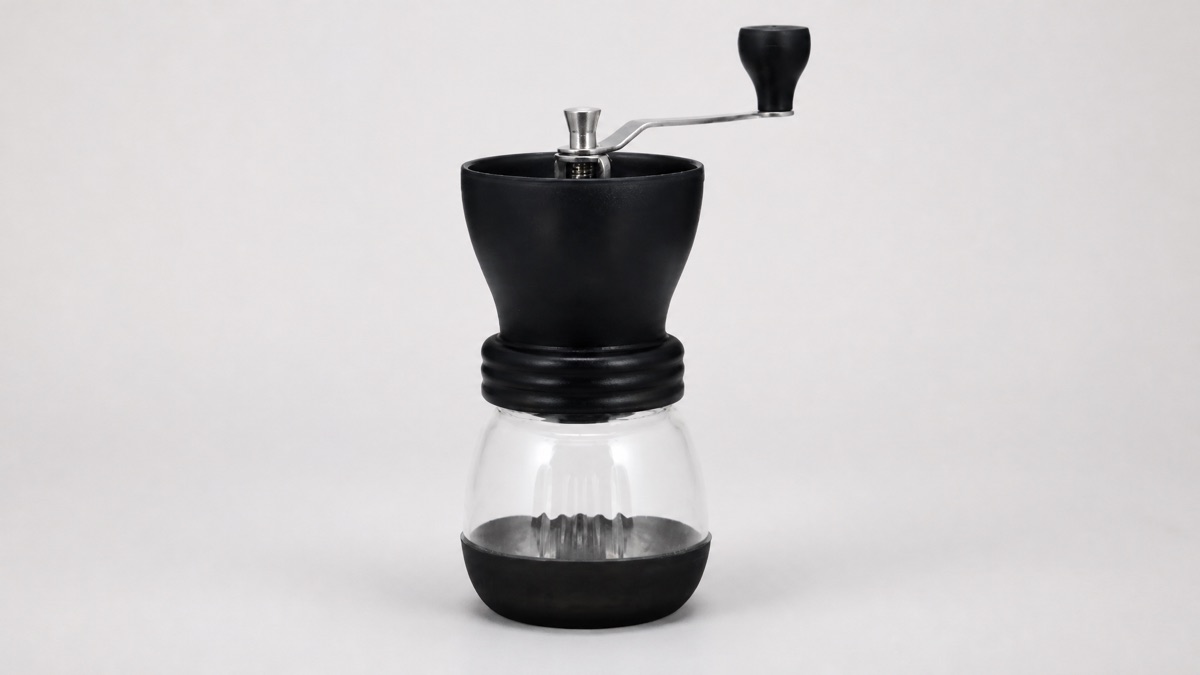
The Kyocera Advanced Ceramic Coffee Grinder is a manual hand-crank grinder from Kyocera of Japan. It crushes beans with a ceramic conical burr and drops the grounds into a glass jar. The standard CM-50CF stands 17 cm (6.7 in) tall and suits single servings of coffee.
The grinder gives average consistency. A double espresso dose takes about 1 minute, and the dial has no markings, so settings need trial and error. Owners praise the low price of about $35 to $50, the sealed jar and the easy cleaning. They complain about spitting beans and slow cranking.
The Hario Skerton looks the same and costs less, and travel rivals such as the Porlex Mini II compete too. Read on to learn how the grinder adjusts, how it compares, how to clean it and who should buy it.
What Is the Kyocera Coffee Grinder?
The Kyocera coffee grinder is a manual hand-crank grinder with a ceramic conical burr, made by Kyocera of Japan. Kyocera lists the standard version as the CM-50CF, which stands 17 cm (6.7 in) tall.
Kyocera is a Kyoto-based ceramics maker. Kyocera International sells and supports its kitchen line in the US.
The standard CM-50CF has a glass collection jar, a plastic upper section and a silicone non-slip base. Newer units add a lid for the jar, so ground coffee can sit sealed.
The conical burr covers a range from espresso to a passable French press grind. The same burr also grinds salt, pepper, green tea and sesame seeds.
The grinder fills the gap between cheap blade grinders and electric burr grinders that cost $70 or more. Its small size suits single servings.
Which Kyocera Coffee Grinder Models Are Sold?
Kyocera sells four coffee grinder models: the CM-50CF, the slim CM-40, the CM-45 and the electric EG-70CF. The CM-50CF is the standard hand mill that most reviews cover.
The slim CM-40 holds 1 oz (28 g) of beans. A silicone base keeps it steady while grinding. Its container is acrylic, and Kyocera's US store lists it at $58.00.
The CM-45 is the espresso-minded hand mill. Orphan Espresso sold it and called it a very good espresso grinder.
The EG-70CF is a battery model. It runs on 4 AA batteries, weighs 0.93 lb (0.42 kg) and made one to two cups per run. Kyocera's US store priced it at $39.95 and now lists it as unavailable.
Kyocera Coffee Grinder Models:
| Model | Type | Key Detail |
|---|---|---|
| CM-50CF | Manual | 17 cm (6.7 in) tall, glass jar |
| CM-40 | Manual, slim | 1 oz (28 g) hopper, $58.00 |
| CM-45 | Manual | Espresso-capable |
| EG-70CF | Battery | 4 AA batteries, $39.95 |
How Does the Kyocera Coffee Grinder Work?
The Kyocera coffee grinder works by crushing beans between a fixed and a turning ceramic conical burr as the hand crank spins. The ground coffee falls into the glass jar below.
Kyocera describes the burr as advanced ceramic close in hardness to diamond. The material never rusts. Ceramic is chemically inert, so the burr cannot alter the taste of the coffee.
A blade grinder chops beans at random and leaves a mix of dust and chunks. The Kyocera design works differently. Its two burr surfaces keep a fixed gap between them, so each bean is crushed to a narrower size range.
The handle sits on a hexagonal shaft that turns the moving burr. The silicone base grips the table, but one hand must still hold the body steady while the other cranks.
How Do You Adjust the Kyocera Grinder?
You adjust the Kyocera grinder by taking off the handle and turning a nut on the burr shaft. Turning counter-clockwise gives a coarser grind for French press. Turning clockwise gives a finer grind for espresso.
The full sequence has several steps. Unscrew the metal cap, remove the handle, lift off the toothed piece and twist the shaft. Then put the toothed piece, handle and cap back on.
Adjustment Steps:
- Unscrew the metal cap.
- Remove the handle.
- Lift off the toothed piece.
- Twist the shaft nut to the wanted setting.
- Replace the toothed piece, handle and cap.
The dial has no markings. One tester needed three tries to dial in a drip grind. AeroPress users count clicks instead, such as 5 clicks out from fully tightened.
The settings move in steps rather than a smooth range. Some owners change the bean dose to fine-tune the result.
Does the Kyocera Coffee Grinder Grind Evenly?
No. The Kyocera coffee grinder does not grind evenly, giving only average consistency. That result is normal for an inexpensive manual grinder.
Coarse settings crank more easily. They also make the grinder stumble or jam more often.
The shaft runs in the plastic upper body only. Play can develop in that guide over time, which hurts evenness.
The Hario Skerton Pro is a revised Skerton. It adds a burr stabilization spring and a hex lock for the shaft, which target that wobble.
Can the Kyocera Grinder Make Espresso?
Yes. The Kyocera grinder can make espresso, but the standard CM-50CF needs careful setting. One owner went a single click too fine and choked the espresso machine.
The CM-45 earns better reports. A Rancilio Silvia owner called the shots amazing and said grinding took about 2 minutes.
Orphan Espresso judged the CM-50 a rebranded Hario Skerton. The shop said the grinder does not reach the extremes of the grind range and would not recommend it to espresso fanatics.
How Fast Is the Kyocera Grinder?
The Kyocera grinder is not fast, taking about 1 minute to grind a double espresso dose. The CM-45 takes about 2 minutes for a similar dose.
Speed gets worse as the dose grows, because every extra bean needs more cranking. One tester needed ten minutes of cranking for a few tablespoons of espresso grind. A full pot of coffee is a chore.
The look-alike Hario Skerton shows the same problem. It needs about 100 turns per tablespoon of beans at a near-espresso setting.
Some owners tried to cut the effort with a cordless drill on the shaft. Two owners did this. The hexagonal shaft on one unit rounded off after about eight months, so a drill adds wear.
What Do Owners Say About the Kyocera Coffee Grinder?
Owners rate the Kyocera coffee grinder as a decent, cheap starter grinder with real drawbacks. Reviewers call it an amazing first grinder and also a decent but unremarkable one.
Praise centers on price, single servings and the CM-45's espresso results. Complaints center on speed, awkward handling and beans that spit from the hopper.
Most owner reports date from 2010 to 2016. Current units may differ in small details such as the jar lid.
What Do Owners Like About the Kyocera Grinder?
Owners like the Kyocera grinder for its low price, solid glass jar and sealed storage. Reviews put the price at about $35 to $36 on Amazon.
The jar is made of thick glass. The whole grinder weighs about a pound (0.45 kg), so it feels stable and solid in the hand. The handle stays on and has a comfortable length.
The glass jar also holds the grounds. One owner says the jar seals so well at top and bottom that grounds stay as fresh as in any other container.
The grinder also suits camping and power cuts, since it needs no electricity.
What Problems Does the Kyocera Grinder Have?
The Kyocera grinder will have four problems: spitting beans, awkward handling, shaft wear and a clumsy adjustment. Bean chunks jump out of the open hopper near the end of grinding.
The body is too big to hold in one hand and too small to grip between the thighs. That makes steady cranking awkward.
The hexagonal handle shaft is soft metal and the handle fits loosely. On one unit the shaft rounded off after about eight months.
Main Problems:
- Beans spit from the open hopper
- Body is awkward to hold
- Soft hexagonal handle shaft wears
- Adjustment needs the handle off
Changing the grind means taking the handle off each time. Trial and error follows, because the dial has no scale.
How Does the Kyocera Coffee Grinder Compare With Rivals?
The Kyocera coffee grinder compares with rivals as a near twin of the Hario Skerton that trails the CM-45 for espresso. Rivals such as the Porlex Mini and the Hario Mini Mill also compete for the same buyers.
Shoppers in a 2011 German forum thread weighed the Porlex Mini, the Porlex, the Hario Skerton and the Kyocera CM-50 for AeroPress and espresso use.
Orphan Espresso rated the CM-45 above both the CM-50 and the Skerton for espresso. A 2010 poster noted that the Hario Mini Mill cost half as much as the CM-45.
The Porlex Mini II holds 20 g of beans in a stainless steel body with ceramic conical burrs. The Hario Mini Mill Plus holds about 24 g. The Hario Skerton Pro has a 100 g grounds container.
| Grinder | Burr | Best use |
|---|---|---|
| Kyocera CM-50CF | Ceramic conical | Drip, French press, AeroPress |
| Kyocera CM-45 | Ceramic conical | Espresso |
| Hario Skerton | Ceramic conical | Drip, French press, AeroPress |
| Hario Skerton Pro | Ceramic conical | Drip, French press, AeroPress |
| Porlex Mini II | Ceramic conical | Travel, AeroPress |
| Hario Mini Mill | Ceramic conical | Travel, single servings |
Is the Kyocera Grinder Better Than the Hario Skerton?
No. The Kyocera grinder is not better than the Hario Skerton, which looks the same, costs less and adds a lid. The Skerton earned the same 4.3 star rating from about twice as many Amazon buyers.
The reason the two look alike is simple. Orphan Espresso found that the Kyocera CM-50CF is a Skerton in a Kyocera box. The box read made in China, with glass made in Japan.
Because the grinders are the same, price is the main difference. In 2010 the Kyocera listing sold for $60 on Amazon while the Skerton sold for about $40. A later review put the gap at about $6.
The Skerton shares the same weak points. Its shaft is supported from above only, the adjustment is clumsy and the handle nut works loose.
How Do You Clean the Kyocera Coffee Grinder?
You clean the Kyocera coffee grinder by brushing the burr area after use and washing the parts weekly. Bean fragments stick to the underside of the grinding mechanism.
A pastry brush sweeps the underside clean over the sink. A toothbrush also works.
For the weekly wash, unscrew the handle and small parts, then soak them in hot water with a few drops of detergent. Rinse well and air dry. Coffee oils turn rancid over time, so skipped washes add off flavors.
Weekly Wash Steps:
- Unscrew the handle and small parts.
- Soak them in hot water with a few drops of detergent.
- Rinse the parts well.
- Air dry the parts before reassembly.
The ceramic burr never rusts, so water does no harm to it. Kyocera Europe advises a neutral detergent for the grinding mechanism.
Is the Kyocera Grinder Dishwasher Safe?
Yes. The Kyocera grinder is dishwasher safe for the glass jar, but the grinding top needs hand washing. Warm tap water and air drying suit the top section.
The plastic upper body and burr stay out of the dishwasher. The burr is the part that grinds the beans. It gets the same hand washing as the body that holds it.
Newer units include a lid for the jar. The lid lets ground coffee sit in the jar sealed until the next brew.
How Much Does the Kyocera Coffee Grinder Cost?
The Kyocera coffee grinder costs about $35 to $50 in most reviews. A 2011 review gave $36 on Amazon and a 2013 article gave about $50.
One 2011 buyer paid $60 delivered from Japan. Prices have moved with the seller and the year.
The slim CM-40 costs $58.00 on Kyocera's US store. The Hario Skerton Pro listed at $58.50 on Hario USA, though it showed as sold out.
The EG-70CF electric model was priced at $39.95 on Kyocera's US store. That listing now reads as unavailable.
The grinder sits between cheap blade grinders and electric burr grinders at $70 and up.
Where Can You Buy the Kyocera Grinder?
You can buy the Kyocera grinder where Amazon, eBay and Kyocera's own US store sell it. Orphan Espresso sold the CM-45.
Kyocera's US store carries a notice about counterfeit Kyocera products. Buyers should check the seller before paying.
Kyocera International answers support calls at (800) 537-0294, Monday to Friday, 8am to 5pm Pacific.
Is the Kyocera Coffee Grinder Worth It?
Yes. The Kyocera coffee grinder is worth it as a cheap, rust-proof starter for single servings, with limits.
The pros are the low price, the solid glass jar, sealed storage and easy cleaning. The cons are slow grinding, a clumsy adjustment, average consistency and shaft wear.
Pros:
- Low price
- Solid glass jar
- Sealed storage
- Easy cleaning
Cons:
- Slow grinding
- Clumsy adjustment
- Average consistency
- Shaft wear
The Hario Skerton offers the same build for less money, with a lid. Buyers who find one at a lower price should take it.
Who Should Buy the Kyocera Coffee Grinder?
Single-serving drinkers should buy the Kyocera coffee grinder, especially AeroPress and French press users. Campers and anyone who loses power also gain from a grinder without a cord.
People who brew full pots should skip it. Anyone who wants fast espresso grinding should skip it too.
The low price makes a later upgrade easy. A better grinder can replace it without much regret.
The Coffee Experiment is a reader-supported platform. Purchases made through our links may earn us an affiliate commission at no extra cost to you.