
Hello, and thanks for stopping by, I'm Mark. I tasted my way through Rome's Piazza Navona and came home pickier about espresso grinders.
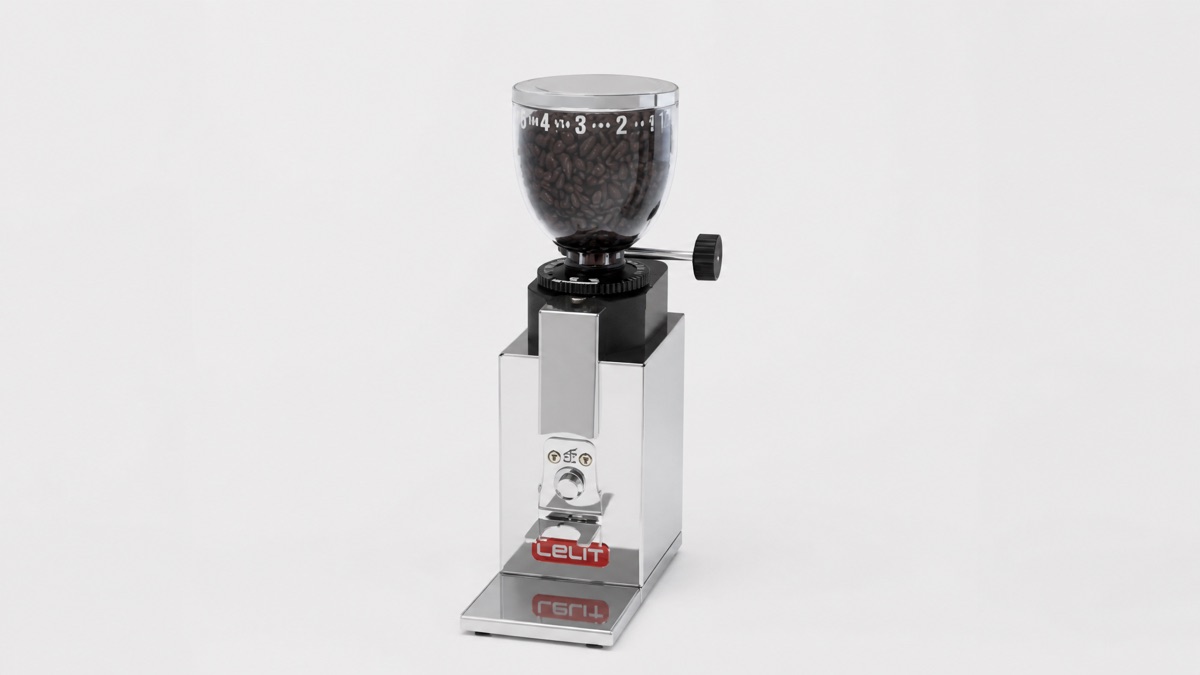
A Lelit coffee grinder is an espresso-focused on-demand grinder from the Italian brand Lelit, owned by Breville Group since 2022. The line has the compact conical Fred and the larger flat-burr William PL72. Both grinders drop coffee straight into the portafilter.
The Fred has stepless adjustment, 38 mm conical burrs and an optional timer. A German lab test measured 4.5 g of retention and 88.9 dB of noise on the Fred Tempo. The same test found the widest particle spread of 24 grinders. The William PL72 grinds faster, at 2.5 g per second.
Prices run from $179.95 for the Fred Prima to $599.95 for the William PL72, with a 12-month warranty. Beginners with a small espresso machine gain the most. This is a full look at burr size, noise and retention and price and warranty. No brand is behind it.
What Is a Lelit Coffee Grinder?
A Lelit coffee grinder is an espresso-focused on-demand grinder from the Italian brand Lelit. The line has two families. The Fred is a compact conical model, and the William is a larger flat-burr model.
Lelit began in Italy in 1986 and made domestic appliances first. The company later moved into prosumer espresso machines. The grinders grew out of that machine range.
Lelit built the grinders as companions to its espresso machines. The Fred sits beside small single-boiler machines such as the Anna and the Grace. The William matches the curves of the Victoria, Elizabeth and Bianca machines.
Lelit grinders are made for espresso first. The Fred's stepless dial has no numbers. Coffee left in the chute makes this worse, so daily swaps between espresso and filter settings are slow.
Which Lelit Coffee Grinder Models Are Sold in the US?
The Lelit coffee grinder models sold in the US are the Fred and the William. The Fred comes as the Prima PL043MMI and the timed Tempo PL044MMT. The William PL72 is the flagship.
The Fred Prima PL043MMI is the simplest of the three. The Prima uses manual press-and-hold grinding, so the user holds the button until enough coffee is ground. The Lelit US site lists the Fred Prima at $179.95.
The Fred Tempo PL044MMT is the timed version of the Fred. A side button sets a grind time from 2 to 20 seconds, and the grinder stops on its own. The Lelit US site lists the Fred Tempo at $199.95. The Tempo weighs 3 kg (6.6 lb) and measures 14 x 22 x 34 cm (5.5 x 8.7 x 13.4 in). Its hopper holds 250 g (8.8 oz) of beans.
The William PL72 is Lelit's flagship standalone grinder. The William has 64 mm (2.5 in) flat burrs, an OLED display and two programmable timed doses. The William is larger than the Fred. The William weighs 14.5 lb (6.6 kg) and stands about 15 in (38 cm) tall. Its hopper holds 350 g (12.3 oz) of beans.
Lelit Grinder Models:
| Model | Burrs | Dosing |
|---|---|---|
| Fred Prima PL043MMI | 38 mm conical | Manual press and hold |
| Fred Tempo PL044MMT | 38 mm conical | Timer, 2 to 20 seconds |
| William PL72 | 64 mm flat | Two programmable timed doses |
The PL53, PL54 and PL71 are earlier models. Buyers mostly see them used, so parts, voltage and electronics need checking.
Who Makes the Lelit Coffee Grinder?
Lelit S.r.l., an Italian company, makes the Lelit coffee grinder in Italy. The Fred and the William both carry the Lelit name.
Breville Group completed its acquisition of Lelit in 2022. Lelit kept its own brand and its Italian espresso focus. Model availability still differs by country.
Because one owner now holds both names, Breville and Lelit remain separate brands. Their grinders show the difference. The Breville Smart Grinder Pro has 60 adjustment settings and a plastic body. The Lelit Fred has stepless adjustment and a stainless steel body.
How Does a Lelit Coffee Grinder Work?
A Lelit coffee grinder works by grinding on demand, straight into the portafilter. Beans wait in the hopper. The portafilter presses a microswitch, and the motor runs.
Once the motor runs, the burrs do the cutting. A micrometric dial moves them closer together or farther apart. The dial sets grind size without fixed steps, so a fine move changes how fast the shot flows.
The microswitch also decides how much work the user does. The Fred needs the switch held for the whole grind. A programmed dose does not release the switch. Hands-free grinding is not possible on the Fred.
The William PL72 lists hands-free grinding as a feature. Its chute angle and top pin height both adjust, so portafilters of different shapes fit.
What Burrs Does a Lelit Coffee Grinder Use?
A Lelit coffee grinder uses 38 mm (1.5 in) conical steel burrs in the Fred and 64 mm (2.5 in) flat burrs in the William PL72.
Flat burrs shear coffee across two opposing faces. This design generally grinds faster than the Fred's smaller conical set. The William PL72 is rated at 2.5 g per second (0.09 oz per second).
Burr size does not rank the cups. Burr shape, alignment, the coffee and the recipe decide the result.
The Fred's 38 mm burrs are small for espresso. Grind times run longer, and the ceiling sits below 50 mm (2 in) rivals.
A German lab test measured the Fred Tempo at 14.3 g in 10 seconds (0.5 oz). That speed is about 1.4 g per second, so an 18 g dose takes roughly 13 seconds.
How Does Lelit Coffee Grinder Stepless Adjustment Work?
Lelit coffee grinder stepless adjustment works by moving the burrs in tiny, continuous amounts instead of fixed steps.
Turning the micrometric dial moves the burrs. A small turn changes the grind size by a small amount. Espresso needs that control because a tiny change alters how fast water flows through the shot.
The Fred has no click positions, so nothing marks one setting from the next. A scale on the hopper gives only a rough guide. Adjusting therefore goes by feel.
Grind adjustments are made while the grinder runs. A stopped motor can leave partly ground beans between the burrs, and those beans can lock them.
Without numbered clicks, large moves are slower. The dial has no count to follow, so returning to an old setting is hard. Marking the dial before a big change gives a point to return to.
The William PL72 works differently. Its dial is numbered 1 to 10 and moves in half steps. Each setting can be written down and repeated, which makes the numbers easy to note.
How Does Lelit Coffee Grinder Timed Dosing Work?
Lelit coffee grinder timed dosing works by running the motor for a programmed number of seconds. The grinder stops when the time ends, so the length of the run sets the amount of coffee.
The Fred Tempo stores one time, from 2 to 20 seconds. Programming starts when the side button is held until the light goes out. Each press after that adds half a second to the stored time.
The William PL72 stores two doses on its display, one single and one double. The doses are time based, not weight based. Neither grinder measures the coffee it grinds.
A timer does not weigh coffee, so the same time can give different amounts. Grind size and bean age change the flow rate. A scale check after each change keeps the dose right.
Weighing the beans before each grind skips the timer. The Fred then works as a single-dose grinder.
How Well Does a Lelit Coffee Grinder Perform?
A Lelit coffee grinder performs well enough for espresso, with stepless control and a clean stainless build. Grinding speed and chute retention are the weaker points.
The Fred drops mostly clump-free grounds straight into the portafilter. That makes it easy to use, since the grounds land where they are needed. Slower grinding holds the Fred back, though, and so does noticeable retention.
Retention means ground coffee stays inside the grinder after a dose. The Kaffeemacher lab test measured 4.5 g of retained coffee in the Fred Tempo. The Fred Prima held 5.0 g. Retained coffee carries over when the beans change.
RoastAroma ranks the Fred Tempo in the lower half of 154 measured grinders for espresso suitability.
Is a Lelit Coffee Grinder Good for Espresso?
Yes. A Lelit coffee grinder is good for espresso, especially as a first stepless grinder.
The Fred grinds fine enough for espresso. Its micrometric dial allows precise dialing in, and its price suits beginners.
The Kaffeemacher test found the widest particle spread of 24 grinders compared, and the tester does not recommend the Fred for pure espresso. A wide spread shows up in the cup.
Filter coffee is a weaker fit. A stepless dial with no numbers and left-over grounds make daily switching awkward.
Serious home baristas often outgrow the Fred. Upgrades usually mean a bigger-burr single-dose grinder with faster output.
Is a Lelit Coffee Grinder Loud?
Yes. A Lelit coffee grinder is loud while it runs, though each shot needs only a few seconds.
The Kaffeemacher lab test put numbers on the noise. The test measured 88.9 dB for the Fred Tempo and 87.5 dB for the Fred Prima.
A typical Fred dose runs about 10 to 13 seconds. The grinder only makes this noise while it grinds, so the total noise per shot stays small.
The motor is not the only source of sound. Stainless panels can rattle and add to the noise. The older PL53 showed this clearly.
The noise ends as soon as the portafilter leaves the switch.
What Problems Does a Lelit Coffee Grinder Have?
A Lelit coffee grinder has four common problems: a thin hopper, a light body, chute retention and no hands-free grinding.
The hopper plastic is thin. The large grind scale on the hopper looks cheap beside the polished stainless shell.
The light body can shift on the counter when the portafilter presses the switch.
The chute holds noticeable retention compared with better-designed on-demand grinders.
The Fred has no hands-free grinding. The microswitch must stay pressed for the whole grind, even with a programmed dose.
Main Problems:
- Thin hopper plastic
- Light body that shifts on the counter
- Chute retention
- No hands-free grinding on the Fred
Is a Lelit Coffee Grinder Reliable?
Yes. A Lelit coffee grinder is reliable enough for daily home use, though early failures and weak plastic parts do appear.
Parts and repairs stay easy to find for the Fred platform. Owner threads describe a long record for the conical burr set.
A Fred can stop feeding beans when a beginner chokes the burrs with coffee. A forum thread on a PL043 failure traced to that common trap.
The older PL53 can jam on oily beans, and its plastic hopper can break within months.
An earlier William has a known flaw. Its adjustment becomes very hard to turn if the grinder is turned upside down, for example in shipping.
How Do You Clean a Lelit Coffee Grinder?
Cleaning a Lelit coffee grinder means removing the hopper and upper burr, then brushing out the dust and wiping off the oils.
A stiff brush clears the coffee dust. A vacuum clears the burr chamber. Frequent use calls for a burr clean every couple of weeks.
The hopper also needs a wipe with a paper towel. Coffee oils build up there and turn rancid.
Cleaning tablets such as Urnex Grindz also work. Regular brushing makes them unnecessary.
Unplug the grinder before opening it and keep water off the steel burrs. Mark the dial first, then approach the fine end slowly after reassembly.
Cleaning Steps:
- Unplug the grinder and mark the dial setting.
- Remove the hopper, then the upper burr.
- Brush the coffee dust off the burrs.
- Vacuum the burr chamber.
- Wipe the hopper with a paper towel.
- Reassemble and approach the fine end slowly.
How Does a Lelit Coffee Grinder Compare With Rivals?
A Lelit coffee grinder compares well on price and build but trails single-dose rivals on retention and speed.
The Breville Smart Grinder Pro costs $199.95 and has 60 adjustment settings in a plastic body. The Fred offers stepless control in stainless steel. Stepless means the grind can be set at any point, not only at fixed clicks.
The Baratza Encore ESP also costs $199.95. The Encore ESP is an all-rounder that grinds for Turkish through French press. The Encore ESP is not set up to dose a portafilter, the handle and basket that hold coffee for an espresso machine.
The William PL72 is the step up inside the Lelit range. The William grinds at 2.5 g per second against the Fred's 1.4 g, with 64 mm (2.5 in) flat burrs.
Price And Type Comparison:
| Grinder | Price | Type |
|---|---|---|
| Lelit Fred Tempo | $199.95 | Hopper-fed, stepless, timer |
| Breville Smart Grinder Pro | $199.95 | 60 settings, plastic body |
| Baratza Encore ESP | $199.95 | All-rounder |
| Turin DF54 | $249 | 54 mm flat, single dose |
| Eureka Mignon Notte | $329 | 50 mm flat, stepless |
Lelit Coffee Grinder vs Turin DF54: Which Is Better?
The Lelit coffee grinder and the Turin DF54 suit different routines, so neither is better for everyone.
The DF54 is a 54 mm (2.1 in) flat-burr single-dose grinder. Its stepless adjustment lets the grind be set to any point, not just fixed clicks. The DF54 lists at $249. Weighed doses and near-zero retention are its strengths.
Single dosing means the DF54 needs a scale, a cup transfer and a clearing routine. That routine suits households that swap beans or brew decaf sometimes.
The Fred PL044MMT works the opposite way. The Fred is hopper-fed, with 38 mm (1.5 in) conical burrs and a timer. Hopper feeding saves weighing beans for each drink.
Choose the DF54 for compact flat-burr single dosing. Choose the Fred when timed hopper espresso is more convenient.
Lelit Coffee Grinder vs Eureka Mignon Notte: Which Is Better?
The Eureka Mignon Notte is the stronger grinder for serious espresso, while the Lelit coffee grinder wins on price and timed dosing.
The Mignon Notte lists at $329. The Notte has 50 mm (2 in) stainless flat burrs, the parts that crush the beans. Its adjustment is stepless, so the grind size changes in tiny increments rather than fixed clicks.
The Mignon Notte has no programmable dosing, so the user cannot set the grinder to deliver a chosen amount. Its hopper, which holds the beans, takes 150 g (5.3 oz).
The Fred hopper holds 250 g (8.8 oz), which is more than the Eureka holds. The Tempo offers a timer.
Both grinders serve espresso well. The Eureka suits true espresso enthusiasts, and the Fred suits beginners on a budget.
How Much Does a Lelit Coffee Grinder Cost?
A Lelit coffee grinder costs $179.95 for the Fred Prima and $199.95 for the Fred Tempo on the Lelit US site.
The Fred Tempo costs $20 more than the Fred Prima. The extra $20 buys the programmable timer.
The William PL72 lists at $599.95 from US dealers. That price is three times the Fred Tempo price.
The Fred costs less than the $329 Eureka Mignon Notte and the $249 Turin DF54. The Fred Tempo price matches the $199.95 Breville Smart Grinder Pro.
RoastAroma finds that 78 percent of grinders with similar capability cost more than the Fred Tempo.
What Warranty Does a Lelit Coffee Grinder Carry?
A Lelit coffee grinder carries a 12-month limited warranty against defects in materials and workmanship.
The warranty covers products bought and used in North America. Commercial use falls outside it. A shop that buys a Lelit grinder for daily service cannot count on this coverage.
Lelit US, run by Breville USA, handles claims in North America. Registration is not required, but proof of purchase may be, so the receipt is worth keeping.
Qualifying claims get a pre-paid shipping label. Typical turnaround runs up to 10 business days, plus shipping.
The same regional limit affects imports. A 230-volt, 50 Hz grinder cannot run on 120-volt North American power. A plug adapter changes only the plug shape, not the voltage, so it does not fix the problem.
Used grinders carry a further risk, because repair parts can cost a lot. Control boards for older PL54 and PL71 models can be costly. A used price needs a parts check.
Is a Lelit Coffee Grinder Worth It?
Yes. A Lelit coffee grinder is worth it as a first stepless espresso grinder, but not as a single-dose or filter grinder.
The pros are stepless micrometric adjustment, a stainless shell, a compact body and a timer on the Tempo.
The cons are slow 38 mm burrs, chute retention, loud grinding, a thin hopper and no hands-free grinding.
Fred Verdict At A Glance:
- Pro: stepless micrometric adjustment
- Pro: stainless shell and compact body
- Pro: timer on the Tempo
- Con: slow 38 mm burrs and chute retention
- Con: loud grinding and a thin hopper
- Con: no hands-free grinding
The William PL72 trades the Fred's small size for 64 mm flat burrs and faster output. The William PL72 costs three times as much.
Who Should Buy a Lelit Coffee Grinder?
Beginners with a small single-boiler machine, such as the Lelit Anna or Grace, gain the most when they buy a Lelit coffee grinder.
The William PL72 suits households that make several milk drinks each morning from one blend. The William stores programmed single and double doses, so each drink repeats the same way every time.
Daily bean swappers and filter brewers are better served elsewhere. Changing beans often calls for a single-dose grinder, which grinds one small portion at a time. The Turin DF54 or DF64 fits that routine.
The Coffee Experiment is a reader-supported platform. Purchases made through our links may earn us an affiliate commission at no extra cost to you.