
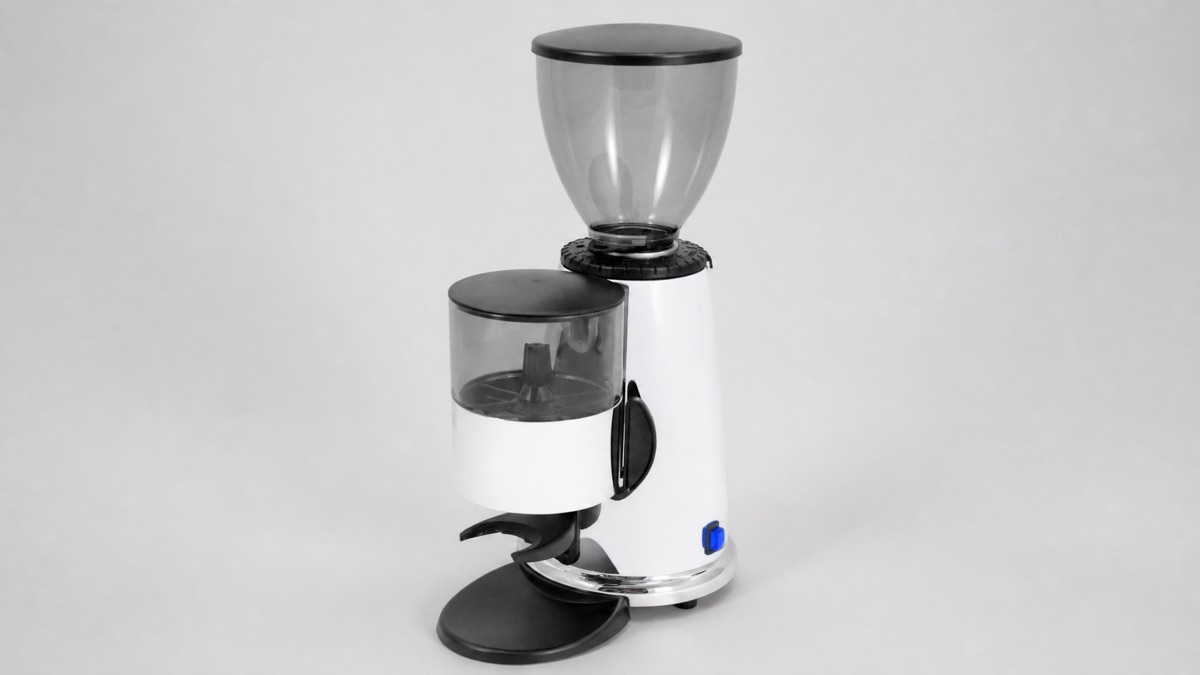
Hello, I'm Mark, the experiment barista here. Between bar shifts and trips to Washington's Dupont Circle, I have used many espresso grinders. This review is independent, built on my barista years, hands-on testing and careful research.
The Macap coffee grinder is a line of Italian burr grinders from a maker founded in 1930 near Venice. Macap sells 29 named configurations today. They range from compact home models such as the M2M to high-output café machines such as the Supra 83, with very different prices.
The M2M uses 50 mm (2 in) flat burrs and suits espresso at home. The M4 adds a worm drive for stepless adjustment. Owners praise the solid build and even grind. They also report hopper screws, confusing adjustment direction and doser chambers that hold stale coffee between shots.
Macap names look alike but differ in dosing, burrs and duty. This review explains what each group does, how it grinds, what it costs and who should skip it. The verdict at the end says plainly whether a Macap grinder earns its price on a home or café counter.
What Is the Macap Coffee Grinder Range?
The Macap coffee grinder range spans 29 named configurations, from compact home models to high-output café machines. Macap is an Italian maker founded in 1930 near Venice. The lines are Supra, Supra G, Pro, Studio, Labo and Leo.
Macap builds on the Italian commercial formula. Heavy cast bodies, steel burrs and micrometric adjustment form the core. Micrometric adjustment lets the user change the grind size in very small steps. Delivery runs either through a dosing chamber or straight into the portafilter.
Model names repeat across generations. M4, M5, M7 and MX each appear in several eras. A buyer must confirm the exact model, voltage and burr set before ordering.
Macap sells grinders for lower-volume and higher-volume work. The Studio and Leo lines suit home, office and small counters. The Supra and Pro lines suit busy cafés.
Where Are Macap Grinders Made?
Macap grinders are made in Italy, where the company base sits in Maerne di Martellago near Venice. Macap describes its professional bar equipment as Italian-made.
The company started in 1930 in the Venice area. Its early products served Italian bars and restaurants. Grinders and dosers later grew into the core of the catalog.
Macap now sells in some 50 countries. Regional catalogs differ. Older names such as MD4 and MD5 appear only in some of them.
What Do Macap Grinder Model Letters Mean?
Macap grinder model letters mean different things in different families. The following are the six codes that matter most:
- D: This usually marks electronic on-demand or programmed dosing.
- M: This often marks manual control.
- E: This marks electronic control, mostly on compact Domus models.
- Z: This marks a zero-setting adjustment version. It does not change the burrs.
- K: This marks a doser configuration that varies by family.
- G Series: This means grind-by-weight dosing.
The M in M7 is part of the family name, not a control code. Numbers often relate to a platform or burr class. A buyer should never infer an exact burr diameter from the number alone.
Which Macap Grinder Models Can You Buy?
Buyers can buy Macap grinder models in six groups: Supra, Supra G, Pro, Studio, Labo and Leo. Supra and Supra G target busy cafés. Pro covers traditional commercial work. Studio and Leo cover compact use. Labo covers experimental work.
The Supra 68 uses 68 mm (2.7 in) flat burrs and a 550 W motor. Output is 3.8 to 4.5 g/s. The Supra 83 uses 83 mm (3.3 in) burrs, 750 W and 5.5 to 6 g/s.
Supra Line Specs:
| Model | Burrs | Motor | Output |
|---|---|---|---|
| Supra 68 | 68 mm (2.7 in) | 550 W | 3.8 to 4.5 g/s |
| Supra 83 | 83 mm (3.3 in) | 750 W | 5.5 to 6 g/s |
| MI40 Pro | 65 mm (2.6 in) | 600 W | 3.5 to 4 g/s |
Both Supra grinders share a 1.5 kg (3.3 lb) hopper and a 3.5-inch touchscreen. The 83 is not automatically the better buy. The larger burr set pays off only where rush-hour dose speed matters.
Supra G models measure the delivered dose instead of estimating it from motor run time. Weighing can reduce timer drift as beans age. The scale hardware needs regular cleaning and calibration.
Used Macap grinders are common. A used unit should be identified from its rating plate, not its looks. Check burr type, voltage, motor, bearings and adjustment threads before buying.
Which Macap Grinder Suits Home Use?
The Macap M2M grinder suits home use. It has 50 mm (2 in) flat burrs and a 250 g (8.8 oz) hopper. Macap sizes the Studio line for home, office and small counter spaces.
The M2M draws 250 W and grinds about 1 g/s. The body weighs 5 kg (11 lb). It measures 152 x 250 x 382 mm (6 x 9.8 x 15 in). Dosing is manual, with a height-adjustable fork.
The Studio line also holds the Domus M2E and the Silent M2D. The M2E adds electronic dosing. The M2D adds timed on-demand dosing in a noise-oriented enclosure.
Home Models:
- Domus M2M with manual dosing
- Domus M2E with electronic dosing
- Silent M2D with timed on-demand dosing
- Leo 55 Touch with a touchscreen
The Leo 55 Touch is a second compact option. It has 55 mm (2.2 in) flat burrs, a 390 W motor and a 300 g (10.6 oz) hopper. Output is 1.8 to 2.2 g/s.
The older M4 is larger. The M4 weighs 25 lb (11.3 kg) and stands 17 in (43 cm) tall. Studio styling does not prove commercial duty, so buyers should confirm the rated workload.
Which Macap Grinders Are Built for Cafés?
Macap grinders built for cafés start at the MI40 Pro and run up to the Supra 83. The MI40 Pro has 65 mm (2.6 in) flat burrs and a 600 W motor. Output is 3.5 to 4 g/s.
The MI40 Pro holds 1.2 kg (2.6 lb) of beans. It adds a 3.5-inch touchscreen, a height-adjustable hands-free fork and a pull-out grounds plate. The grind ring can return to a defined zero.
The M7DL uses 75 mm (3 in) flat burrs and an 800 W motor. Retail listings show 65 mm flat steel burrs on the MXA and MXDL. Both families come in doser and on-demand forms.
The Labo 70D and 70M use 70 mm (2.8 in) flat burrs and a 900 W motor. Output reaches 6 g/s. The 70D weighs 17 kg (37.5 lb) and the 70M weighs 16.5 kg (36.4 lb).
The Pro Shop line, MC6, MC42 and MC7, grinds for bags and larger containers. Chute design, knocker, cooling and pounds per hour matter more there than burr size.
How Does a Macap Coffee Grinder Work?
The Macap M4 coffee grinder does its work with 58 mm (2.3 in) flat burrs. A 250 W motor turns them at 1600 RPM at 60 Hz.
Flat burrs are two parallel, toothed steel rings. The gap between the rings sets the grind size. The low burr speed keeps heat down. The burrs are replaceable. Macap burr sizes run from 50 mm (2 in) on the M2M. The Supra 83 tops the range at 83 mm (3.3 in).
Doser models hold ground coffee in a chamber. The M4 dosing levels adjust from 5.5 to 9 g (0.19 to 0.32 oz). On-demand models grind straight into the portafilter, so coffee does not sit.
The base M2M uses manual dosing and a portafilter trigger. Pushing the portafilter under the chute starts the grind.
How Does the Macap Grinder Worm Drive Work?
The Macap M4 grinder worm drive works through a worm gear that gives stepless micro-adjustments. A smooth, easy-to-turn handle makes the change. Because the gear moves in tiny, continuous amounts, the fine control helps a barista find a hard-to-hit grind.
The standard M2M is smoothly stepped instead. Its grind levels are preset, and many steps sit close together. A stepless system and a double-face regulation disk are optional extras.
Stepless adjustment suits espresso. Switching between brew modes is a chore on the micrometric version. The stepped version handles brewing changes more easily.
The worm drive therefore suits a café where settings change through the day. A home user adjusts far less often, so the extra precision matters less there.
How Well Does a Macap Grinder Grind?
A Macap grinder grinds well and evenly, and the M4 beats the Rancilio Rocky Doserless for smoothness. Owners describe a more even grind and a smoother cup. The change is clearest in drip coffee.
The M4D can grind very fine. Owners dial in about 17 g (0.6 oz) for a 60 ml (2 fl oz) shot in 25 seconds. The grind is fine enough to choke a shot completely.
Fine espresso grinds clump on any grinder. Macap clumps fall apart when the portafilter is shaken. The resulting grounds are fluffy and even.
The M2M is fast for its size. It grinds 18 g (0.6 oz) in 14 seconds with 50 mm (2 in) burrs. Macap publishes 1 g/s for the model.
Does the Macap M2M Grinder Make Good Espresso?
Yes. The Macap M2M grinder makes good espresso, with even, fluffy grounds and fast dosing. The grounds improve cup quality even on a lower-end machine.
The M2M pairs with single boiler home machines, lever machines and E61 commercial-style machines. Buyers with a prosumer machine, or plans to buy one, are the natural fit.
The stepped version of the M2M has many close steps. A user can dial in a shot very close to ideal. The zero point is hard to see on the first adjustment.
The M2M grinds 18 g (0.6 oz) in 14 seconds. A portafilter trigger starts the grind. The compact body takes little counter space.
Can a Macap Grinder Handle Pour Over?
Yes. A Macap grinder can handle pour over, though espresso remains its focus. Macap states the burrs suit both espresso and brewing.
The M4 improved drip coffee noticeably in one early review. The cup was smoother than the one the Rocky Doserless gave. Pour over use is workable, but not optimal.
The stepless M2M adjusts in endless tiny increments with no fixed settings. That makes mode changes tedious. The stepped M2M has fixed settings, so each one is a clear click. It suits brewing better. Some reviewers call the M2M an espresso-only grinder.
What Do Macap Grinder Owners Complain About?
Macap grinder owners complain mostly about awkward adjustment, a fiddly hopper and a hard-to-read display. The grinders themselves draw praise for build and grind quality.
The M4 stepped hopper is held by a screw. The screw limits the adjustment ring to one 360 degree turn. The hole picked for the screw sets the available grind range.
The sliding trap door at the hopper bottom leaves ledges where beans collect. Grounds also cling to the central pillar of the dosing chamber.
Main Complaints:
- Confusing adjustment direction on the M4
- Hopper screw limits the grind range
- Beans collect on trap door ledges
- Hard-to-read M4D display
The M4D display is hard to read. The manual does not explain the adjustment direction. Some M2M units can need a replacement capacitor after years of use.
Macap grinders suit repeated grinding of one coffee. Single-cup workflows with frequent bean changes fit them less well.
Is the Macap M4 Grinder Hard to Adjust?
Yes. The Macap M4 grinder is hard to adjust at first because the direction markings confuse new owners. The rule is simple once learned.
The adjustment happens at the worm drive, and the direction is easy to mix up. Tightening the worm drive gives a finer grind. Loosening it gives a coarser grind. Smaller numbers on the scale also mean finer grinds. The manual is of little help.
The hopper also turns. Turning the whole hopper clockwise gives a coarser setting. The position of the hopper screw sets the range of settings that the grinder can reach.
That range matters because the M4D can grind extremely fine. A setting that is too tight can stop a shot from flowing at all.
Does a Macap Grinder Retain Grounds?
Yes. A Macap grinder retains some grounds, but retention is not severe on the M2M. Running the grinder on after the beans finish expels most of the leftovers.
The M2M is an on-demand model, so it grinds only when asked. Static is minimal on this model. The grounds land tidy in the portafilter, the metal basket that holds coffee for the espresso machine. A single dose workflow is doable, where the grinder gets only the beans for one shot.
Doser models such as the M4 work differently. They hold ground coffee in a chamber, so coffee can sit there between shots. The doser also gives quick access to the grinds chute.
The chamber matters most when the coffee changes. Specialty cafés that change coffees often generally prefer on-demand models. Doser designs fit repetitive service of one coffee better, since the same grounds are used again and again.
How Does a Macap Grinder Compare With Rivals?
A Macap grinder compares closely with rival grinders such as the Mazzer Mini, and the grinds are very similar. The M4 adds a worm drive and flexible micro-dosing.
The Mazzer Mini allows a larger hopper swap. The M4 hopper cannot be replaced. Both hold 1.3 lb (0.6 kg) of beans.
The M4 uses 58 mm (2.3 in) stepless burrs. The M2M uses 50 mm (2 in) stepped burrs. The Mazzer Mini matches the M4 on burr size and motor, with 58 mm (2.3 in) flat burrs and 250 W.
The Rancilio Rocky uses 50 mm (2 in) flat steel burrs, the same size as the M2M. Retail listings give the Mazzer Mini a 600 g (1.3 lb) hopper.
Burr Comparison:
| Grinder | Burr Size |
|---|---|
| Macap M2M | 50 mm (2 in) |
| Rancilio Rocky | 50 mm (2 in) |
| Macap M4 | 58 mm (2.3 in) |
| Mazzer Mini | 58 mm (2.3 in) |
The Turin DF64 Gen 2.7 is the closest home rival for single dosing. The DF64 offers 64 mm (2.5 in) burr flexibility and bellows-assisted dosing. It is not a hopper-based café replacement.
Café buyers compare the Supra 68 with three rivals. Those are the Fiorenzato F64 Evo Pro, the Ceado E37S and the Mazzer Super Jolly V Pro.
Is the Macap M2M Grinder Better Than a Rancilio Rocky?
Yes. The Macap M2M grinder is better than a Rancilio Rocky for build quality, and costs a little more. The M2M is heavier and very well built.
The two sell at close prices in some markets. The M2M is worth the extra money where budget allows.
The M4 grinds more evenly than the Rocky Doserless. The cup is smoother, especially in drip coffee.
Speed is the one weak spot. The M2M is great value, particularly where speed is not a major concern.
How Much Does a Macap Coffee Grinder Cost?
A Macap coffee grinder costs from about $475 for the M2M upward. Prices rise with burr size, screens and output.
The following are four Macap models with their listed prices:
- M2M: This model starts at about $475.
- M4: This model costs upwards of $500.
- M42M: This is the newer stepless doserless successor to the M4. A US retailer lists it at $749.
- Leo 55 Touch: This model lists at $699.
Prices vary by retailer and region, so a buyer should expect some difference from these figures.
Commercial Supra and Labo grinders cost far more than these models. A busy café should compare the price against peak demand and downtime risk.
Used units are common. A buyer should check a used unit against its rating plate before purchase.
Does Macap Cover Its Grinders With a Warranty?
Yes. Macap covers its grinders with a warranty, listed at 12 months on parts for the M2M and M4. Terms vary by retailer and region.
Because terms differ by region, where the grinder comes from matters. Commercial buyers should check voltage and certification before ordering. An imported unit may not match local electrical rules.
Buyers should also plan service before purchase. Replacement burrs, electronics and display modules should be obtainable.
Is the Macap Coffee Grinder Worth It?
Yes. The Macap coffee grinder is worth it for espresso drinkers who want a solid Italian grinder. The M2M is the value pick.
The range is large, so the exact model matters. The M4 suits cafés where settings change through the day. The M4 is also surprisingly quiet and grinds consistently.
Most reviews are owner posts. Independent tests are rare.
Buyers who single dose or switch beans per cup may prefer another grinder. Buyers who only make pour over can look elsewhere.
Who Should Skip a Macap Coffee Grinder?
Single dose users should skip a Macap coffee grinder when they change beans every cup. The M4 especially fits that routine poorly.
Buyers who brew only pour over coffee can look elsewhere. The micrometric M2M is built around espresso, so switching brew modes is a chore.
High-volume buyers should skip the Studio models. The M2M grinds about 1 g/s. Studio styling looks professional, but it does not prove commercial duty.
Buyers who want a larger hopper should skip the M4. Its hopper cannot be swapped, so the size it comes with is the size the owner keeps.
The Coffee Experiment is a reader-supported platform. Purchases made through our links may earn us an affiliate commission at no extra cost to you.