
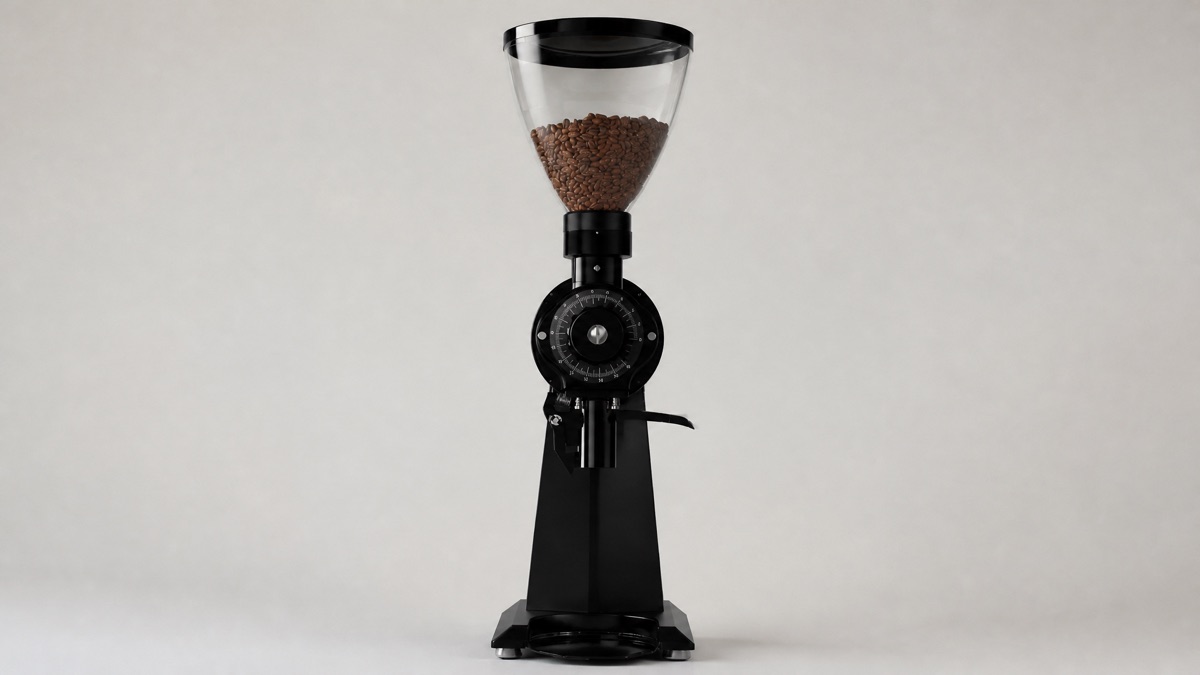
Good morning, coffee people, I'm Mark. The Mazzer set the bar for many commercial burr grinders, and I know it well.
A Mahlkonig coffee grinder is a commercial burr grinder from a German maker established in Hamburg in 1924. The brand builds espresso, filter, retail and industrial models, plus one home grinder, the X54. Cafes and roasteries treat it as a reference for even grinds, from espresso bars to production lines.
The E65 and E80 families dose espresso, and the E80 grinds faster. The EK43 grinds filter coffee very evenly but has no on-demand dosing. The EK Omnia adds motorized grind control with saved recipes. The Guatemala and GH2 grind retail bags, and the DK15 LS and VTA 6S serve roasteries. The X54 serves the home with a plastic body and a short burr life.
Prices run from about $600 for the X54 to about $4,400 for the EK Omnia. The right model depends on the job, not on the size of the burrs. Home espresso drinkers and low-volume cafes often gain little from the brand. Most commercial models carry a one-year warranty, and buyers choose by volume, workflow and counter space.
This review comes from my café background and research, not from Mahlkonig.
What Is a Mahlkonig Coffee Grinder?
A Mahlkonig coffee grinder is a commercial burr grinder from a German maker established in 1924. The company builds grinders for cafes, roasteries and specialty shops. Its lineup holds one home model so far, the X54.
The name Mahlkönig is German for grinding king. English listings often drop the umlaut, so searches for Mahlkonig and Mahlkönig find the same brand.
The brand traces back to Stawert Mühlenbau in Hamburg. The Mahlkonig trademark was registered there on December 13, 1924. Early output covered spice, grain and coffee grinders.
Mahlkonig is a flagship brand of the Hemro Group, which is headquartered in Switzerland.
Mahlkonig designs each grinder for one job. The E65 and E80 families dose espresso, the EK models grind all-round, and the GH2 and Guatemala fill retail bags. The DK15 LS serves industrial production.
Specialty coffee treats the brand as a reference. Cafes value the even particles, the reliability in continuous use and the service and parts network. The burrs come from the company's own production in Germany.
Mahlkonig grinders suit professional work first. The price and size reflect that duty. Home buyers get a single dedicated model, the X54.
Where Are Mahlkonig Coffee Grinders Made?
Mahlkonig grinders are made in Hamburg, Germany, where the company has built them by hand since 1924. The company expanded its factory in 2020 to improve working conditions and meet demand for the premium brand.
Mahlkonig also produces its burrs in house in Germany. Burrs are the metal parts that crush the beans, so they set the particle size of every grind. This covers the part that shapes the grind.
A service and spare parts network backs the grinders. Buyers still check local parts availability before ordering.
Which Grinders Make Up the Mahlkonig Coffee Grinder Lineup?
The grinders that make up the Mahlkonig lineup fall into five groups: espresso, all-round, retail, industrial and home. Each group answers a different job.
The five groups are:
- Espresso: The E65 family uses 65 mm (2.6 in) flat burrs. The E80 family uses 80 mm (3.1 in) flat burrs and grinds faster.
- All-round: The EK43, EK43 S, EKK43 and EK Omnia carry 98 mm (3.9 in) flat burrs. They grind for filter, cupping and retail work.
- Retail: The GH2 (85 mm, 3.3 in) and the Guatemala (71 mm, 2.8 in) grind retail bags.
- Industrial: The VTA 6S (120 mm, 4.7 in) and the DK15 LS (130 mm, 5.1 in) grind for production.
- Home: The X54 (54 mm, 2.1 in) serves the home.
Mahlkonig Lineup by Job:
| Group | Models | Burrs |
|---|---|---|
| Espresso | E65 family | 65 mm (2.6 in) |
| Espresso | E80 family | 80 mm (3.1 in) |
| All-round | EK43, EK43 S, EKK43, EK Omnia | 98 mm (3.9 in) |
| Retail | GH2 | 85 mm (3.3 in) |
| Retail | Guatemala | 71 mm (2.8 in) |
| Industrial | VTA 6S | 120 mm (4.7 in) |
| Industrial | DK15 LS | 130 mm (5.1 in) |
| Home | X54 | 54 mm (2.1 in) |
The older K30 line, now discontinued, came as the Vario, Vario Air and Twin. The Peak is the earlier 80 mm espresso model that the E80 Supreme builds on.
What Makes a Mahlkonig Coffee Grinder Different?
A Mahlkonig coffee grinder is different through large flat steel burrs, stepless adjustment and on-demand dosing.
Stepless adjustment has no fixed click positions. The barista turns the ring to any point between two marks. Because the ring moves in tiny amounts, the grind can be tuned very finely.
Newer models add Disc Distance Detection. The patented sensor reads the real distance between the burrs. A grind setting then repeats by distance rather than by dial position, so a chosen setting can be found again.
On-demand grinding grinds only the dose for one order. A doser grinder stores grounds in a chamber instead. With on-demand grinding, fresh grounds go into the portafilter with less waste.
Espresso models grind straight into the portafilter. A universal portafilter holder frees the barista to steam milk while the grinder runs. The E65S stores six recipes in an icon menu.
The tall transparent hopper marks the look of the brand. Mahlkonig sells larger and smaller hoppers for nearly every model. Steel burrs can be swapped for tungsten carbide or titanium alloy burrs in high-volume shops.
Why Do Mahlkonig Coffee Grinders Use Large Flat Burrs?
Mahlkonig grinders use large flat burrs because a bigger burr set grinds faster with less heat. Large burrs turn more slowly for the same output. Slower turning cuts friction heat, and less heat protects flavor in the cup.
Flat burrs give a uniform grind, and baristas link that grind to sweet, deep flavors. Conical burrs run quieter and cooler. The Mazzer Robur S Electronic uses them.
Flat burrs have one main weakness: ground retention, which is coffee that stays inside the grinder. Mahlkonig answers this problem with vertical burr alignment. Three of its grinders use this design:
- EK43: Its vertically aligned burrs cut ground retention.
- EK Omnia: Its vertical alignment also cuts ground retention.
- Guatemala: Its vertical alignment gives the same lower retention.
Burr size alone does not predict speed. The Guatemala has 71 mm (2.8 in) burrs, smaller than the 85 mm (3.3 in) burrs of the GH2. Motor, burr design and workflow matter too.
What Is Grind-by-Weight on a Mahlkonig Coffee Grinder?
Grind-by-weight on a Mahlkonig coffee grinder weighs the grounds with a load cell and stops at the programmed dose. The E65S GbW doses to 0.1 g (0.004 oz).
The E65T doses by time instead of weight. It uses an adaptive algorithm that changes the grind time when the burrs move.
Grind-by-Sync is a different feature. It links the grinder to compatible espresso equipment and adjusts the grind from extraction feedback. Sync features need a compatible espresso machine, so buyers confirm compatibility before counting on automatic feedback.
Disc Distance Detection is a separate patented feature. It measures the real gap between the burrs. The E65S GbW and E80 Supreme use it to set fineness by distance.
Weighing does not fix a wrong grind setting or poor puck preparation.
Which Mahlkonig Coffee Grinder Is Best for Espresso?
The best Mahlkonig coffee grinder for espresso depends on volume. The E65 suits small and midsize cafes, and the E80 suits busy bars.
Volume matters because it sets how fast a grinder must work. The E65W Grind-by-Sync adds a load cell to the compact 65 mm (2.6 in) platform. A load cell is a sensor that weighs each dose. A cafe pulling about 80 to 120 shots a day fits it.
Busier shops need more speed. The E80W Grind-by-Sync has 80 mm (3.1 in) burrs, which grind faster. That helps a cafe with several baristas on shift and about 120 to 250 shots a day. Cafes often outgrow an E65 sooner than planned.
The Sync System pairs the E65W and E80W with La Marzocco machines in AV or ABR configuration. Examples are the Linea Classic S and Strada. Retailers list the Linea Mini and Micra as not compatible. On any other machine, the grinders still work as grind-by-weight grinders.
Size is the last check before buying. The E65W stands 24.4 in (62 cm) tall and the E80W stands 24.8 in (63 cm). Cabinets above the grinder need that clearance.
Two other Mahlkonig models come up in espresso buying, the Peak and the EK43:
- Peak: This is the older 80 mm model. It times doses to 0.01 seconds, lights the spout and holds 3.3 lb (1.5 kg) of beans.
- EK43: This is not a house espresso grinder. Each dose needs weighing, grinding and transfer by hand. Cafes pair it with an E-series grinder.
Is the Mahlkonig E65 Coffee Grinder Worth Buying?
Yes. The Mahlkonig E65 is worth buying for a small or midsize cafe that wants a compact, repeatable espresso grinder.
The E65S grinds 4 to 5 g/s (0.14 to 0.18 oz/s) with 65 mm (2.6 in) flat steel burrs. A double shot takes under 5 seconds. A retail pound of beans would take far too long, so the grinder is built for shots, not bulk bags.
A new owner also needs to know which E65 to pick, because the line has changed. The E65W GbS replaced the E65S GbW and keeps grind-by-weight dosing. That means the grinder stops when the dose reaches the set weight. The E80W GbS likewise replaced the E80S GbW.
Repeatable shots depend on the grinder remembering its settings. The E65 stores six recipes. Its adjustment is stepless, so the grind can be set to any fine point, not just fixed notches. It also cools with a fan.
Counter space matters in a new shop, and the E65 is small. It measures 19.5 x 58.3 x 28.3 cm (7.7 x 23 x 11.1 in). That size lets it fit between other machines on a crowded counter.
The E65W and the E65T differ in how they dose:
- E65W: This is the standard for small to medium cafes. It doses by weight.
- E65T: This version doses by time. It suits teams that check weight while they dial in.
The choice comes down to how the team sets doses. Cafes that want the grinder to handle weight pick the E65W. Teams that weigh doses by hand pick the E65T.
Is the Mahlkonig E80 Supreme Coffee Grinder Worth the Extra Cost?
Yes. The Mahlkonig E80 Supreme is worth the extra cost only for a busy espresso bar.
The 80 mm (3.1 in) steel flat burrs grind 6 to 7 g/s (0.21 to 0.25 oz/s), the fastest rate in its class. Two fans cool the motor, one on top and one below. The pair keeps heat down in long rushes.
Disc Distance Detection and a high-resolution display add control. The spout adjusts in height and carries a light. The hopper holds 3.9 lb (1.8 kg), or 2.6 lb (1.2 kg) in the short version.
E80 Supreme Features:
- Disc Distance Detection
- High-resolution display
- Height-adjustable spout
- Spout light
- 3.9 lb (1.8 kg) hopper, or 2.6 lb (1.2 kg) short
A US retailer lists the E80W GbS at $4,199 and the E65W GbS at $3,099, a gap of about $1,100. A grinder idle between orders gains nothing from a faster dose. Quiet cafes spend the difference on bar layout or water treatment.
Is the Mahlkonig EK43 a Good Grinder for Filter Coffee?
Yes. The Mahlkonig EK43 is a good grinder for filter coffee because its 98 mm (3.9 in) burrs grind evenly.
The EK43 raised extraction in a test by Matt Perger, the 2012 World Brewers Cup champion. It reached 23.12% against 21.1% for the best of three other grinders. Evenness of particle size explains the gain, not fewer fines.
A shop owner also needs the right grind range. The stepless ring covers medium-fine to medium-coarse grinds, which suits filter coffee. A numbered scale helps the user return to a setting. Output reaches 21 g/s (0.74 oz/s) on one measure. A bag clamp holds a retail bag while the grinder runs.
The EK43 has no on-demand dosing. Weighed beans go into the 2.2 lb (1 kg) hopper before each grind. The price runs from $2,700 to $3,500. A thermal cutoff stops the motor under overload. The cutoff needs about an hour to reset.
The machine is large. It draws up to 1,300 W and weighs about 24 to 26 kg (53 to 57 lb). The shorter EK43 S stands about 68 cm (27 in) tall.
The EK43 began as a grain and spice grinder. A Montreal shop adopted it for coffee in 2009. A 2012 World Brewers Cup winner then lifted its fame.
What Is the Difference Between the Mahlkonig EK43 and EK Omnia Coffee Grinders?
The difference between the Mahlkonig EK43 and EK Omnia is micron-based, motorized grind control with saved recipes.
Both grinders use 98 mm (3.9 in) cast steel burrs, so the cutting parts are the same size and material. The difference is how the gap between the burrs gets set. The EK43 relies on a numbered ring. The Omnia measures burr distance in microns and returns to a saved setting by motor.
The motor is what makes saved settings possible. The Omnia offers Classic Mode, Time Mode and Library Mode. Library Mode stores up to ten recipes with their burr positions. A brew bar that switches coffees all day gains the most. Each coffee can return to its stored position without a hand adjustment.
EK43 vs EK Omnia:
| Feature | EK43 | EK Omnia |
|---|---|---|
| Burrs | 98 mm (3.9 in) cast steel | 98 mm (3.9 in) cast steel |
| Grind control | Numbered ring | Micron-based, motorized |
| Saved recipes | None | Up to ten |
| Hopper | Larger | Much smaller |
| Price | $2,700 to $3,500 | $4,199 to $4,399 |
The Omnia has limits that the EK43 does not. It grinds slower and holds a much smaller hopper. It has no load cell, so it does not weigh the dose. Mahlkonig introduced it as the flagship of the EK series.
Mahlkonig launched the EK Omnia in October 2023. US retailers list it between $4,199 and $4,399.
Does Mahlkonig Make a Coffee Grinder for Home Use?
Yes. Mahlkonig makes one coffee grinder for home use, the X54 Allround, released in 2021.
The X54 uses 54 mm (2.1 in) flat steel burrs and stepless adjustment. Stepless means the grind size can be set to any point, not just fixed clicks. It competes with the Eureka Mignon series and the Turin DF64. Grind uniformity holds across a wider range of settings than most rivals in its class.
The grinder fits different brewing habits. A portafilter fork and a dosing cup swap in and out. The display offers four time presets and a manual mode, so a user can grind by timer or by hand.
The X54 costs about $599 to $649 at US retailers and carries a 12-month warranty. The hopper holds 250 g (8.8 oz) in black and white and 500 g (17.6 oz) in chrome.
The E64 WS bridges home and pro use for ambitious home baristas. The E65S often proves overkill on a home counter.
What Are the Limits of the Mahlkonig X54 Coffee Grinder?
The limits of the Mahlkonig X54 coffee grinder are a plastic body, a short burr life and no recipe recall.
Commercial Mahlkonig grinders use metal bodies. The X54 swaps that for plastic, which rival grinders at its price avoid. Its steel burrs last about 500 kg (1,100 lb) of coffee, against 6,000 kg (13,200 lb) on the EK Omnia.
The X54 connects by WiFi for settings and notifications. Moving from espresso to filter still means finding the setting again. A busy bar needs a commercial grinder instead.
Which Mahlkonig Coffee Grinder Handles Retail Bags and Roastery Work?
The Mahlkonig GH2 and Guatemala handle retail bags, and the DK15 LS and VTA 6S handle roastery production.
The GH2 has 85 mm (3.3 in) burrs, a bag clamp and manual adjustment. It suits a cafe with occasional bag orders. It does not replace an espresso grinder.
The Guatemala has 71 mm (2.8 in) vertical flat burrs and an aluminum body. It comes as Standard, Filter and Lab versions. The hopper holds 1.9 lb (0.9 kg), and output runs 13 to 15 g/s (0.46 to 0.53 oz/s).
The DK15 LS has 130 mm (5.1 in) burrs and a 66 lb (30 kg) hopper. Mahlkonig rates it at about 265 to 287 lb/hour (120 to 130 kg/hour) in laboratory tests. US units need 220V, 60Hz, three-phase power and weigh about 291 lb (132 kg).
The VTA 6S has 120 mm (4.7 in) burrs and reaches 43 g/s (1.5 oz/s). It runs on three-phase power. Roasteries and wholesale buyers measure its work in kilograms per day.
Retail and Roastery Grinders:
| Model | Burrs | Output |
|---|---|---|
| GH2 | 85 mm (3.3 in) | About 1 lb (0.45 kg) a minute |
| Guatemala | 71 mm (2.8 in) | 13 to 15 g/s (0.46 to 0.53 oz/s) |
| VTA 6S | 120 mm (4.7 in) | Up to 43 g/s (1.5 oz/s) |
| DK15 LS | 130 mm (5.1 in) | 265 to 287 lb/hour (120 to 130 kg/hour) |
Is the Mahlkonig Guatemala Coffee Grinder Better Than the GH2?
Yes. The Mahlkonig Guatemala is better than the GH2 when retail grinding runs all day. The Guatemala outputs faster and adds an adjustable bag platform with a clamp.
The Guatemala grinds about 13 to 15 g/s (0.46 to 0.53 oz/s). Retailers rate the GH2 near 1 lb a minute, or 7.5 g/s. That gap adds up when grinding runs all day.
The Guatemala has a larger, heavier body, so it needs a dedicated spot. It also costs more. It lists between $1,999 and $2,399, while the GH2 lists between $1,100 and $1,499.
The GH2 grinds with simple manual adjustment and a clamp. A shop grinding a handful of bags between espresso orders needs nothing more.
Neither grinder doses portafilters, so dosing does not separate them. Burr size alone does not decide the winner either. The Guatemala's 71 mm (2.8 in) burrs sit below the GH2's 85 mm (3.3 in).
How Much Does a Mahlkonig Coffee Grinder Cost?
A Mahlkonig coffee grinder costs from about $600 for the home X54 to about $4,400 for the EK Omnia.
US retailers list the X54 at $599 to $649, the GH2 at $1,100 to $1,499 and the Guatemala at $1,999 to $2,399. The EK43 sells from $2,700 to $3,500.
The E65W GbS lists at $3,099 and the E80W GbS at $4,199, a gap of about $1,100. The EK Omnia lists at $4,199 to $4,399.
US Retailer Prices:
| Model | Price |
|---|---|
| X54 | $599 to $649 |
| GH2 | $1,100 to $1,499 |
| Guatemala | $1,999 to $2,399 |
| EK43 | $2,700 to $3,500 |
| E65W GbS | $3,099 |
| E80W GbS | $4,199 |
| EK Omnia | $4,199 to $4,399 |
Steel burrs wear. They last about 500 kg (1,100 lb) of coffee on the X54 and 6,000 kg (13,200 lb) on the EK Omnia. Tungsten carbide burrs extend that life.
The grinder shapes the cup more than the espresso machine does, so budget for it first. A cheap grinder on an expensive machine is a classic mistake. A one-year warranty comes with the grinders.
How Does a Mahlkonig Coffee Grinder Compare to Mazzer and Eureka?
A Mahlkonig grinder compares to Mazzer and Eureka as the specialty and B2B choice with the highest price.
Mahlkonig stands out for particle distribution, consistency and Sync and grind-by-weight integration. Price is its weakness, and not every model pays off for every cafe.
Mahlkonig vs Mazzer, Eureka and Fiorenzato:
| Brand | Strength | Weakness |
|---|---|---|
| Mahlkonig | Particle distribution, consistency, Sync and grind-by-weight integration | Price |
| Mazzer | Robust, long-lived grinders | Traditional workflow, less digital integration |
| Eureka | Quiet models, value for home and small cafes | Less depth for high volume |
| Fiorenzato | Sturdy espresso grinders at attractive prices | Less system depth than Mahlkonig |
Mazzer builds extremely robust, long-lived grinders with a more traditional workflow and less digital integration. The Robur S Electronic uses conical burrs.
Eureka offers quiet models and strong value for home baristas and small cafes. It has less depth for high volume. Fiorenzato offers sturdy espresso grinders at attractive prices with less system depth than Mahlkonig.
Is a Mahlkonig Coffee Grinder Worth It?
Yes. A Mahlkonig coffee grinder is worth it when the model matches the job. The best Mahlkonig is not the one with the biggest burrs.
The E65W is the sweet spot for a main cafe espresso station. The E80W earns its extra speed in heavy service.
The EK43 and EK Omnia excel as second grinders for filter, single doses and retail. They do not replace a dedicated espresso grinder at peak service.
Best Mahlkonig by Job:
- Main cafe espresso station: E65W
- Heavy espresso service: E80W
- Filter, single doses and retail: EK43 or EK Omnia as a second grinder
Price is the cost. Many models carry commercial size and output, which overshoots a home counter.
Who Should Skip a Mahlkonig Coffee Grinder?
Casual home espresso drinkers, single-dose fans and low-volume cafes skip a Mahlkonig coffee grinder and save the money.
Three kinds of buyers gain little from this grinder:
- Casual home espresso drinkers: A single-user home setup pays for headroom it rarely uses.
- Single-dose fans: The E65S is not a single-dose grinder, so changing beans costs more effort. A home barista who brews only espresso and switches beans often compares purpose-built single-dose grinders first.
- Low-volume cafes: A quiet cafe gains nothing from a fast grinder that sits idle. The money works harder on bar layout, water treatment or a second grinder for decaf.
The Coffee Experiment is a reader-supported platform. Purchases made through our links may earn us an affiliate commission at no extra cost to you.