
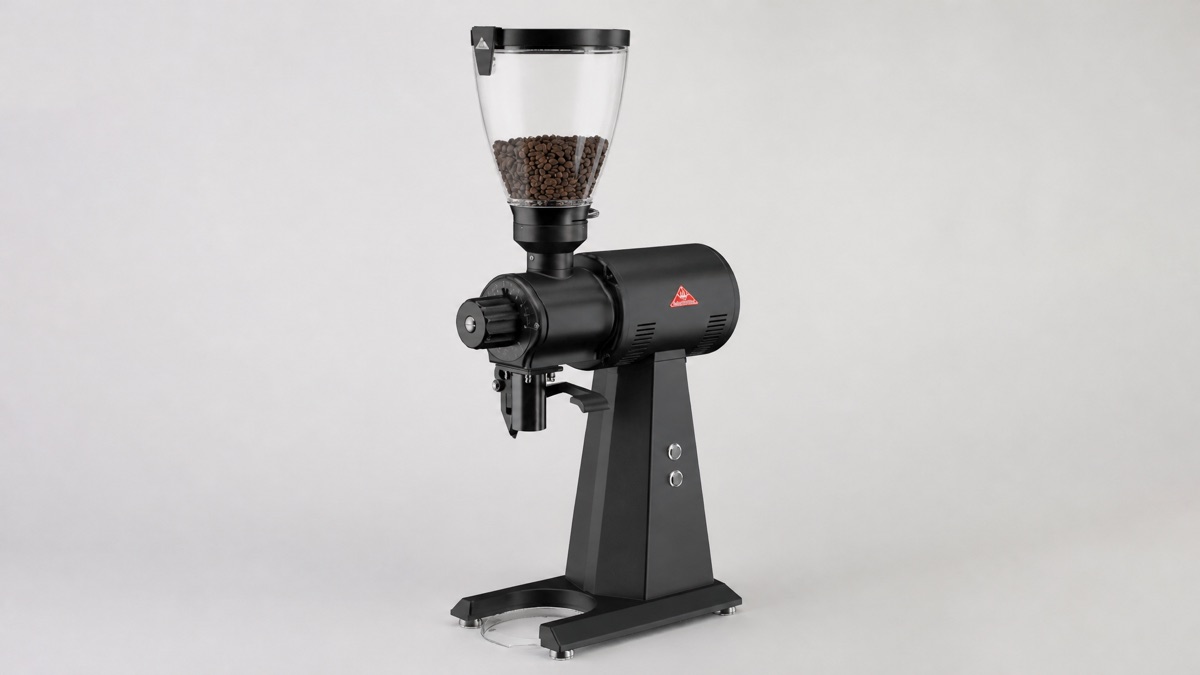
Welcome in, I'm Mark, and the Mahlkonig review starts here. The Mahlkonig EK43 is a commercial all-round grinder built in Hamburg with 98 mm (3.9 in) flat steel burrs. Cafes, roasters and retail shops use it for filter, espresso and Turkish grinds. It began life as a grain and spice grinder, and a Montreal shop first used it for coffee in 2009.
The EK43 grinds fast and produces uniform particles. A Matt Perger test measured 23.12% extraction against 21.1% for the best of three rivals. It grinds fine enough for espresso, but it has no doser and it retains more coffee than a single-dose grinder. The machine is also large, heavy and loud, so it needs a firm counter and some space.
Current US listings run from $3,899 to $4,074. The sections below cover specs, grind quality and downsides. They also cover rivals such as the Tanzania and E80S, costs and who should buy one. The verdict separates cafes that gain from the EK43 from home buyers who would pay for capacity they never use.
Twelve years behind bars in three countries made me picky about commercial flat burr grinders. This is an independent review, and my verdict stays my own.
What Is the Mahlkonig EK43?
The Mahlkonig EK43 is a commercial all-round grinder with 98 mm (3.9 in) flat steel burrs. Cafes, roasters and retail shops use it to grind coffee for filter, espresso and Turkish brewing.
The machine began as a grain and spice grinder. A Montreal coffee shop adopted it for coffee in 2009. The 2012 World Brewers Cup winner used one, and its fame spread from there.
Mahlkonig, spelled Mahlkönig in German, was founded in 1924. The brand has built coffee grinders for nearly a century, so the EK43 sits inside a long line of commercial machines.
The EK43 targets retail bag grinding and busy bars. A retailer guide calls it a poor match for everyday home use, since it is large and built for volume.
What Is the Difference Between the EK43 and EK43S?
The difference between the EK43 and EK43S is body height, because the EK43S keeps the same burrs and motor. The S version suits bars with less counter height, and the standard EK43 suits taller vessels and bag grinding.
The EK43S stands 68 cm (26.8 in) tall against 82.8 cm (32.6 in) for the EK43. It also weighs less, at 24.5 kg (54 lb) net against 26 kg (57 lb). Its hopper is smaller, which means more refills during a busy service.
EK43 and EK43S Compared:
| Spec | EK43 | EK43S |
|---|---|---|
| Height | 82.8 cm (32.6 in) | 68 cm (26.8 in) |
| Net weight | 26 kg (57 lb) | 24.5 kg (54 lb) |
| Burrs | 98 mm (3.9 in) flat | 98 mm (3.9 in) flat |
A third sibling, the EKK43, puts two independent grinders in one chassis. Its total hopper holds 4.2 lb (1.9 kg), so a bar can keep two coffees ready at once.
The EK43S also suits a single-dose workflow. That point makes it the more flexible pick for espresso stations.
Where Is the EK43 Made?
The EK43 is made in Hamburg, Germany, where Mahlkonig builds it. The company's address is in the Hamburg district of Wandsbek, where its grinders have been made since the 1960s.
Mahlkonig belongs to the Hemro Group, a Swiss company. Hemro also owns the Ditting and Anfim grinder brands, so the EK43 sits in a family of grinder makers.
Demand for the EK43 was part of the reason Hemro expanded the Hamburg factory in 2020. Most grinder parts are made in-house.
US buyers order the grinder from specialty retailers. Some retailers ship it straight from the manufacturer.
How Does the Mahlkonig EK43 Work?
The Mahlkonig EK43 works by grinding beans between two identical 98 mm (3.9 in) flat steel burrs that face each other. A 1,760 RPM motor spins the burrs while beans drop from a removable hopper.
The burrs are large, so they turn fewer times to grind the same dose. Fewer turns create less friction. Less friction means less heat, so the coffee stays cooler during the grind.
Heat still builds up in the motor, so a thermal overload system protects it. A thermostatic sensor cuts the circuit when the motor runs too hot. The grinder then needs about an hour to recover.
A slide plate closes the channel below the hopper. Staff can lift the hopper off while it is still full, and no roast goes to waste.
A bag clamp holds a retail bag under the outlet. The operator flips the switch and walks away. A knock-off device then pushes the last grounds into the bag.
Why Does the EK43 Use Vertical Burrs?
The EK43 uses vertical burrs so ground coffee falls out of the chamber. Most flat burr grinders mount burrs horizontally, which lets grounds collect between the burrs.
Horizontal designs hold back grams of coffee on every grind. Vertical burrs send nearly all of the dose into the bag or container.
A retail shop gains from this design. Customers receive their full purchase, and less coffee is left behind in the machine.
The EK43S still retains more coffee than a dedicated single-dose grinder. So frequent bean changes need a short purge, even with vertical burrs.
How Do You Adjust the EK43 Grind Size?
You adjust the EK43 grind size with a stepless dial on the front of the grinder. The dial moves smoothly, so any fineness between espresso and French press is possible.
The numbered dial gives reference points, and the numbers are targets. One chart places espresso near 3.7, V60 near 8.8, drip near 10.7 and French press near 14.1.
Approximate Dial Settings:
| Brew Method | Dial Number |
|---|---|
| Espresso | 3.7 |
| V60 | 8.8 |
| Drip | 10.7 |
| French press | 14.1 |
Sixteen numbers cover the whole range from fine to coarse. Fine work therefore needs half-steps, and the stepless design allows that.
Switching between fine and coarse takes many turns of the dial. Bars that swap between espresso and filter often should plan the dial work ahead.
What Are the Mahlkonig EK43 Specs?
The Mahlkonig EK43 specs include a 1300 W motor at 1,760 RPM and 98 mm (3.9 in) cast steel burrs. The US model draws 7 A at 120 V. Burrs are the two toothed metal parts that crush the coffee, and these are flat.
The grinder carries CE, ETL and ETL-Sanitation certifications. Those marks cover safety and food-contact requirements for commercial kitchens.
A machine with this much power is also large. The maker lists the grinder at 23 cm (9 in) wide, 41 cm (16 in) deep and 82.8 cm (32.6 in) tall. It weighs 26 kg (57 lb) net.
The hopper sits on top of that frame and holds the beans. The removable hopper holds about 1,200 g (2.6 lb) by the maker's sheet. US retailers list it as a 3.3 lb (1.5 kg) hopper. A lockable slide plate, a magnet and finger protection sit at the hopper opening.
The motor and burrs also make noise. The manual lists 60 dB at idle and 87 dB while grinding. That level is loud for a home kitchen.
Key Specs:
| Spec | Value |
|---|---|
| Burrs | 98 mm (3.9 in) cast steel, flat |
| Motor | 1300 W at 1,760 RPM |
| Electrical | 7 A at 120 V |
| Net weight | 26 kg (57 lb) |
| Noise | 60 dB idle, 87 dB grinding |
How Fast Does the EK43 Grind?
The EK43 grinds fast, at 19 to 21 g (0.7 oz) of coffee per second on average. Retailers quote a top rate of 25 g per second, or about 3.4 lb (1.5 kg) per minute.
At fine to medium settings, one guide gives 2.8 to 3.4 lb (1.3 to 1.5 kg) per minute. A one-pound bag finishes in under half a minute.
The Mahlkonig Tanzania grinds 1.2 to 2 lb (0.5 to 0.9 kg) per minute. Next to the EK43, it is clearly the slower machine.
Speed matters most during rushes, when a line of customers waits. A café with an EK43 can fill a batch brewer in seconds and return to service.
Does the Mahlkonig EK43 Grind Well?
Yes. The Mahlkonig EK43 grinds well and produces one of the narrowest particle distributions in commercial grinding. The uniform particles give clean, sweet cups with high clarity.
A Matt Perger comparison measured extraction on four big-name grinders. The EK43 reached 23.12% extraction. The best of the other three reached 21.1%.
The flat burrs shape the taste as well. They lean the cup toward clarity and sparkle. Cups taste brighter and more separated than coffee from grinders that favor syrup and body.
Home owners on r/pourover describe the uniformity and clarity as unreal. They add that the grinder demands a learning period.
A skeptical forum poster says the EK43 loses body and texture in espresso. The same poster allows that a skilled roaster can make a tasty light-roast cup with it.
Can the EK43 Grind for Espresso?
Yes. The EK43 grinds fine enough for espresso and even for Turkish coffee. Espresso is possible but not its strongest use.
A comparison site rates espresso suitability at 4 out of 5 for the EK43S. The Mahlkonig E80S earns 5 out of 5 in the same table. The EK43S is a strong espresso grinder, but the E80S scores higher.
One owner loves the EK43 but would not use it as an only espresso grinder. A dedicated espresso grinder suits that job better.
The grinder also has no on-demand doser, so it does not release a set amount of coffee for each shot. Espresso dosing therefore needs a scale and a steady routine for every shot.
What Are the Downsides of the Mahlkonig EK43?
The downsides of the Mahlkonig EK43 are its high price, higher retention than single-dose grinders and no on-demand doser. It also has no on-demand dosing option.
Retention shapes the workflow. Shops with a full hopper barely notice it. Shops that change beans often need to purge the chamber.
Some units show wear over time. Reviewers list burr alignment drift that needs recalibration and bearing wear on heavily used machines.
Demand is high. One retailer warns that orders can take a couple of weeks to arrive.
The grinder is loud. The manual lists 87 dB during grinding.
Burrs wear out eventually. The maker rates a burr set at about 6,000 kg (13,200 lb) of coffee. A replacement set costs roughly $539 to $704 in US listings.
Main Downsides:
- High price
- Retention higher than single-dose grinders
- No on-demand doser
- Loud, at 87 dB
- Possible alignment drift and bearing wear
- Order lead times
How Much Space Does the EK43 Need?
The EK43 does need counter space of 23 cm (9 in) by 41 cm (16 in). The standard hopper brings the height to 82.8 cm (32.6 in).
That height decides where the grinder can sit. Shelves above the counter limit the spot, since the tall hopper must clear them. The EK43S stands 68 cm (26.8 in) tall, so it fits under more shelves.
The counter itself also matters. The machine has a net weight of 26 kg (57 lb). The surface must be firm enough to hold it.
Size is a bigger issue for buyers with a home counter. Even the EK43S is far larger than a single-dose home grinder.
How Does the Mahlkonig EK43 Compare With Rivals?
The Mahlkonig EK43 compares with rivals such as the Tanzania, the E80S and single-dose grinders. Each rival trades some speed or range for lower size or price.
Small shops that cannot fit an EK43 look at single-dose grinders. Baristas name the Baratza Forte, the Weber Workshops EG-1, the Kafatek Monolith conical and the Versalab M3.
Mahlkonig EK43 vs Mahlkonig Tanzania?
The EK43 beats the Mahlkonig Tanzania on speed, burr size and fineness range. The Tanzania costs less and fits smaller counters.
Burr size is the first difference. The EK43 uses 98 mm (3.9 in) burrs. The Tanzania uses 80 mm (3.1 in) burrs.
Speed is the second difference. The EK43 grinds 2.8 to 3.4 lb (1.3 to 1.5 kg) per minute. The Tanzania grinds 1.2 to 2 lb (0.5 to 0.9 kg) per minute.
The two grinders also differ in size. The Tanzania measures 8.1 by 11.6 by 24.9 in (21 by 29 by 63 cm). The EK43 measures 9 by 16.1 by 32.6 in (23 by 41 by 83 cm). The EK43 needs more counter space, but its hopper holds more than the Tanzania's 1.6 lb (0.7 kg).
The grind range matters most for espresso. The Tanzania can approach espresso but is not designed for it. The EK43 reaches espresso and Turkish settings with more accuracy.
EK43 and Tanzania Compared:
| Spec | EK43 | Tanzania |
|---|---|---|
| Burrs | 98 mm (3.9 in) | 80 mm (3.1 in) |
| Speed | 2.8 to 3.4 lb/min (1.3 to 1.5 kg/min) | 1.2 to 2 lb/min (0.5 to 0.9 kg/min) |
| Footprint | 9 by 16.1 in (23 by 41 cm) | 8.1 by 11.6 in (21 by 29 cm) |
Mahlkonig EK43 vs Mahlkonig E80S?
The Mahlkonig EK43 wins on brew range, while the Mahlkonig E80S wins on espresso duty and quiet. The two machines suit different bars.
The E80S fits a bar that pulls 250 to 400 doses a day. Buyers choose it for speed and thermal stability under steady load.
The EK43S suits a different goal. It leans clarity and sparkle, so its cups taste bright and clean. The E80S leans syrup and balance, so its cups taste fuller and rounder. The cup in the glass decides the choice.
Cost and capacity come next for a new business. The E80S costs US$3,049 to $4,199, while the EK43S costs US$3,899 to $5,350. The E80S hopper holds 1,800 g, while the EK43S hopper holds 800 g.
EK43S and E80S Compared:
| Spec | EK43S | E80S |
|---|---|---|
| US price | US$3,899 to $5,350 | US$3,049 to $4,199 |
| Hopper | 800 g | 1,800 g |
| Cup profile | Clarity and sparkle | Syrup and balance |
How Much Does the Mahlkonig EK43 Cost?
The Mahlkonig EK43 costs between $3,899 and $4,074 in current US listings. Seattle Coffee Gear lists $3,899, and Whole Latte Love and Pro Coffee Gear list $3,999 before sales.
A restaurant supplier lists $4,074. Older guides list $2,700 to $3,500, so prices have risen.
The EK43S ranges from US$3,899 to $5,350 on a price comparison site. The EK43S is the usual choice for bars with limited height.
The price covers the grinder only. Replacement burrs cost roughly $539 to $704 per set. Warranty terms vary by seller, from one year of parts and labor to parts only.
US Price Snapshot:
| Retailer | Price |
|---|---|
| Seattle Coffee Gear | $3,899 |
| Whole Latte Love | $3,999 |
| Pro Coffee Gear | $3,999 |
| Restaurant supplier | $4,074 |
Why Does the EK43 Cost So Much?
The EK43 costs so much because of its large burrs, strong motor and commercial build. Each part is built for daily commercial use.
The 98 mm (3.9 in) cast steel burrs are large for a coffee grinder. The maker rates them at about 6,000 kg (13,200 lb) of coffee.
The 1300 W motor and heavy drivetrain handle constant duty. The steel housing and ETL-Sanitation certification add to the cost.
Demand also holds prices up. Some retailers ship straight from the manufacturer, with lead times of 3 to 6 business days.
Is the Mahlkonig EK43 Worth It?
Yes. The Mahlkonig EK43 is worth it for cafes and roasters that grind filter and espresso in volume. Home buyers usually get more from a single-dose grinder.
The strengths are grind quality, speed, versatility and durability. The 23.12% extraction result shows what the uniform particles can do.
The weaknesses are price, size, retention and the missing doser. Those costs weigh heavily on buyers with low volume.
Best Fit:
- High-volume cafes
- Multi-method bars
- Roasters
- Retail bag grinding
Buyers who want clarity over body get the most from the EK43. Buyers who want a syrupy espresso grinder should look at the E80S.
Who Should Buy the EK43?
High-volume cafes, multi-method bars, roasters and retail shops should buy the EK43. These users need speed and a wide grind range, and the EK43 gives both.
Home espresso users, low-volume cafes and tight counters are a poor fit. They do not need that speed or range. They would pay for capacity they never use.
Three alternatives suit the buyers the EK43 does not fit:
- Tanzania: This grinder suits moderate volume with limited space.
- E80S: This grinder suits espresso-first bars.
- Single-dose grinders: These suit homes.
Volume, counter space and the main brew method decide which one fits.
The Coffee Experiment is a reader-supported platform. Purchases made through our links may earn us an affiliate commission at no extra cost to you.