
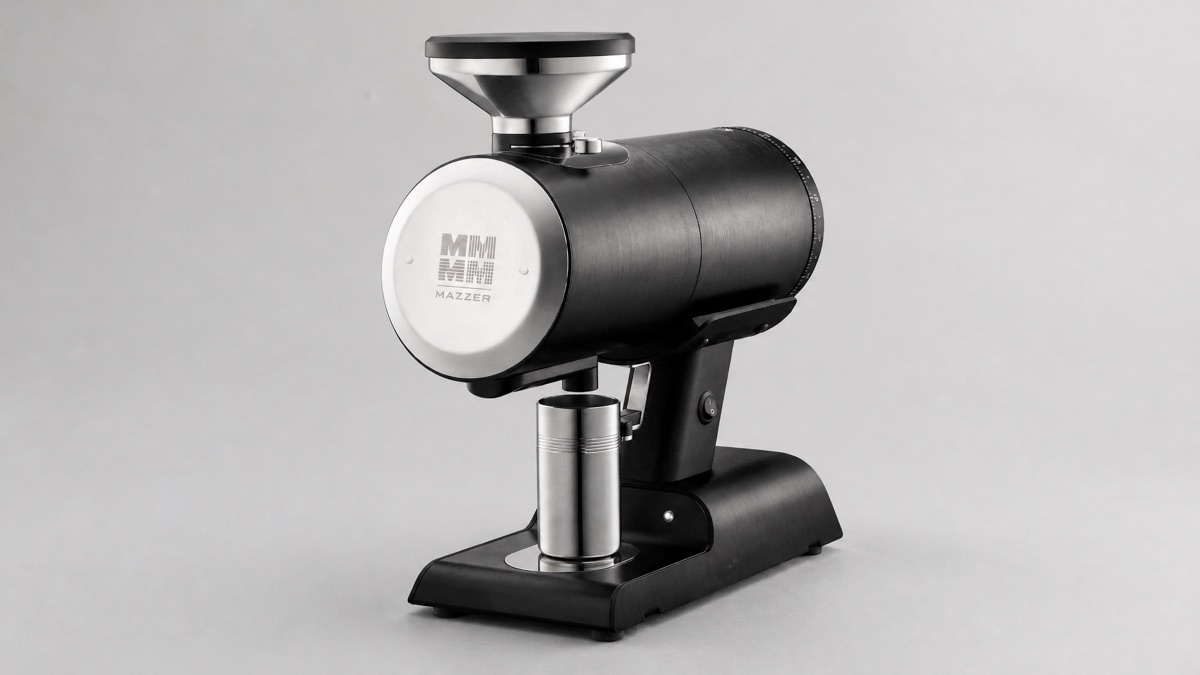
Hey, Mark here, the barista behind these reviews. A Mazzer coffee grinder is a flat-burr grinder from a family company near Venice, Italy. The range runs from the café Super Jolly and compact Mini to the single-dose Philos. New prices start near $1,195.
The Philos retains about 0.1 g and pulls syrupy, sweet espresso. The Mini keeps 8 g in its chamber and suits one coffee for weeks. The Super Jolly brings 64 mm burrs and a busy used market. Pour-over works, but espresso is the strong suit.
People comparing the Mazzer grinder with the Eureka Mignon Oro usually ask me first. No company reviewed or approved this article before it went live. Mazzer charges for metal build, spare parts and decades of service. The Oro matches much of the cup for about half the price.
What Is a Mazzer Grinder?
A Mazzer grinder is an Italian flat-burr coffee grinder built for cafés and serious home espresso. The brand makes compact café models like the Mini and Super Jolly. Its newer Philos targets the home counter. All of them use flat steel burrs and heavy metal bodies.
Luigi Mazzer founded the company as a mechanic workshop between the two World Wars. The workshop took the Mazzer name in 1948, when Luigi began making professional grinders and burrs. The family firm still builds every grinder in Scorzè, near Venice.
His son Giovanni took over in 1988. In 2023, a grandson, also named Luigi, joined the company as the third generation.
Most Mazzer grinders use flat burrs, two parallel cutting rings. The Robur and Kony are the conical exceptions, a cone turning inside a ring. The Robur uses 71 mm (2.8 in) conical burrs, and the Kony uses 63 mm (2.5 in) conical burrs.
The Super Jolly first came off the line about 50 years ago. That model is still one of the core grinders in the range today.
The name stands for precision and tanklike durability. Mazzer grinders line the counters of many specialty espresso cafés. Baristas trained on traditional Italian gear use them without retraining.
For decades, a Mazzer rarely fit a home kitchen. The big bean hoppers suit a busy shop, not a couple making two drinks a day. The Philos is the first Mazzer built mainly for home use.
Which Mazzer Grinder Models Suit Home Use?
The Mazzer grinder models that suit home use best are the Philos, the Mini and a short-hopper Super Jolly. The Philos is a compact single-dose grinder. The Mini is a small café grinder that many home baristas own.
The type of grinder shapes which model fits a home. A single-dose grinder takes only the beans for one drink at a time. A hopper grinder holds a full load of beans. A doser grinder also stores ground coffee in a chamber.
The Philos is a premium light commercial single-dose grinder. Its 64 mm (2.5 in) flat burrs handle espresso through batch brew. The design aims at small spaces and demanding home baristas.
The Mini serves small cafés, low-volume shops and restaurants. Mazzer rates the current Mini for up to 1 kg (2.2 lb) of coffee a day. Home users buy it for the build. The Mini A version is time based, with two programmable buttons for single and double doses.
The Super Jolly V Up Electronic runs on 110 V. Its height can be a problem in a kitchen. A Mazzer Mini short hopper lowers the Super Jolly to 19.5 in (49.5 cm) tall. The shorter body then fits under kitchen cabinets.
The Major V Electronic is a café machine. Its 83 mm (3.3 in) flat burrs and dual cooling fans suit busy service. A home kitchen gains little from that capacity.
Mazzer Models for Home:
| Model | Best Fit | Key Detail |
|---|---|---|
| Philos | Home single dosing | 64 mm (2.5 in) flat burrs |
| Mini | Small cafés and homes | Up to 1 kg (2.2 lb) a day |
| Super Jolly V Up Electronic | Homes with tall counters | 19.5 in (49.5 cm) with short hopper |
| Major V Electronic | Busy cafés | 83 mm (3.3 in) flat burrs |
How Does a Mazzer Grinder Work?
A Mazzer grinder works by crushing beans between two flat steel burrs set a precise distance apart. The gap between the burrs decides the grind size. A wider gap leaves coarser grounds, and a narrower gap makes finer ones.
Mazzer designs and makes its burrs in Italy, and the steel depends on the model. The Super Jolly uses hardened high carbon steel burrs. The Philos uses stainless steel burrs that resist oxidation and moisture.
The motor spins at 1400 rpm on 50 Hz power and 1600 rpm on 60 Hz power. The low burr speed keeps grinding cool. Cooler grinding protects the flavor of the coffee.
Speed also matters when the grind is changed. Owners adjust finer only with the motor running, so the burrs do not jam.
Does a Mazzer Grinder Use a Doser?
Yes. Some Mazzer grinder models use a doser, while others grind on demand straight into the portafilter. A doser is a chamber that holds ground coffee and releases it in small portions. The Super Jolly V Up Timer has one. The V Up Electronic, V Pro, Mini On Demand and Philos grind on demand.
The current Mini shows how on-demand grinding works without a doser. It doses by time. A dose counter tracks each grind, and dose times adjust in steps of a hundredth of a second. Single and double doses sit on programmable buttons.
The V Up Timer doser works by hand. Its chamber holds 280 g (9.9 oz) of grounds. The lever turns a segment of the chamber. Each pull drops 5.5 to 8 g (0.19 to 0.28 oz) into the portafilter. Several pulls build a double shot.
A doser suits steady café service. At home, grounds sit in the chamber between drinks and go stale. The chamber also needs some coffee inside for even doses, so it wastes more coffee.
Coffee left in the chamber also leaves oils behind. Doser chambers and sweepers collect these oils. Mazzer doser models need a daily clean to keep doses accurate. On-demand models skip that chore.
How Does Mazzer Grinder Adjustment Work?
Mazzer grinder adjustment works through a stepless collar on café models or a 6 micron Philos dial. Stepless collars stop at any point in the range. The Philos dial clicks in tiny, repeatable steps.
The Mini and Super Jolly use stepless micrometrical adjustment. A number scale on the collar marks each position, so returning to a saved setting is easy. Small moves matter on a Mazzer Mini, because a two-number move on the collar shifts the grind far too much. Fine tuning takes patience on the first bag.
The Philos has 145 positions, each worth 6 microns. Every setting is counted from the zero point, which is the reference position on the dial. Mazzer calibrates the dial with a small gap between the burrs at 0. The burrs never touch at that mark. Owners can reset the zero point by moving the adjustment cover.
Espresso lands between 20 and 40 on the dial. Pour-over and drip start near 80. The dial converts to stepless mode through a short procedure.
What Features Does the Mazzer Philos Grinder Have?
Key Mazzer Philos grinder features are vertical 64 mm flat burrs and a 400 W motor. The hopper holds 60 g (2.1 oz) of beans. The body uses stainless steel, brass and anodized aluminum. The grinder weighs 12.5 kg (27.5 lb).
Key Features:
- Vertical 64 mm flat burrs
- 400 W motor
- 60 g (2.1 oz) hopper
- Stainless steel, brass and anodized aluminum body
- 12.5 kg (27.5 lb) weight
Buyers pick one of two burr sets. The I200D burrs bring clarity and fruity acidity to light and medium roasts. The I189D burrs are the evolution of the Mini burrs and give full body with medium-dark roasts.
A magnetic front plate covers the grinding chamber. Hand-turned wing nuts hold the front burr carrier. The carrier pulls out for cleaning without losing the grind setting.
A full burr swap takes a little more work. Changing between the I200D and I189D sets needs a Phillips-head screwdriver. The job is short and does not need special tools.
The Philos measures 351 mm by 361 mm by 153 mm (13.8 by 14.2 by 6 in). The steel hopper lifts off. Without the hopper, the chute still takes 24 g (0.85 oz) of beans. The grinder comes in black or silver.
How Much Coffee Does the Mazzer Philos Grinder Retain?
The Mazzer Philos grinder retains under 0.1 g of coffee on filter grinds and about 0.1 g on espresso. Those figures come from a month of testing. The amount is too small to taste.
Several parts keep retention low. The burrs sit vertically, and the chute is short. A metal plate grounds static, and a spring-loaded knocker taps loose grounds into the cup.
A dose finisher slides into the chute to clear the last grounds. The tool stores in a slot behind the front plate. Mazzer recommends the supplied canister to cut static.
The Mini sits at the other end. Mazzer lists 8 g (0.28 oz) of retention in the Mini grinding chamber and chute. That amount needs purging after each grind change.
How Well Does a Mazzer Grinder Grind for Espresso?
A Mazzer grinder grinds espresso very well, with full body and tight particle sizes. The Philos makes syrupy, sweet shots, even from light roasts. The Mini shines with traditional darker roasts.
A Difluid Omni particle test compared the Philos with grinders priced from $200 to $500. On fine settings, the Philos made fewer fines, which are very small particles. The test found almost no coarse boulders. That is what tight particle sizes look like.
The older Mini has limits with lighter coffees. Its stock burrs are tuned for medium-to-dark roasts. Light roasts can choke at 15 g in the morning, meaning water barely flows through the puck. They can run fine by afternoon.
The current Mini ships with 233M bearing steel burrs, 64 mm (2.5 in) wide, for body that cuts through milk. Optional ZZ burrs (K202P) suit light roasts with clarity and sweetness. Mazzer recommends only its 233M and 202D burrs for the Mini.
RDT, the Ross Droplet Technique, is a light water spritz on beans to cut static. Mazzer advises against spraying beans on the Mini, since water can clog and oxidize its burrs. The Philos burrs and bean path are moisture safe, even with RDT.
The Philos lifts cheaper espresso machines too. Its grounds made rich shots on a Breville dual boiler. The same grounds also improved shots on a Ninja semiautomatic and an entry-level De'Longhi.
Does a Mazzer Grinder Work for Pour-Over?
Yes. A Mazzer grinder works for pour-over, though espresso remains its strongest use. The Philos covers espresso to batch brew. The Super Jolly also grinds the full range.
The older Mini is an espresso grinder first. Its doser and stock burrs aim at shots. Filter drinkers gain little from its design.
The Philos throws a few coarse boulders at filter settings. Lighter roasts still show lovely aromatics. The Fellow Ode Gen 2 at $400 gives clearer pour-over flavor.
The Philos hopper holds about 60 g (2.1 oz). An eight-cup drip carafe needs a little more. Big batches need two grinds or steady feeding.
How Loud Is a Mazzer Grinder?
A Mazzer grinder is moderately loud, with the Philos humming at about 65 dB. Vibration damping softens the grinding sound on the Philos. The Mini runs louder at its fixed speed.
The Mini spins flat burrs at a fixed 1600 rpm on 60 Hz power. Its 8.5 kg (18.7 lb) body does little to damp the 350 W motor. Mazzer lists no decibel figure for the Mini.
Noise is relative. The Mini is much quieter than a small LeLit home grinder. On doser models, the lever thwack is louder than the grinding itself.
What Do Mazzer Grinder Owners Say?
Mazzer grinder owners say the build, durability and espresso quality justify the high price. Their main complaints cover size, doser waste, clumping and cost. Most of the praise comes from long-term use.
Long-term use also shows how each model starts out. The Mini needs a short break-in. The first few shots rarely impress. Results settle after a few rounds of grinding.
The Philos needs almost no break-in. Its burrs arrive factory-seasoned. Mazzer asks owners to discard only the first 50 g (1.8 oz) of grounds.
After that short start, the Philos holds up well in daily use. Six months of daily use show a steady routine, and the grinder stays dialed in. Grounds come out fluffy and even, with only slight static.
What Do Owners Like About Mazzer Grinders?
Owners like Mazzer grinders for their durability, stable heavy bodies and consistent espresso. Many Minis run for more than a decade with little service. Parts stay easy to buy.
Nearly every component of a Mazzer can be replaced. Burrs, doser parts and service parts are widely stocked. A Mazzer is built to be serviced, not thrown away.
Burrs are the parts that cut the beans. Super Jolly owners often fit aftermarket burrs. SSP is a burr maker that sells High Uniformity burrs for 64 mm grinders like the Super Jolly. Mazzer itself advises only Mazzer burrs made for each model.
The heavy die-cast body stays planted on the counter. Thick rubber feet stop it from sliding. A cat or a bump will not tip it over.
The Philos holds its setting from day to day. Shots run sweet and balanced. Pour-overs taste the way the roaster intended.
What Are Common Mazzer Grinder Complaints?
Common Mazzer grinder complaints are clumping, high retention on the Mini, large size and price. Older Minis clump with no anti-static help. Clumps can cause channeling in the shot.
The current Mini adds an antistatic system to keep coffee dust off the counter. Static still appears on most hopper grinders. Tapping and brushing the chute remains part of daily use.
Size is a real issue. The Super Jolly stands 23.5 in (59.7 cm) tall and 16.25 in (41.3 cm) deep. The Philos also takes up a lot of space from front to back.
Main Complaints:
- Clumping on older Minis
- 8 g (0.28 oz) retention on the Mini
- Tall, deep bodies
- Small Philos hopper
- High prices
The Philos has small quirks. The hopper is small, and the rear dial takes getting used to. Jams can happen when the bean gate stays open before the motor starts.
The Mini workflow feels dated in a home. The hopper design wastes coffee when beans change often. Home buyers have moved toward single dosing.
How Does a Mazzer Grinder Compare to Rivals?
A Mazzer grinder compares well on build and longevity, but rivals often match its grind for less. The Eureka Mignon Specialita costs about half as much as a Mini. The Baratza Encore ESP at $200 makes good espresso.
Several rivals sit at a similar price. The Lelit William PL72 retains less coffee than the Mini. The Ceado E37S runs quieter, and the Niche Duo offers 83 mm burrs with single dosing.
The Timemore Sculptor 078S comes close to the Philos for less money. Many 64 mm grinders from China have narrowed the gap. Mazzer charges for materials, tight tolerances and its service network.
Higher-priced rivals exist too. The Option-O Lagom P64 also uses 64 mm flat burrs and costs $1,475 to $1,600. The Mahlkönig E65W Grind-by-Sync weighs every dose with a load cell and costs $3,099.
Is the Mazzer Mini Grinder Better Than the Super Jolly?
No. The Mazzer Mini grinder is not better than the Super Jolly for grind quality, but it is smaller. The older Mini uses 58 mm (2.3 in) burrs. The Super Jolly uses 64 mm (2.5 in) burrs and a 350 W motor.
The older Mini weighs 22.5 lb (10.2 kg). The Super Jolly weighs 33 lb (15 kg). The Mini suits a tighter counter.
Mini vs Super Jolly:
| Spec | Older Mini | Current Mini | Super Jolly |
|---|---|---|---|
| Burrs | 58 mm (2.3 in) | 64 mm (2.5 in) 233M | 64 mm (2.5 in) |
| Weight | 22.5 lb (10.2 kg) | 18.7 lb (8.5 kg) | 33 lb (15 kg) |
| Motor | Not listed | 350 W | 350 W |
The Super Jolly opens a wide range of 64 mm upgrade burrs. Used Super Jolly units often sell for about $500. That price makes the Super Jolly a popular step up from a Mini.
The current Mini On Demand closes the gap. The new Mini uses 64 mm 233M burrs and a 350 W motor. The grinder runs about 2 to 2.5 g per second and costs $1,295.
Is the Mazzer Philos Grinder Better Than the Eureka Mignon Oro?
Yes. The Mazzer Philos grinder is better than the Eureka Mignon Oro on build and burrs, at twice the price. Both grinders single dose with very low retention. The Oro lists an MSRP of $799.
Single dosing means the user weighs out beans for one drink and grinds only that amount. Retention is the coffee that stays inside the grinder after grinding. Both machines list retention near 0.1 g.
Burrs are the two metal rings that crush the beans. The Oro uses 65 mm burrs at 1650 rpm. The Philos uses 64 mm burrs. The Philos also offers two burr sets and tool-free front access. The user can reach the grinding chamber without tools.
Build shows most in weight. The Philos weighs 12.5 kg (27.5 lb). The Oro weighs 7.2 kg (15.9 lb). The Oro is smaller, and it costs about half as much as the Philos. Budget buyers get most of the result from the Oro.
Philos vs Mignon Oro:
| Spec | Mazzer Philos | Eureka Mignon Oro |
|---|---|---|
| Burrs | 64 mm | 65 mm |
| Weight | 12.5 kg (27.5 lb) | 7.2 kg (15.9 lb) |
| Retention | About 0.1 g | About 0.1 g |
| Price | $1,595 | $799 |
How Much Does a Mazzer Grinder Cost?
A Mazzer grinder costs between about $1,195 and $2,495 new in the US. The Philos sells for $1,595. The Mini On Demand sells for $1,295.
Super Jolly prices depend on the version. The V Up Timer costs $1,195, and the V Up Electronic costs $1,645. The V Pro costs $2,095, and the Major V Electronic costs $2,495.
Mazzer Prices:
| Model | US Price |
|---|---|
| Super Jolly V Up Timer | $1,195 |
| Mini On Demand | $1,295 |
| Philos | $1,595 |
| Super Jolly V Up Electronic | $1,645 |
| Super Jolly V Pro | $2,095 |
| Major V Electronic | $2,495 |
The Philos price has climbed. Early preorders sat closer to $1,000. The list price now sits around $1,500 to $1,595.
Seasonal deals can lower the real cost. Mazzer USA paired the Philos with free alternate burrs worth $160 from November 27 to 30, 2026. The Mini came with free ZZ burrs worth $195 over the same days.
Mazzer USA sells direct through its online shop. US coffee retailers such as Majesty Coffee, Clive Coffee and La Marzocco Home also carry Mazzer grinders. US models run on 110 V power.
Are Used Mazzer Grinders a Good Deal?
Yes. Used Mazzer grinders are a good deal when the burrs and motor check out. A used Super Jolly often sells for about $500. Bargains near $250 appear too.
Cafés sell old units when they upgrade. One coffee chain sold a doser Major for $300. A doser model holds ground coffee in a chamber. Doser models need new burrs and setup work for single dosing.
Spare parts make used units safer. Burrs and doser parts stay easy to find. A tired Mazzer can be rebuilt instead of replaced, so a worn unit is less risky to buy.
Shipping is the main risk. A 22 lb (10 kg) grinder can arrive damaged. Claims of a virtually new unit need checking on arrival.
Is a Mazzer Grinder Worth It?
Yes. A Mazzer grinder is worth it for espresso-first buyers who value build and longevity over price. The Mazzer is not the value pick. Cheaper grinders now match much of its cup.
The strengths are clear. Mazzer grinders last for decades, and parts stay available. The Philos adds near-zero retention and sweet, full-bodied espresso.
Pros:
- Decades of service life
- Easy-to-find parts
- Near-zero retention on the Philos
- Sweet, full-bodied espresso
Cons:
- Prices start near $1,200
- 8 g (0.28 oz) retention on the Mini
- Filter coffee is not the strongest use
- Large footprint
Each model earns its price in a different case. The Philos fits home espresso with frequent bean changes. The Mini On Demand at $1,295 and the Super Jolly fit steady, one-coffee use.
The weaknesses are clear too. Prices start near $1,200. The Mini retains 8 g (0.28 oz) of coffee, and filter coffee is not the strongest use of any model.
Who Should Buy a Mazzer Grinder?
Espresso lovers who switch beans often should buy a Mazzer grinder, specifically the Philos. Its low retention makes bean swaps clean. Its burr choice fits light or dark roasts.
A small café or a heavy milk-drink home suits the Mini or Super Jolly. Both work best when one coffee runs for weeks. Back-to-back drinks keep a hopper fresh.
Pour-over first drinkers have better options. Tight budgets and small counters also point elsewhere. A Fellow Ode Gen 2 or Eureka Mignon costs far less.
The Coffee Experiment is a reader-supported platform. Purchases made through our links may earn us an affiliate commission at no extra cost to you.